Hymn Parade – O Come All ye Faithful

Hymn Parade – O Come all ye Faithful (Adeste Fidelis) by John Francis Wade (1743)

How does this hymn emphasize the importance of this historic event in Bethlehem?

Video: https://vimeo.com/2506973

Luke 2:15-16:  15 When the angels had left them and gone into heaven, the shepherds said to one another, “Let’s go to Bethlehem and see this thing that has happened, which the Lord has told us about.” 16 So they hurried off and found Mary and Joseph, and the baby, who was lying in the manger.

O come, all ye faithful, joyful and triumphant, O come ye, O come ye to Bethlehem! Come, and behold Him, born the King of angels!

Refrain: O come, let us adore Him; O come, let us adore Him; O come, let us adore Him, Christ, the Lord!

Sing, choirs of angels; sing in exultation; sing, all ye citizens of heav’n above! Glory to God, all glory in the highest!

Yea, Lord, we greet Thee, born this happy morning; Jesus, to Thee be all glory giv’n! Word of the Father, now in flesh appearing!

The context of this story begins 400 years before with the prophesy in Micah 5:2 that Jesus or Immanuel would be born in Bethlehem.

“But you, Bethlehem Ephrathah, though you are small among the clans of Judah, out of you will come for me one who will be ruler over Israel, whose origins are from of old, from ancient times.”

For 400 years, God was silent or a 21st century person might think that ‘God was dead.’ But by living and dying in real time on earth, Jesus saved us from our sins. Fact Check: It is documented real news!

We are familiar with the story, but these words in Micah 5:2 give some context about how God prophesied that Jesus would be born in Bethlehem and told to us through His prophet Isaiah that His Son would be named Jesus, sometimes called Immanuel, “because by coming to dwell with us, living and dying among us, He would be able to save us from our sin.” That’s the Christmas story. Jesus came to live among us, not as royalty, but in poverty, “with no place for the Son of Man to lay His head.” 

 Adoration of the Shepheds-1622

The Adoration of the Shepherds (1622), by Gerard van Honthorst

The hymn was composed in Latin and is also named, Adeste Fideles. It was sung regularly at the Portugese Embassy in France during their Christmas services and this is how it came to England about 100 years later. In England Frederick Oakeley translated the hymn from Latin to English. It was published in the hymnal in the Anglican Church in 1852 (during the time of Queen Victoria) in the form we are familiar with today.

The words of the hymn place the singer among the shepherds and in the continuing procession of Christians from the historic event over 2,000 years before. The second stanza, which is not included in all hymnals, reflects the words of the Nicene Creed.

God of God, light of light, Lo, he abhors not the Virgin’s womb;

Very God, begotten, not created:

Martin Luther wrote in his commentary on Matthew 2, “The revelation is itself divided into parts of its own, the first of which is the star; the second, the confession of the Wise Men; the third, the witness of the priests; and the fourth, godless Herod’s admitted fear. By all these things the birth of Christ is preached and revealed – that is, by a mute creature, the star; by foreigners, the Wise Men; by His own people; and by His enemy and persecutor – so that there may be no excuse for anyone not to know that Christ has been born.

 His personal identity is this: from the tribe of Judah, the city of Bethlehem, the true Son of David and true man from the Father in eternity; the true Son of God, true God, as is more fully evident in Micah 5:2. His office is this: the prince of the people of God, but a prince in a different way, not like David and other mortals and their successors. He is unique and He is immortal – without successor – because He is an eternal person, as Micah 5:2 says, ‘His coming forth is from the beginning before the days of the world.’”

Comments: hbitten@reverendluther.org

Hymn Parade – Joy to the World!

 Joy to the World by Isaac Watts (1719)

How is this a song about our future?

Video: https://www.youtube.com/watch?v=tHS7StIz1S8 (National Cathedral, Washington, D.C.)

Video: https://www.youtube.com/watch?v=kLLtnTXxErM (Chris Tomlin)

Psalm 98:4-9    Shout for joy to the Lord, all the earth, burst into jubilant song with music; make music to the Lord with the harp, with the harp and the sound of singing, with trumpets and the blast of the ram’s horn—shout for joy before the Lord, the King.

Let the sea resound, and everything in it, the world, and all who live in it. Let the rivers clap their hands, let the mountains sing together for joy; let them sing before the Lord, for he comes to judge the earth. He will judge the world in righteousness   and the peoples with equity.

This favorite Christmas hymn was not written for Christmas, is not based on the birth of Jesus as written in Luke 2, and the familiar tune is pieced together from various sources! The original poem was written in the present tense, “Joy to the world, the Lord is come!” However, it is not uncommon to hear it sung in the past tense, Joy to the world, the Lord has come.

The tune, Antioch, was pieced together from Handel’s Messiah by Lowell Mason, a Boston music teacher, in 1836.

joy to the world

The story of Joy to the World is emphatically written in St. Paul’s letter to the people in the large urban center of Ephesus in Ephesians 2:4-9

God, who is rich in mercy, out of the great love with which he loved us, even when we were dead through our sins, made us alive together with Christ (by grace you have been saved); and raised us up with him, and made us sit with him in the heavenly places in Christ Jesus, that in the coming ages he might show the immeasurable riches of his grace in kindness toward us in Christ Jesus.  For by grace you have been saved through faith; and this is not your own doing, it is the gift of God!”

Martin Luther wrote in The Freedom of a Christian Man about the everlasting joy that is our greatest gift! Yes, God’s personal love for each of us should be understood as a gift that is equal to or greater than saving Noah’s family from the flood, the exodus of the Hebrews from Egypt to the Promised Land, and the return to Israel from captivity under the Persians in Babylon. God’s gift came to us in the birth of Jesus Christ!

“Should you ask how it happens that faith alone justifies and offers us such a treasure of great benefits without works in view of the fact that so many works, ceremonies, and laws are prescribed in the Scriptures, I answer: First of all, remember what has been said, namely that faith alone, without works justifies, frees and saves; we shall make this clearer later on.  Here we must point out that the entire Scripture of God is divided into two parts: commandments and promises.  Although the commandments teach things that are good, the things taught are not done as soon as they are taught, for the commandments show us what we ought to do but do not give us the power to do it.  …That which is impossible for you to accomplish by trying to fulfill all the works of the law – many and useless as they all are – you will accomplish quickly and easily through faith.  God our Father has made all things depend on faith so that whoever has faith will have everything, and whoever does not have faith will have nothing.  …Thus the promises of God forgive what the commandments of God demand and fulfill what the law prescribes so that all things may be God’s alone, both the commandments and the fulfilling of the commandments.  He alone commands, He alone fulfils.

The third incomparable benefit of faith is that it unites the soul with Christ as a bride is united with her bridegroom.  …Christ is full of grace, life and salvation.  The soul is full of sins, death, and damnation.  Now let faith come between them and sins, death, and damnation will be Christ’s, while grace, life, and salvation will be the soul’s; for if Christ is a bridegroom, He must take upon himself the things which are his bride’s and bestow upon her the things that are His.”

Comments: hbitten@reverendluther.org


Jesus Heals Ten Lepers

Healing the Ten Lepers

Why did Jesus heal these lepers and how does He heal us?

Luke 17:11-18: 11 Now on his way to Jerusalem, Jesus traveled along the border between Samaria and Galilee. 12 As he was going into a village, ten men who had leprosy met him. They stood at a distance 13 and called out in a loud voice, “Jesus, Master, have pity on us!”

14 When he saw them, he said, “Go, show yourselves to the priests.” And as they went, they were cleansed.

15 One of them, when he saw he was healed, came back, praising God in a loud voice. 16 He threw himself at Jesus’ feet and thanked him—and he was a Samaritan.

17 Jesus asked, “Were not all ten cleansed? Where are the other nine? 18 Has no one returned to give praise to God except this foreigner?”

Brooklyn_Museum_-_The_Healing_of_Ten_Lepers_(Guérison_de_dix_lépreux)_-_James_Tissot_-_overallThe Healing of the Ten Lepers by James Tissot (1896) Brooklyn Museum

The watercolor of James Tissot may have taken him ten years to complete. He captures the unworthiness of the lepers and the response of love and mercy by Jesus Christ who hears their cry from the road He was walking along. In 1521 on the 14th Sunday after Trinity Sunday (September) Luther uses the example of the healing of the ten lepers to emphasize how Jesus called them to faith without any conditions and with the example of the leper from Samaria to show how our faith motivates us to show the love and mercy of God in the way we live.

Luther: “These lepers here prove this clearly, who hope for the grace of Christ without the least merit. What good had they ever done to Him before? They had never seen Him, how then could they have served Him? Besides they were lepers, whom he could justly have avoided according to the law, Leviticus 13:1, and kept Himself free from them as was just and right.

For in reality and truth there was unworthiness, and reason why He should have nothing to do with them nor they with Him. For this cause they also stand far off, like those who well knew their unworthiness.

Thus faith also stands far from God, and yet it goes to meet Him and cries out, for it knows itself in the reality of truth to be unworthy of His goodness, and has nothing on which to depend, except His highly renowned and loudly praised goodness. And such a soul also seeks Christ’s favor, while it stands far off and is empty; for it cannot in the least tolerate in its company our merit and work, and comes freely like Christ into this village to the lepers, in order that its praise may be free and pure.

Observe how everything agrees perfectly that God’s love gives its favor freely, does not take nor seek anything for it, and how faith also receives quite freely and pays nothing for it, and thus the rich and the poor meet together, as the Psalms say, To this their words also testify when they say: Have mercy on us! He who seeks mercy of course neither buys nor sells anything, but seeks pure grace and mercy, as one unworthy of it, and evidently having greatly deserved the contrary.

Behold, here is a good, real, living and true example of Christian faith, that sufficiently teaches us how we must be disposed if we would find grace, piety and salvation. Now, in addition to this doctrine follows the incentive or inducement to faith, that we should gladly believe as we are at present taught to believe. This incentive, however, consists in that we observe how such faith never fails, that as it believes so it comes to pass, and that it is certainly heard and answered. For Luke describes how graciously and willingly Christ beheld and heard the lepers, and says:

“And when he saw them, he said unto them, Go and show yourselves unto the priests.”

How very friendly and lovingly the Lord invites all hearts to Himself in this example, and stirs them to believe in Him! For there is no doubt that he desires to do for all what He here does for these lepers, if we only freely surrender ourselves to Him for all His favor and grace. Just as true faith and a Christian heart should do and delight to do; so these lepers also do and teach us to do. For how earnestly the Lord desires that we should joyfully and freely venture to build on His favor before we experience or feel it, He has here sufficiently testified that He hears them willingly, without any hesitation, that He does not first say He will do it, but as though it were already done, he did as they wished.

For He does not say: Yes, I will have mercy on you, ye shall be cleansed; but merely: “Go and show yourselves unto the priests.” As though He would say: There is no use of asking, your faith has already acquired and obtained it, before you began to ask; you were already cleansed in my sight when you began to expect such things of me; it is no longer necessary, only go and show your purity to the priests; as I consider you and as you believe, so you are and shall be. For He would not have sent them to the priests, if He had not considered them clean, and so wished to deal thus with them, as those who had become cleansed.

Now we must also examine the other part of this example of the nature of Christianity, love. The lepers have instructed us how to believe; Christ teaches us to love. Love does to our neighbor as it sees Christ has done to us, as he says in John 13:15: “For I have given you an example, that ye also should do as I have done to you.” And immediately afterwards He says in verse 34: “A new commandment I give unto you, that ye love one another; even as I have loved you, that ye also love one another. By this shall all men know that ye are my disciples, if ye have love one to another.”

What else does this mean than to say: Through me in faith you now have everything that I am and have: I am your own, you are now rich and satisfied through me; for all I do and love I do and love not for my but only for your sake, and I only think how to be useful and helpful to you, and accomplish whatever you need and should have. Therefore consider this example, to do to each other as I have done to you, and only consider how to be useful to your neighbor, and do what is useful and necessary for him. Your faith has enough in my love and grace; so your love shall also give enough to others.”

Comments: hbitten@reverendluther.org


Hymn Parade – Jesus Loves Me

Jesus Loves Me – Anna Bartlett Warner 1862

Why is this short and simple hymn timeless and popular with every culture?

Jesus loves me—this I know, For the Bible tells me so; Little ones to him belong,—They are weak, but he is strong.

Jesus loves me—loves me still, Though I’m very weak and ill; From his shining throne on high, Comes to watch me where I lie.

Jesus loves me—he will stay, Close beside me all the way. Then his little child will take, Up to heaven for his dear sake.

Hymn by William Batchelder Bradbury

Jesus loves me—this I know, For the Bible tells me so; Little ones to Him belong—They are weak, but He is strong.

Refrain: Yes, Jesus loves me! Yes, Jesus loves me! Yes, Jesus loves me! The Bible tells me so.

Jesus loves me—He who died, Heaven’s gate to open wide; He will wash away my sin, Let His little child come in. Jesus loves me—loves me still, Though I’m very weak and ill;

From His shining throne on high, Comes to watch me where I lie. Jesus loves me—He will stay, Close beside me all the way, Then His little child will take, Up to Heaven for His dear sake.

Video: https://www.youtube.com/watch?v=-jABcYKhDrI

Psalm 19: 7, 8     The law of the Lord is perfect, refreshing the soul. The statutes of the Lord are trustworthy making wise the simple. The precepts of the Lord are right, giving joy to the heart. The commands of the Lord are radiant, giving light to the eyes.

The song Jesus Loves Me is timeless. Parents sing this hymn to their children at nap and bedtime, and it has probably been sung in every country since it was published in 1862. The history of the song is about 25 miles from where I live but its history touches all of us.

800px-Warner_House,_Constitution_Island_31_July_2010

The Warner House

Anna and Susan Warner lived on Constitution Island in the Hudson River and many cadets from West Point Military Academy came by rowboat to their cottage to attend their Sunday School classes. (Sunday Schools date back to Brooklyn in 1816 and Rally Day parades began in 1829.)As a result of the economic crisis in 1857, the sisters began to write novels to supplement the family’s income. Anna wrote the verses to Jesus Loves Me as part of the novel about a young boy who was dying with no chance for recovery. In 1862, when a William Bradbury read their novel, Say and Seal, he added the refrain and composed the melody. Bradbury’s company also provided the pianos for the White House, beginning in 1857.

Say and Seal


The novel and short hymn became popular in both the north and south during the American Civil War. It was preached in pulpits and sung at funerals. The simplicity of the poem made it easy to memorize. Although the novel, Say and seal was a national best seller in 1860, few have heard of it today. However, the simplistic poem, Jesus Loves Me, is known by almost everyone and two million copies were sold in 1862.

OLYMPUS DIGITAL CAMERA

Psalm 19 reveals to us the love of God! Martin Luther said, “The Bible is alive, it speaks to me. It has feet, it runs after me. It has hands, it lays hold of me.”

The central question in religion is how do we know that God is real or how and where has he revealed Himself to us? The hymn, Jesus Loves Me, answers this essential question emphatically!

Comments: hbitten@reverendluther.org

Constitution Island

Constitution Island in the Hudson River looking towards West Point Military Academy. During the American Revolution, a chain was laid across the river in 1778 to prevent the British ships from advancing north from New York City.

Healing the Deaf Man

Time for a checkup?

Are your ears open and is your Facebook post about God’s love?

Mark 7:31-37 31 Then Jesus left the vicinity of Tyre and went through Sidon, down to the Sea of Galilee and into the region of the Decapolis 32 There some people brought to him a man who was deaf and could hardly talk, and they begged Jesus to place his hand on him.

33 After he took him aside, away from the crowd, Jesus put his fingers into the man’s ears. Then he spit and touched the man’s tongue. 34 He looked up to heaven and with a deep sigh said to him, “Ephphatha!” (which means “Be opened!”). 35 At this, the man’s ears were opened, his tongue was loosened and he began to speak plainly.

36 Jesus commanded them not to tell anyone. But the more he did so, the more they kept talking about it. 37 People were overwhelmed with amazement. “He has done everything well,” they said. “He even makes the deaf hear and the mute speak.”

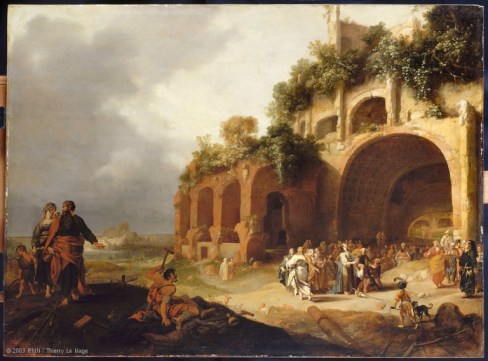
Blind Man-louvre-jesus-guerissant

 The Healing of the Deaf and Dumb Man by the Dutch artist Bartholomew Breenbergh (1599-1657)

Bartholomew Breenbergh illustrates this miraculous healing in a supernatural setting that is more similar to an ancient Roman city of Tivoli than Tyre in northern Israel. (Tyre is about 85 miles north of Tel Aviv in southern Lebanon) Although he takes liberty with the scene, he recounts Mark’s Gospel literally with Jesus taking the man away from the crowd and putting his fingers in his ears and touching his tongue. Breenbergh uses contrasting images of light and darkness to place the deaf man in the spotlight as others ( a boy with a dog, a man with crutches) witness this miracle.

Martin Luther:  In his sermon on Mark 7 in 1533, Martin Luther emphasized the importance of opening our ears and loosening our tongue. We hear God’s Word and confess our sins! Here are selected passages from Martin Luther’s sermon:

“Christ shows us that He opens ears and unbinds tongues. He seeks to perform this work daily in his church. . . . It is a physical fact that God gives sound ears and tongues also to the heathen; but only for Christians is this spiritual fact true, that he opens ears and looses tongues. For we Christians must hear His Word with our ears and confess with our lips.

“This is sure, that we have our salvation alone through the Word of God. What would we otherwise know about God, about our Lord Christ, his sacrifice, and the Holy Spirit? To this day the greatest miracle and mightiest work is giving a person ears that gladly hear God’s Word and a tongue that honors God and does not blaspheme.

“Many people are a thousand times worse off than this poor deaf and dumb man. They have ears that are really stopped up. They hear God’s Word and yet really do not hear it, nor do they want to. But those who hear God’s Word gladly and to whom Christ says, as to the deaf man, ‘Ephphatha (Be opened),’ are helped. . . God has shown us no other way by which we can come into heaven than through his precious Word, the Holy Gospel. Whoever gladly and diligently hears and receives it and who loves and delights in it will be helped.

“God also stirs our tongues and causes us to speak. . . . Through faith in Christ we come to have the forgiveness of sins; confession should also follow. We must not be mute, but speak what we believe in our hearts.”

“Our tongues will not be loosed, our ears opened, faith in our hearts begun, without the outward, oral preaching of the Word and external Sacraments. For parish pastors and preachers are the fingers of our Lord God, the servants and spittle through which he looses our tongues and opens our ears. When you hear them, God says to your heart, as to this deaf man, ‘Ephphatha!’ so that your ears are opened, your tongue unsticks, and you become a hearing, speaking person, no longer deaf and mute.”

“Then they praise God, saying: “He hath done all things well, he has made the deaf to hear and the dumb to speak.” For wherever there is true faith, there the Spirit will not allow you any rest; you will break forth, become a priest, teach other people also, as we read Ps. 116:10: “I believe, for I will speak.” There the heart is full, and the mouth must run over. Then when they are persecuted, they will not care.

But the part of the story, that Christ took the man apart from the others, looks up to heaven, has this meaning: If God do not take me alone to a separate place, and give me the Holy Spirit, so that I cling to the Word which I have heard, then all preaching is in vain. But why does this require so much that he looks up to heaven and makes use of divine power, calling upon God’s grace to come and to act? By this he teaches us that such power must come from heaven, working in the heart of man by divine strength; then help comes to him.

Thus have you learned, from the story and from its spiritual or secret meaning, that we must first hear the Word of God and thus, through the intercession of Christ, obtain a faith of our own, and then we come out, confessing this and praising God forever.”

Comments: hbitten@reverendluther.org


The Calling of Matthew (Levi)

Why did Matthew (and others) immediately decide to follow Jesus?

Matthew: 9:9-12:   As Jesus went on from there, he saw a man named Matthew sitting at the tax collector’s booth. “Follow me,” he told him, and Matthew got up and followed him.

10 While Jesus was having dinner at Matthew’s house, many tax collectors and sinners came and ate with him and his disciples. 11 When the Pharisees saw this, they asked his disciples, “Why does your teacher eat with tax collectors and sinners?”

12 On hearing this, Jesus said, “It is not the healthy who need a doctor, but the sick. But go and learn what this means: ‘I desire mercy, not sacrifice. For I have not come to call the righteous, but sinners.”

Luke 5:27: 27 After this, Jesus went out and saw a tax collector by the name of Levi sitting at his tax booth. “Follow me,” Jesus said to him, 28 and Levi got up, left everything and followed him.

Caravaggio_calling_Matthew

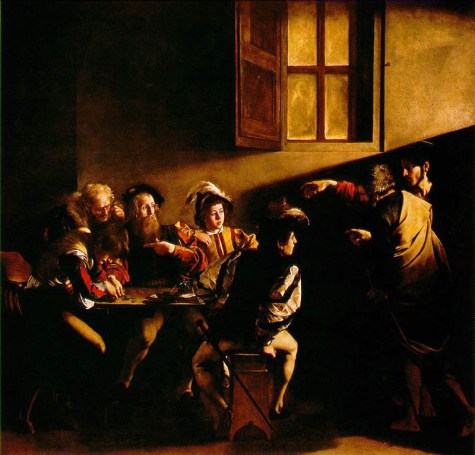
The Calling of Saint Matthew by Caravaggio (1600)

The Calling of Saint Matthew is one of the first works of Michelangelo Caravaggio and is located in the chapel of the French congregation’s church in Rome, San Luigi dei Francesi. Matthew was a Jewish tax collector in Capernaum, and is also known as Levi. Matthew was considered greedy and rich and Jesus asked him to give up his worldly possessions and take to the straight and narrow path.

In this painting, Caravaggio depicts the very moment when Matthew first realizes he is being called. Although it is difficult to see, Jesus appears outside of the room through a window. This is the artist’s way of respecting the literal interpretation of what is written in the Bible that “Jesus saw Matthew sitting at his booth.”

Martin Luther interpreted the calling of the Matthew, Andrew and others as examples of ministers of God’s Word who are called to proclaim the message of forgiveness and salvation. Jesus called common and ordinary people (day laborers, fishermen, and sinful tax collectors) to preach that Jesus came to save and to announce the forgiveness of sins. He did this because forgiveness brings life and salvation and creates the environment for how the Holy Spirit leads people to trust God, grow in faith, and respond with praise, prayer, love, and service for others! (Robert Kolb. Luther and the Stories of God, 135)

Comments: hbitten@reverendluther.org

The Lord’s Prayer


 The Lord’s Prayer

Does Martin Luther deserve full credit for the popularity of this prayer?

Matthew 6:9-15:   “This, then, is how you should pray:  “‘Our Father in heaven, hallowed be your name, 10 your kingdom come, your will be done, on earth as it is in heaven. 11 Give us today our daily bread. 12 And forgive us our debts, as we also have forgiven our debtors. 13 And lead us not into temptation, but deliver us from the evil one.’14 For if you forgive other people when they sin against you, your heavenly Father will also forgive you. 15 But if you do not forgive others their sins, your Father will not forgive your sins.

The_Lord's_Prayer-_James_TissotJames Tissot – The Lord’s Prayer (Le Pater Noster) – Brooklyn Museum
James Tissot illustrates Jesus teaching his disciples how to pray. The disciples are gathered around Jesus and ask Him the question about how to pray. The arms of Jesus are open wide as He acknowledges His Father in heaven with the introduction, “Our Father…” which has become the most famous invocation in history. The setting on the top of a hill and the colors of the sky enhance the significance of Jesus Christ as both human and divine. James Tissot is a French impressionist artist who traveled to the Holy Land to research the places where Jesus walked and taught.

Luther included The Lord’s Prayer in The Deutsche Mass for the first time (1526) as it was not part of the Latin Mass in the Roman Catholic Church before the Reformation. This was also a revolutionary change from the understanding of forgiveness in Judaism, which differentiates between sins against God, rules, and other persons. Jews also expect forgiveness first from the one who committed the act (i.e. gossip, stealing) first before they would forgive the other person. In The Lord’s Prayer, people have a new standard when they pray, ‘forgive us our sins, as we forgive those who sin against us’!

Luther: Here, now, learn how great need there is of such prayer. For because we see how full the world is of sects and false teachers, who all wear the holy name as a cover and sham for their doctrines of devils, we ought by all means to pray without ceasing, and to cry and call upon God against all such as preach and believe falsely and whatever opposes and persecutes our Gospel and pure doctrine, and would suppress it, as bishops, tyrants, enthusiasts, etc. Likewise also for ourselves who have the Word of God, but are not thankful for it, nor live as we ought according to the same. If now you pray for this with your heart, you can be sure that it pleases God; for He will not hear anything more dear to Him than that His honor and praise is exalted above everything else, and His Word is taught in its purity and is esteemed precious and dear.” (The Large Catechism by Martin Luther)

Comments: hbitten@reverendluther.org

Calling of Andrew and Peter

The Calling of the Disciples

How does one become filled with the Holy Spirit?

Matthew 4:18-21: 18 While walking by the Sea of Galilee, he saw two brothers, Simon (who is called Peter) and Andrew his brother, casting a net into the sea, for they were fishermen. 19 And he said to them, “Follow me, and I will make you fishers of men.”[a] 20 Immediately they left their nets and followed him. 21 And going on from there he saw two other brothers, James the son of Zebedee and John his brother, in the boat with Zebedee their father, mending their nets, and he called them. 22 Immediately they left the boat and their father and followed him.

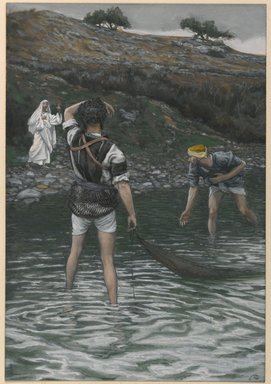
Calling of Simon and Andrew-2The Calling of Simon and Andrew by James Tissot (1886-1894)
James Tissot, a French artist sees Simon Peter and Andrew fishing in shallow water and close enough to the shore to hear the voice of Jesus. Tissot visited the Holy Land in 1880 and observed local fishermen wearing nets around their waste.

Calling of Simon and Andrew

The Calling of Saint Peter and Andrew by Bernardo Struzzo but more recently (2006) verified that this was painted by Caravaggio.

In this painting Caravaggio pictures a youthful Jesus without a beard leading two older brothers. Peter is holding a fish in his right hand and Andrew and Peter still appear confused about what they have just experienced regarding the large number of fish they caught after Jesus directed them to fish in the deeper water.

Martin Luther: In Luther’s sermon on Matthew in 1521, he marks the calling of the disciples as the time for grace to be preached throughout the world. The disciples will minister to people in need, preach to the heathen, forgive sinners, be witnesses that Jesus Christ is the Son of God.

In his sermon on the Monday after Easter in 1525 (Luke 24:13-25), Martin Luther describes the disciples as ignorant fishermen who came to know Jesus Christ through the Holy Spirit.

“‘The apostles likewise, being ignorant fishermen, learned to know the Scriptures, not in the schools of the great scribes, but through the revelation by which Christ led them into the Scriptures. Thus they were enabled to understand and to write on the basis of a single passage a book or a sermon the world cannot understand. And if I had the same Spirit Isaiah or Paul had, I could take this passage and develop from it a New Testament, if that were not already written.

 How did St. Peter know, or where is written in Moses that which he says in 1 Peter 10-11: “Concerning which salvation the prophets sought and searched diligently, who prophesied of the grace that should come unto you, searching what time or what manner of time the Spirit of Christ which was in them did point unto?” Who told him that the Spirit of Christ existed and prophesied of Christ, before there were prophets and, above all, before Christ and the Holy Ghost were present? Are these the words of a fisherman, or of a learned, wise scribe? Nay, it is the revelation of the Holy Spirit who had also revealed it to the prophets before.’”

Comments: hbitten@reverendluther.org


The Parable of the Sower

The Parable of the Sower

How does this story from Jesus support anyone who is overwhelmed by the challenges of daily living and troubles of this world?

 Matthew 13:1-24  That same day Jesus went out of the house and sat by the lake. Such large crowds gathered around him that he got into a boat and sat in it, while all the people stood on the shore. Then he told them many things in parables, saying: “A farmer went out to sow his seed. As he was scattering the seed, some fell along the path, and the birds came and ate it up. Some fell on rocky places, where it did not have much soil. It sprang up quickly, because the soil was shallow. But when the sun came up, the plants were scorched, and they withered because they had no root. Other seed fell among thorns, which grew up and choked the plants. Still other seed fell on good soil, where it produced a crop—a hundred, sixty or thirty times what was sown. Whoever has ears, let them hear.”

10 The disciples came to him and asked, “Why do you speak to the people in parables?”

11 He replied, “Because the knowledge of the secrets of the kingdom of heaven has been given to you, but not to them. 12 Whoever has will be given more, and they will have an abundance. Whoever does not have, even what they have will be taken from them. 13 This is why I speak to them in parables:

“Though seeing, they do not see; though hearing, they do not hear or understand.

14 In them is fulfilled the prophecy of Isaiah:

“‘You will be ever hearing but never understanding; you will be ever seeing but never perceiving. 15 For this people’s heart has become calloused; they hardly hear with their ears, and they have closed their eyes. Otherwise they might see with their eyes, hear with their ears, understand with their hearts and turn, and I would heal them.’

16 But blessed are your eyes because they see, and your ears because they hear. 17 For truly I tell you, many prophets and righteous people longed to see what you see but did not see it, and to hear what you hear but did not hear it.

18 “Listen then to what the parable of the sower means: 19 When anyone hears the message about the kingdom and does not understand it, the evil one comes and snatches away what was sown in their heart. This is the seed sown along the path. 20 The seed falling on rocky ground refers to someone who hears the word and at once receives it with joy. 21 But since they have no root, they last only a short time. When trouble or persecution comes because of the word, they quickly fall away. 22 The seed falling among the thorns refers to someone who hears the word, but the worries of this life and the deceitfulness of wealth choke the word, making it unfruitful. 23 But the seed falling on good soil refers to someone who hears the word and understands it. This is the one who produces a crop, yielding a hundred, sixty or thirty times what was sown.”

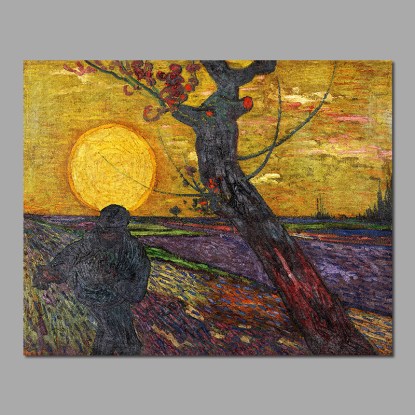
 Sower-VanGogh

Sower with Setting Sun, Vincent Van Gogh (1888)

 Sower with Setting Sun is a personal and introspective work for Vincent Van Gogh. He saw in the painting, Sower, by another French artist, Jean Francois Millet, the story of Christ’s parable in Matthew 13. Van Gogh understood this parable as the presence of Jesus Christ in a troubled world. Van Gogh studied theology and regarded his art as a form of ministry for connecting people with Jesus Christ. He hoped that his paintings would give hope to the people who are living in spiritually and socially infertile soil. Instead of seeing things in the two dimensions of a painting, Van Gogh believed that God gives us the capacity to understand the infinite dimensions or perspective of living a spiritual world.

Although many who read this story are familiar with it, Van Gogh allows us to engage in his work of art with both our eyes (visual literacy) and heart (spiritual literacy). When we do this, the painting and the words of Christ’s parable have the capacity for changing our life! We see the humble sower on the left whose work is blessed by the sun and the growing tree on the right. The tree represents life, and Van Gogh gives us this tree as an image of Christ’s resurrection and the life changing power of faith! Note the Word of God in John 12: “I tell you the truth, unless a kernel of wheat falls to the ground and dies, it remains only a single seed. But if it dies, it produces many seeds. The man who loves his life will lose it, while the man who hates his life in this world will keep it for eternal life.”

Martin Luther preached a sermon on this parable in 1525 at the height of the violence in the Peasants War:  “The Savior himself explained this parable in the same chapter upon the request of his disciples and says: He that soweth the good seed is the Son of man; and the field is the world; and the good seed, these are the children of the kingdom; and the tares are the sons of the evil one; and the enemy that sowed them is the devil; and the harvest is the end of the world; and the reapers are the angels. These seven points of explanation comprehend and clearly set forth what Christ meant by this parable. But who could have discovered such an interpretation, seeing that in this parable He calls people the seed and the world the field; although in the parable preceding this one he defines the seed to be the Word of God and the field the people or the hearts of the people. If Christ Himself had not here interpreted this parable everyone would have imitated his explanation of the preceding parable and considered the seed to be the Word of God, and thus the Savior’s object and understanding of it would have been lost….  Today’s Gospel also teaches by this parable that our free will amounts to nothing, since the good seed is sowed only by Christ, and Satan can sow nothing but evil Seed; as we also see that the field of itself yields nothing but tares, which the cattle eat, although the field receives them and they make the field green as if they were wheat. In the same way the false Christians among the true Christians are of no use but to feed the world and be food for Satan, and they are so beautifully green and hypocritical, as if they alone were the saints, and hold the place in Christendom as if they were lords there, and the government and highest places belonged to them; and for no other reason than that they glory that they are Christians and are   among Christians in the church of Christ, although they see and confess that they live unchristian lives.      In that the Savior pictures here also Satan scattering his seed while the people sleep and no one sees who did it, he shows how Satan adorns and disguises himself so that he cannot be taken for Satan. As we experienced when Christianity was planted in the world Satan thrust into its midst false teachers. People securely think here God is enthroned without a rival and Satan is a thousand miles away, and no one sees anything except how they parade the Word, name and work of God. That course proves beautifully effective. But when the wheat springs up, then we see the tares, that is, if we are conscientious with God’s Word and teach faith, we see that it brings forth fruit, then they go about and antagonize it, and wish to be masters of the field and fear lest only wheat grows in the field, and their interests be overlooked.” 

Thanks to Dr. James Romaine, Associate Professor of Art History at Nyack College and cofounder of the Association of Scholars of Christianity in the History of Art, www.christianityhistoryart.org for his contribution to the research of this blog.

Comments: hbitten@reverendluther.org

Baptism of Jesus

The Baptism of Jesus

If baptism is important why is it not stated in the Apostles’ or Nicene Creed?

 Mark 1:4-11: And so John the Baptist appeared in the wilderness, preaching a baptism of repentance for the forgiveness of sins. The whole Judean countryside and all the people of Jerusalem went out to him. Confessing their sins, they were baptized by him in the Jordan River. John wore clothing made of camel’s hair, with a leather belt around his waist, and he ate locusts and wild honey. And this was his message: “After me comes the one more powerful than I, the straps of whose sandals I am not worthy to stoop down and untie. I baptize you with water, but he will baptize you with the Holy Spirit.”

At that time Jesus came from Nazareth in Galilee and was baptized by John in the Jordan. 10 Just as Jesus was coming up out of the water, he saw heaven being torn open and the Spirit descending on him like a dove. 11 And a voice came from heaven: “You are my Son, whom I love; with you I am well pleased.”

The_Baptism_of_Christ_(Verrocchio_&_Leonardo)[1]

The Baptism of Christ by Andrea del Verrocchio (1472)

Andrea del Verrocchio was the master teacher of Leonardo da Vinci. Leonardo, at the age of 23, painted the kneeling angels. Several students contributed to this famous work of art including Botticelli and Credi. Leonardo’s angels bring life and spirit to the kickoff of the ministry of Jesus Christ with his baptism. What a powerful confession of faith for everyone involved in creating this masterpiece!

Luther: Luther in his sermon on January 6, 1534 preached:At the Jordan, in his thirtieth year, Christ reveals himself fully for the first time. John is shocked by his desire to be baptized and says, “Shall I baptize you? I am not worthy.” But Jesus responds, “Be content; this is the way it should be.” The Son, who is without sin, allows himself to be baptized for our example and our comfort. He does something here that is not required of him, whereas we do nothing that is not required of us. More, we do what is evil. How will we ever get to the point of doing something not required? Christ is holier even than baptism, yet still allows Himself to be baptized. Thereby he institutes baptism. So those accursed people who despise or ridicule baptism are banished to the depths of hell. May God blight them and blind them, since they don’t have the ears and eyes to see what is going on here. Although they do not choose baptism, God’s Son does! Are we so arrogant that we should despise baptism? Even if it offered us nothing at all, we should honor baptism simply for Christ’s name’s sake, and be baptized to honor him. But [something is offered]: God in heaven poured himself out when Christ was baptized.

John indeed saw that the heavens were opened. That was a sign that our Lord God holds baptism dear—baptism that was sanctified by the Son of God himself in his own body. The heavens, previously closed, are now opened, becoming a clear gateway and window for us to see into heaven itself. There is no longer a dividing line between God and us, for he has descended into the [baptismal] water. Isn’t this a great revelation? That is why we call [this festival] Epiphany, because God—Father, Son, and Holy Spirit—has revealed himself with all his angels.The Holy Spirit comes like an innocent dove. Among all birds, the dove is known for its kind heart and lack of anger. Thus, the Holy Spirit presents itself in this friendly form. Here [too] there is no anger. The Son of God, who did not need [to be baptized], reveals himself to us not only as example but also as grace itself. The Father makes himself heard in the voice: “This is my Son, the Beloved, with whom I am well pleased.”

It would not be surprising if the heavens and the earth shook before this voice, the speaking of our Lord God himself. If our Lord God spoke, I would fall on my face. But, for all that, the voice comes with nothing but kindness, grace, and mercy, saying, “There you have it: One who has been baptized!” So, do you want to know who [our God] is? He does not come with a sword, or with the noisy clamor of Sinai; he comes with nothing but the images and appearance of friendship. The Son is an innocent man who does more than is required of him; the Holy Spirit comes in a friendly form; the Father has a friendly voice: “I am not sending you prophets or apostles or angels; instead you have my Son, with whom I am completely pleased.”

Comments: hbitten@reverendluther.org