Behind the Numbers: A Traditional Church Faces a New America

Behind the Numbers: A Traditional Church Faces a New America

A Discussion for Church Leaders on the Decline of Weekly Church Attendance and Possible Strategies for Growing Your Place of Worship

Hank Bitten

The free exercise of religious beliefs is written into our constitution and has been part of the framework of our democratic society and American identity since the Pilgrims arrived in 1620. The principle of the separation of church and state prevented America from having a religious institution or denomination supported by the state, it has enabled the proliferation of houses of worship, the establishment of colleges to train clergy, the dissemination of religious beliefs into our culture through art, literature, and music, and prayers in public places. Religious beliefs and the practices of denominational churches are part of the tapestry of America.

“Congress shall make no law respecting an establishment of religion, or prohibiting the free exercise thereof; or abridging the freedom of speech, or of the press; or the right of the people peaceably to assemble, and to petition the Government for a redress of grievances.” (First Amendment)

This is clearly evident in the First and Second Great Awakening, the Sunday School movement, and the missionary zeal in the 19th century to convert people to the Christian faith. The names of Jonathan Edwards, George Whitfield, Charles and John Wesley, Francis Asbury, Billy Sunday, Billy and Franklin Graham, Dwight Moody, Phoebe Smith, Mary Baker Eddy, James Dobson, Tim Keller, Oral Roberts, and Pat Robertson are just a few names that are part of several high school history textbooks.

In the first two chapters of the dissertation, “Behind the Numbers: A Traditional Church Faces a New America”, Rev. Larry Vogel, presents us with a turning point in the first two decades of the 21st century that is an opportunity for discussion, debate, and discernment.  The dissertation provides a sociological, anthropological, and theological perspective that is insightful in how evidence is used to support a claim or thesis.

The data from the U.S. Census Bureau presents a vision of America that is as influential today as Jean de Crèvecoeur’s “Letters from an American Farmer” were in 1782. Crèvecoeur tried to describe the ‘new American’ as industrious and religious. The experiences of living during and after the American Revolution changed the colonists from Europeans to Americans.  The ‘new American’ following the passage of the Immigration and Nationality Act of 1965 is from global origins and the ‘new American’ is Hispanic, African, and Asian.

By analyzing the census data in this dissertation, high school students will be able to make a claim regarding the importance of religion in American by 2050, the impact of immigration on society, the consequences of a society that is changing over time, and make predictions for the future. In a Sociology class, students can also survey their own community and compare the data with the national data in the U.S. Census.

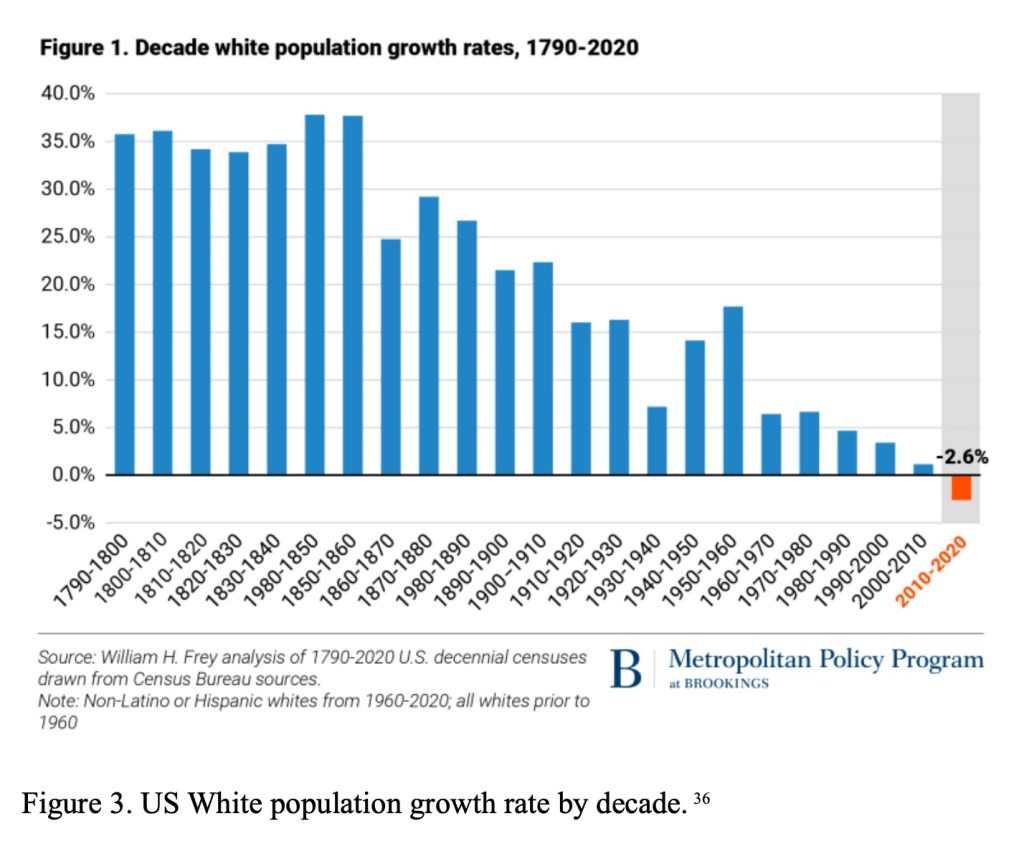
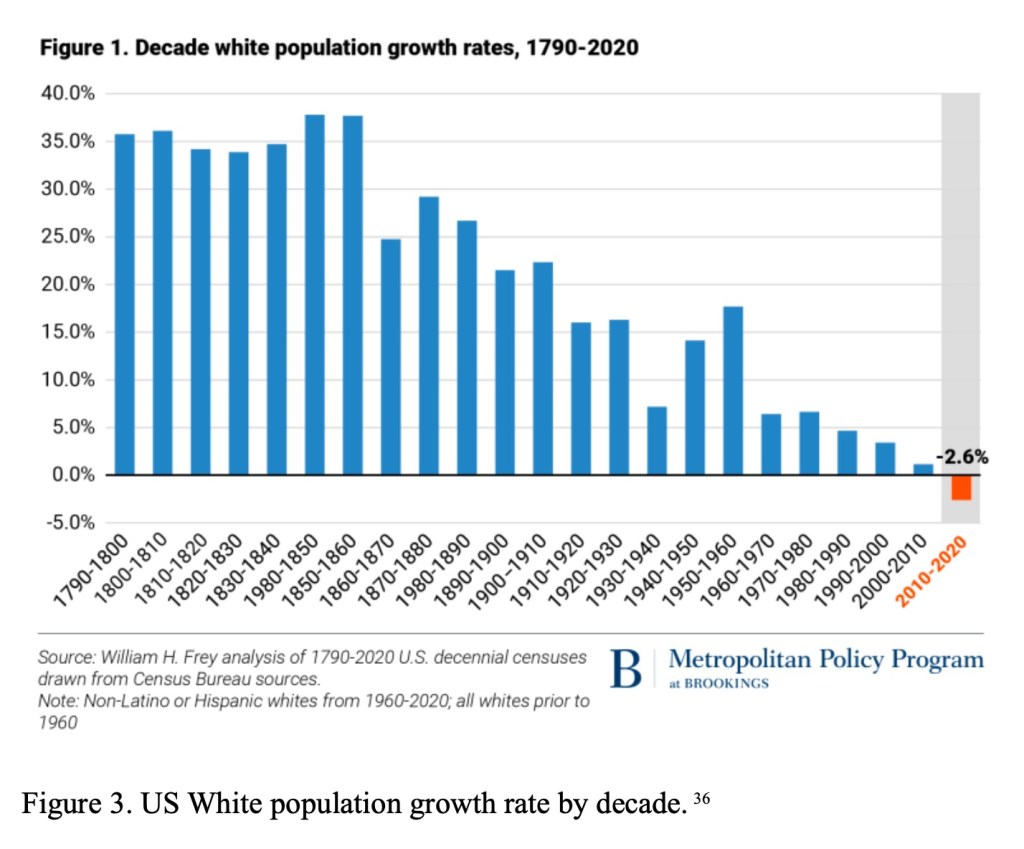
“As for ethnicity, 61.6% of the US population is White alone (204.3 million), a decline from 223.6 million and 72.4% in 2010. Blacks who self-identified without any other racial combination increased slightly in number between 2010 and 2020 (from 38.9 to 41.1 million), but declined very slightly as a percentage of the population (from 12.6% to 12.4%). The Asian alone population of the US increased both numerically and proportionately. In 2010 14.7 M (4.8%) Americans identified as Asian alone. In 2020 that number swelled to 19.9 M (6%).” The Asian population is projected to more than double, from 15.9 million in 2012 to 34.4 million in 2060, with its share of nation’s total population climbing from 5.1 percent to 8.2 percent in the same period. (p. 58)

In the table below, the majority population in the United States declined 11% in ten years from 2010-2020. Will this trend continue to fall another 10% or will it be greater than 10% in this decade?

The demographics of what is happening to the religious beliefs of the ‘new American’ are important to our culture, economy, education, families, and government. Religion is perhaps the largest service industry in the United States with more than 100 million people attending worship regularly. The number of subscribers to weekly worship experiences is declining but this change is likely disguised as the ‘new American’ still believes in a supreme deity but expresses this belief differently than the way Crèvecoeur’s ‘American’ did. The insights in “Behind the Numbers: A Traditional Church Faces a New America” encourages the debate by church leaders and clergy. The analysis of the data provides a perspective of what life will be like in the United States at mid-century. Some will see this as an opportunity and others as a threat.

To begin our inquiry into the data, examine the population profile of the top ten states with the highest immigrant populations. (pp.66) Half of these states are in the Boston-New York-Philadelphia-Baltimore- Washington, D.C. corridor.  A third of these states are in the western region of the United States.

One of the striking observations in the census report is that these changes have occurred after 2000.

“The continued growth of the US population is due to immigration rather than to immigrant birth rates. All-in-all, the foreign-born US population in 2018 was nearly 14% of the total US population and their second-generation children were an additional 12.3% of the total population. This means that fully 25% of the current US population is the result of immigration and that the changing racial-ethnic profile of the US is due almost entirely to immigration in recent decades. As Taylor puts it: “Immigration is driving our national makeover.” (p. 67)

As you review the data in the graph below, consider the implications of this decline in your community and state.
Here are some questions to ask regarding this data?

  1. Will these demographic trends continue on the same trajectory over the next three decades or escalate?
  2. Will external events (i.e., climate, artificial intelligence, economic conditions, etc.) have a direct effect on immigration trends?
  3. Will the immigrant population move to other states as they have in the past?
  4. As the immigrant population of 2020 ages, how will this influence the ‘new American’ identity?
  5. As immigrants assimilate into American culture, will they be influenced by the religious institutions in America?

The Census Bureau predicts that the trend toward racial-ethnic diversity will continue: The non-Hispanic White population is projected to shrink over coming decades, from 199 million in 2020 to 179 million people in 2060—even as the U.S. population continues to grow. Their decline is driven by falling birth rates and a rising number of deaths over time as the non-Hispanic White population ages. In comparison, the White population, regardless of Hispanic origin, is projected to grow from 253 million to 275 million over the same period. (p. 236)

Dr. Vogel’s thesis claims that “the underlying support and stimulus for Global Christianity’s surge is the Bible translated into the vernacular. The Bible in whole or in part is available in over 1500 languages, including more than 650 African tongues. With the Bible in their own tongue, Christians in Africa and throughout the globe “can claim not just the biblical story, but their own culture and lore in addition.” (p. 82) However, his thesis also raises the counterargument that the Millennial generation (birth years 1981-1996) is leading the shift away from organized religion, specifically, Christian denominations. According to the Pew research from 2019, 40% of the Millennials (also Generation Y) identify as unaffiliated with 9% claiming a faith other than Christianity. The trend for Generation Z (birth years 1996-2010) will likely be higher.

The perspective of Dr. Mark Chaves of Duke University (and high school student of the author of this article), is that America will likely continue its religious identity in this century. The diversity of the American population will lead to changes, notably that non-Christian beliefs also lead to eternal life. Church membership and worship practices will likely change.  A new subculture within the religious and worshipping population may emerge in the 21st century.  The ‘new American’ will likely continue helping others in need by donating food, working in a soup kitchen, providing assistance after a disaster, building homes for the homeless, as the volunteer spirit will likely continue throughout this century. But this ‘new American’ may also be influenced by social media and artificial intelligence. Engage your students in exploring answers to these questions and possibilities.

George Hawley of the University of Alabama presents a strong counter argument regarding the demographics of the denominational church in 2022. He cites that 23 percent (almost one-fourth) of the population affiliated with a Christian denominational church are over the age of 65. He also observed that only 13 percent who attend church regularly are under the age of 30. This is not sustainable beyond 2050. Non-Christian religious traditions increased from 5% percent to 7% since 2010. In terms of actual numbers, 13 million Americans identify as atheists and 33 million or 10 percent) have no particular religious affiliation.  To place this in perspective, the populations of 49 states are less than 33 million people. The population of Texas is 31 million.

To add a second layer of analysis to our scaffold is the research of the Barna Group which used three factors in determining affiliation with a Christian Church.

  1. Christian identity with a denominational church
  2. Regular worship attendance
  3. Placing faith as a high priority

The data reports that 25% of the American population of 330 million people are practicing Christians. In 2000, the number was 45%!  (p. 113) Although weekly church attendance continues to decrease in both Protestant and Roman Catholic churches, the diversity of Roman Catholic congregations appears positive, especially if the United States will continue as a Christian country.  “Nearly 40% of Catholic churches are either predominantly or very much non-White. In 2014, The Center for Applied Research in the Apostolate (CARA) study of RCC parishes, 323 out of 846 responding parishes could be identified as multi-cultural parishes.” (p. 131)

By using the data below, ask this question: ‘Why is Roman catholic weekly attendance decreasing in the first quarter of this century and Protestant weekly attendance showing a slight increase?’  (Note: the years on the y axis appear to have 1983-1986 reversed with 1995-1996)

Having reviewed the data from the U.S. Census Bureau and the data on individuals who are unaffiliated with a church denomination, consider the following observations regarding strategies for your individual need. One size does not fit every situation because of locations in rural, suburban, and urban areas, income and population demographics, and the fact that the research in the dissertation applies to Lutheran church experiences over the past 50 years. However, the research and data apply to most church denominations and readers should consider selective ‘talking points’ for their individual experience or need in the context of the catholicity of the Christian church, which is broader than the introspective doctrinal definitions of clergy or a religious organization.

Observations on the decline of Lutheran church populations (pp. 154-174)

Chapter 3 of the dissertation analyzes the demographics of several denominational churches and non-denominational churches. The Lutheran Church (LCMS) is presented as a case study for empirical and comparative evidence. Of the nearly 6,000 LCMS congregations, about 20% have fewer than 25 people attending weekly and 75% have fewer than 100 attending weekly. The picture for the Mid-Atlantic region, despite LCMS congregations in about two-thirds of all the region’s counties. New York, New Jersey, and Pennsylvania all experienced steady decline from 1970 to 2010. Total LCMS membership was a little over 100,000 in the region in 2010, about half of its membership in 1970.101 (p.187) Lutherans are not, on average, particularly committed to their faith. They are less diverse than any other group and they are much older than the overall population—with the LCMS even older than the ELCA. (p. 216)

The LCMS statistics for the South Atlantic region are more positive. Between 1970 and 2010, six of its eight states grew in LCMS membership. Maryland lost about 10,000 of the 30,000 members, the largest loss in the region. South Carolina membership grew by about 1,000 (nearly 50%). Virginia added over 5,000 (also about 50%). Florida added about 50%, or 20,000 members. Georgia added about 30%, around 2,500 members. And North Carolina added about 50% or 7,000. Only Georgia and North Carolina added members during the final decade of the period, from 2000 to 2010. (p. 189)

Baptists are in decline as a percentage of the United States (from about 20% of the United States in 1973 to around 14% in 2014). But the retention rate for Baptists is quite strong at about 78% and the total number of Baptists remained about the same.

The United Methodist Church now claims less than 4% of the population and far smaller numbers are active members. Only the African Methodist Episcopal branches of Methodism are growing. The UMC is 94% non-Hispanic White, has smaller than average families, with low retention rates of about 40% of those raised Methodist remaining in the church.

Mormon families enable the Church of Latter-Day Saints to remain strong. Mormon women with an average of 3.4 children compared to the national average of 2.1. They are also more likely to be married.

• “The retention of baptized and confirmed youth is a key area on which to focus.”

• “The number of child baptisms and adult converts have decreased together in a remarkably similar pattern.”

Baptisms are important for growing the church at the parish level. If infant or child baptism is considered important, then the activities organized by the congregation should consider intergenerational opportunities for children, parents, and grandparents to continually support the baptized child in faith through the life of the local congregation.

The connection between marriage, parenthood, and religiosity is well established. This effect is particularly pronounced for men, who are more likely to return to religion upon getting married or becoming a father. (pp. 179-80) The U.S. Census data reports that the unmarried population of the United States is approaching 50% of all adults. It is important to acknowledge the spiritual needs of this large and significant segment of the population. Marriage and parenthood are “critical for the survival of a church,” but only when children remain in the church as they become adults. (p. 185)

The LCMS ought to be fostering both internal and external growth by engaging in solid teaching about the gifts of marriage and children, so that the LCMS would grow as individual members marry, faithfully live according to the Word of God together, bear children, and bring them up as baptized disciples who learn to keep all that Christ has given to His church. In addition, the LCMS and its congregations ought to be vigorously engaged in evangelizing those who do not know Christ. (p. 254) “Congregations must be safe places for young people to wrestle with life and faith.” (p. 255)

A second strategy considered in the dissertation is stewardship education. In planning this, church leaders need to be aware of how to optimize income, the number of single parent households, extended family living arrangements, budgeting, and how to minimize debt. A serious threat to families and the local congregation is poverty, loss of income, and overspending.  Churches effectively ask for contributions and some make an effort for their members to tithe. Unfortunately, few churches have the resources to help people with unexpected situations such as a loss of income, medical situation, or disability. In addition, young families and single parents have the high costs of child care, child care, and a plan to save and invest. Developing a financial mindset is an opportunity for local congregations to assist people in a practical way.

A third observation that Dr. George Hawley noted is that churches that demand more of their members have outpaced churches with minimal expectations. (p. 183) In this context, he suggests that small groups were equally effective regardless of congregational size. He also observed that contemporary worship music and styles are less of an appeal to young adults than to middle-aged adults. (p.185) One of the barriers to congregational growth is the complacency of its members.  The model of the first century church should be considered by 21st century church leaders by making an effort to engage the entire spiritual community in serving others and growing together. As populations migrate from one community to another and as individuals experience anxiety and mental stress from feeling alone, the local church community needs to utilize its human resources to assimilate members into their community, culture, and place of worship.  

Perhaps the two most effective strategies are the reputation of the church in the community and the personal contact that church leaders have with members and visitors through phone calls and interactive conversations. (p. 185) “Over these last two chapters, we saw that there are three variables that are correlated with strong denominations: the propensity to marry young and have large families, racial and ethnic diversity, and the percentage who claim that religion is very important to them.” (p.229)

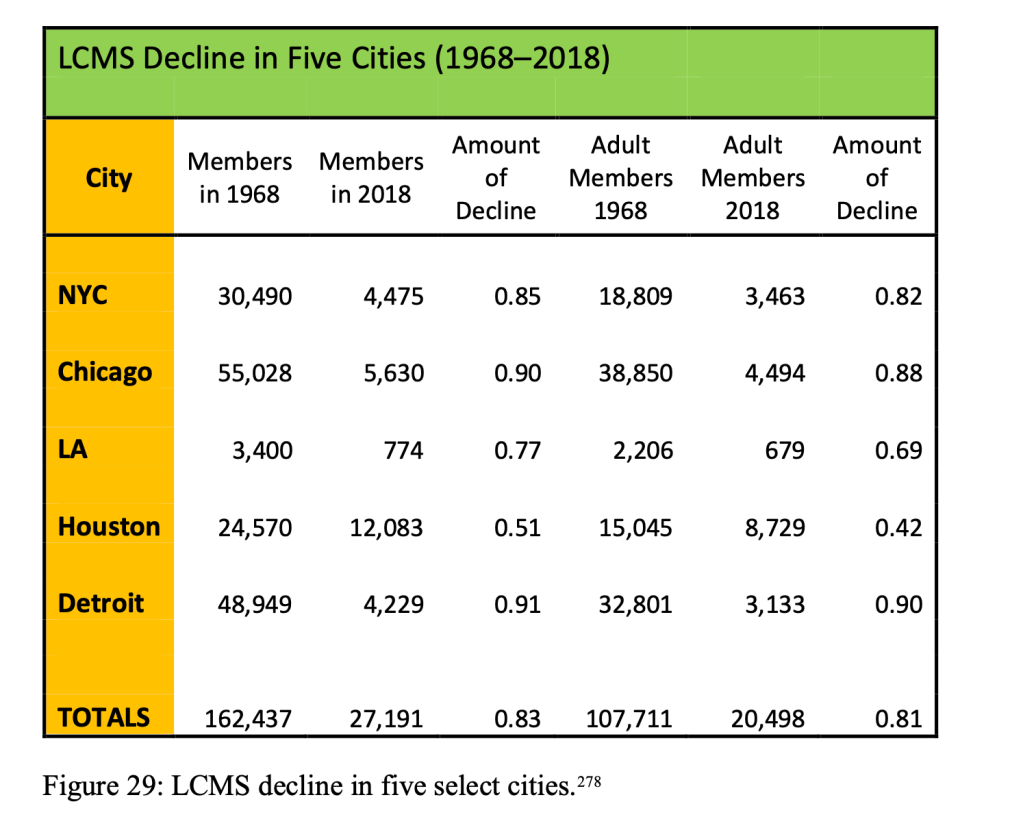
To summarize the fifty-year data presented in Figure 29, LCMS baptized membership in the five cities in question declined, overall, from 162,437 souls to 27,191. The LCMS has only slightly more than 15% as many members today as five decades ago in those cities. That is a decline of 83%! Two of those cities, Chicago and Detroit, lost population, but not nearly on the level that the LCMS declined. Detroit’s population loss was the most dramatic. Detroit and Chicago had strong populations for most of the 20th century. Its 1970 census population was 1,511,482. By the 2020 Census, Detroit’s population was only 639,111, a loss of 58% of its population (p. 239). The decline in New York City follows a similar pattern. Lutherans began worshiping in New York City in 1643 and in the 19th century, New York had a vibrant Lutheran and Protestant population and the first Thursday in June was designated as a local holiday in commemoration of the first Sunday School in 1838. As recently as 2005, this became a city-wide school holiday! This is a reminder that populations change as a result of the economy, crime, or political changes and that population changes affect schools and churches.

LCMS presence on the coasts is in sharp decline while the coastal US remains densely populated with 40% of the US population living in counties adjacent to either the Pacific or Atlantic coasts. (p. 244) The local church in decline needs to consider the changes in the diversity of the American population, especially in the top 25 states identified on the map below. Changes to worship styles, a visible presence in the community, hosting invitational events each have value but they are short term applications for sustained growth and connections with people.

The events of the next 15 years (2025-2040) will continue to support population migrations as climate changes cause coastal flooding, food insecurity, wildfires and heat related deaths. The influence of artificial intelligence will challenge church doctrines and civic understanding. Local and state governments may become more influential in coping with poverty, education, and the assimilation of new populations. The costs and scope of the anticipated problems in this century are likely beyond the power of national governments to solve which leads to my conclusion that this is an opportunity for the global church. The model presented in the dissertation by Dr. Vogel deserves discussion and debate as it supports the model of the first century church at a time when the Roman Empire was declining. If historians select 1975 as the beginning of the decline of American hegemony, then we are already a half-century into a turning point in world civilization and history.

The conclusion of Dr. Vogel’s thesis speaks to us as a fire bell calling the first alarm to a five-alarm fire at a church that is becoming disconnected to the population. The church in every local community needs to connect with a diverse, and perhaps disconnected, population. This is the purpose of the churches in our communities.

Chapter 4 of the dissertation provides an important analysis and historical overview of the catholic role of the Christian Church. This chapter is worth reading as the evidence clearly supports the worldview of the Christian Church in connecting with the population changes in the 21st century. A summary is not practical because of the comprehensive analysis offered.

“The church’s catholicity—its inclusiveness—involves different socio-economic groups. When Jesus says that we will always have the poor with us (Matt. 26:11; John 12:8), he is not inviting his disciples to neglect care for the poor in favor of gifts to him. Rather, he contrasts the beauty of a gift given at an opportune time (the woman’s anointing of her Lord) to a constant concern for the poor. How right it is for the Church both to adorn its worship with the most beautiful sights and sounds, and to do so all-the-while regularly seeking ways to include and to assist those who struggle with poverty and other immediate needs. To take catholicity to heart as a Synod would therefore require a sober assessment of our abandonment of the poor, whether rural or urban, although special attention herein has been given to cities.” (p. 377)

The conclusion in Chapter 5 is also worth reading regarding the acceptance of all people in a diverse community. If we use 1975 as a pivotal year for marking the end of the “American Century” we will recognize that every country in the world has experienced changes as a result of population, economics, technology, and spirituality. Fernand Braudal, a French historian and leader at the Annales School, developed a model for understanding how change occurs over time in human societies. We understand history differently in each era. The lens or perspective of understanding life on our planet and civilization may be understood through political, geographic, economic, and cultural interpretations. The Christian church can learn from this model and embrace it by connecting with the diversity of people on its doorstep. The lens of the 21st century is experiencing a change in direction because of the diversity of populations and the sharing of ideas, resources, and the need to address global problems. Church leaders and church members need to embrace this as an opportunity.

I leave you with this thought by Dr. Larry Vogel:

“Segmenting the church by generational groups not only is potentially problematic in its effects on families. It is also contrary to the horizontal catholicity of the faith. Christianity is for all people, not only in terms of ethnicity or cultural group or language, but also for all ages. For the tiniest infant and the aging woman with Alzheimer’s.” (p. 371)

https://scholar.csl.edu/phd/146/

Behind the Numbers: A Traditional Church Faces a New America

Larry VogelConcordia Seminary, St. Louis

Date of Award:   5-19-2023

Document Type: Dissertation

Degree Name:    Doctor of Philosophy (PhD)

Department:      Practical Theology

First Advisor:     Richard Marrs

Abstract

The dissertation examines membership data for The Lutheran Church—Missouri Synod (LCMS) from the mid-1970s to the present. It considers the analysis of LCMS decline by two scholars, George Hawley and Ryan MacPherson, who independently proposed that LCMS membership decline was internal in causation due to diminished birthrates and fewer young families. While acknowledging the reality of such internal decline, this dissertation argues that the lack of external growth is a greater cause for LCMS decline. Its lack of external growth is due primarily to the racial and ethnic homogeneity of the LCMS and its failure effectively to evangelize the increasingly diverse American population. This indicates a theological weakness: a failure to teach and emphasize the catholicity of the church adequately in LCMS catechesis and dogmatic theology.

Recommended Citation

Vogel, Larry, “Behind the Numbers: A Traditional Church Faces a New America” (2023). Doctor of Philosophy Dissertation. 146. https://scholar.csl.edu/phd/146

INTRODUCTION ……………………………………………………………………………………………………… 1

WHAT STARTED AT PENTECOST……………………………………………………………………………. 1

The Mystery of Faith ………………………………………………………………………………………………. 1

Two Ways of Growth—Handing On and Handing Down ………………………………………. 2

Marks and Mission …………………………………………………………………………………………………. 3

Movement toward People ………………………………………………………………………………………. 4

THE THESIS ……………………………………………………………………………………………………………..7

Support for the Thesis……………………………………………………………………………………………… 7

THE APPROACH……………………………………………………………………………………………………….. 9

CHAPTER ONE…………………………………………………………………………………………………………. 12

DEMOGRAPHIC CHANGE IN THEORY, REALITY, AND APPLICATION ………………… 12

THE DEMOGRAPHIC TRANSITION—A GLOBAL PHENOMENON…………………………. 12

Demographics Defined ………………………………………………………………………………………….. 12

The First Demographic Transition ………………………………………………………………………… 13

The Second Demographic Transition…………………………………………………………………….. 17

Cause of the Demographic Transition ………………………………………………………………….. 23

US DEMOGRAPHICS ………………………………………………………………………………………………. 24

EFFECTS OF THE DT ………………………………………………………………………………………………. 27

Primary Effects: Declining Births, Increasing Age………………………………………………… 27

Secondary Effects: Changes in Female Life Patterns and Family Formation …………………… 32

RESPONSES TO DEMOGRAPHIC CHANGE……………………………………………………………… 40

Responses to the Demographic Transition: A Survey…………………………………………….. 41

China’s Response to Demographic Transition……………………………………………………….. 42

Brazil’s Response to Demographic Transition……………………………………………………….. 45

The European Response to Demographic Transition …………………………………………….. 47

The North American Response to Demographic Transition…………………………………… 50

THE CHANGING DEMOGRAPHIC PROFILE……………………………………………………………… 57

New America: Older and More Female,……………………………………………………………………. 58

New America: Greater Diversity……………………………………………………………………………….. 58

CHAPTER TWO …………………………………………………………………………………………………………. 68

THE DEMOGRAPHIC CHALLENGE AND RELIGION………………………………………………….. 68

DEMOGRAPHIC CHANGE AND RELIGIOSITY—A WORLD TOUR …………………………….. 68

DT and Religion in Asia ……………………………………………………………………………………………… 68

DT and Religion in Latin America………………………………………………………………………………. 74

DT and Religion in Africa …………………………………………………………………………………………… 78

DT and Religion in Europe …………………………………………………………………………………………. 85

DT and Religion in the United States: Six Trends……………………………………………………… 92

The Millennial Challenge…………………………………………………………………………………………… 96

The Challenge of Multiethnic America ……………………………………………………………………. 100

The Challenge of Family Decline………………………………………………………………………………. 102

The Challenge of Income Inequity …………………………………………………………………………… 104

Conclusion: DT and Religion in America…………………………………………………………………. 106

DEMOGRAPHIC TRANSITION AND DECLINE IN AMERICAN CHRISTIANITY………..108

Rise of the Religiously Unaffiliated and the DT……………………………………………………… 109

The Healthiest Churches………………………………………………………………………………………….. 118

THE NEW AMERICA IN THE ROMAN CATHOLIC CHURCH…………………………………….. 123

A Church in Crisis: Flight from the Roman Church ………………………………………………… 125

A Church’s Hidden Strength: The Diversity of American Roman Catholics…………… 127

THE NEW AMERICA IN THE PRESBYTERIAN CHURCH IN AMERICA ……………………. 133

A History of Struggle ………………………………………………………………………………………………… 133

Growth in the PCA through Doctrinal Fidelity and Outreach …………………………………. 142

Reflection and Redirection ………………………………………………………………………………………. 144

CHAPTER THREE………………………………………………………………………………………………………. 153

A CLOSER LOOK AT THE LCMS DEMOGRAPHIC DILEMMA ……………………………………. 153

DEMOGRAPHIC TRANSITION AND THE LCMS ……………………………………………………….. 153

From Growth to Decline …………………………………………………………………………………………… 153

The Graying of the LCMS …………………………………………………………………………………………. 159

ADDRESSING LCMS DEMOGRAPHIC DECLINE: RYAN MACPHERSON AND GEORGE HAWLEY …………………………………………………………………………………………………………………….161

Ryan MacPherson…………………………………………………………………………………………………….. 162

George Hawley………………………………………………………………………………………………………….. 176

LCMS—Demographic and Social Change ……………………………………………………………….. 177

District-Level Trends………………………………………………………………………………………………. 202

Demography, Culture, and the Decline of America’s Christian Denomination………205

MACPHERSON AND HAWLEY: AFFIRMATION AND CRITIQUE……………………………… 218

Affirmation……………………………………………………………………………………………………………….. 219

Critique ……………………………………………………………………………………………………………………. 223

THE DEPTH OF THE DEMOGRAPHIC DILEMMA …………………………………………………… 233

The Constancy of the LCMS Demographic Profile …………………………………………………. 235

A Homogeneous Synod and Growing American Diversity……………………………………… 235

Population Migration and the LCMS—Flight from Urban America ……………………… 238

Breaking Down the LCMS Dilemma ………………………………………………………………………… 243

What’s Going On? Failure to Connect with America’s Changing Demographic Profile ……………………………………………………………………………………………………………………………………243

“Why Is It Going On?” Families, Homogeneity and Racialization …………….……….….244

“What Ought to Be Going On?” Plotting a Future for the LCMS …………………………… 254

“How Might We Respond?” Reflection on the LCMS Demographic Profile…..……… 256

CHAPTER FOUR……………………………………………………………………………………………………….. 257

CATHOLICITY AND THE CHURCH …………………………………………………………………………. 257

HOLY SCRIPTURE …………………………………………………………………………………………………… 263

The Hebrew Scriptures…………………………………………………………………………………………… 264

The Gospels…………………………………………………………………………………………………………….. 266

The Acts of the Apostles…………………………………………………………………………………………. 268

Epistles of Paul and Hebrews…………………………………………………………………………………. 274

Catholic Epistles and the Apocalypse …………………………………………………………………….. 280

TRADITION……………………………………………………………………………………………………………… 286

Catholicity in the Early Church………………………………………………………………………………. 286

Catholicity in the Medieval Church ……………………………………………………………………….. 293

The Reformation and Catholicity…………………………………………………………………………… 300

The Synodical Conference and the LCMS ………………………………………………………………. 310

Catechisms ……………………………………………………………………………………………………………… 313

Doctrinal Theology…………………………………………………………………………………………………. 325

CATHOLICITY AND THE CONTEMPORARY CHURCH …………………………………………… 340

Lamin Sanneh…………………………………………………………………………………………………………. 341

Soong-Chan Rah…………………………………………………………………………………………………….. 350

Leopoldo A. Sánchez M. …………………………………………………………………………………………. 359

SUMMARY: CATHOLICITY IN SCRIPTURE AND TRADITION……………………………….. 366

CHAPTER FIVE ………………………………………………………………………………………………………. 369

CONCLUSIONS AND RECOMMENDATIONS …………………………………………………………. 369

THE NEW AMERICA AND THE LCMS: ACKNOWLEDGING THE PROBLEM………… 369

The Demographic Dilemma—Transition …………………………………………………………… 370

Implementing Merits of MacPherson and Hawley……………………………………………… 370

Catholicity Ignored………………………………………………………………………………………………. 373

TAKING CATHOLICITY TO HEART: REMEMBERING THE FORGOTTEN…………… 374

The Work of Catholicity……………………………………………………………………………………….. 380

Race—an Ongoing Challenge……………………………………………………………………………….. 383

Challenging Political Polarity ………………………………………………………………………………. 387

Thoughts on Further Research ……………………………………………………………………………. 389

Learning Catholicity …………………………………………………………………………………………… 390

APPENDIX ONE……………………………………………………………………………………………………. 394

APPENDIX TWO…………………………………………………………………………………………………… 395

AMERICAN GENERATIONS ……………………………………………………………………………….. 395

APPENDIX THREE………………………………………………………………………………………………. 396

BIBLIOGRAPHY………………………………………………………………………………………………….. 397

VITA ………………………………………………………………………………………………………………….. 455

Talking Points for Church Leaders:

  1. “The conclusion of this research is that the LCMS will not be able to engage in effective mission outreach unless it forthrightly addresses the changing demographic reality of the United States. There is no reason for the LCMS to forsake its constitutional objectives such as promoting doctrinal unity while avoiding unionism and promoting mission. But when we give minimal attention to the doctrine of catholicity are we meeting our second objective? Will we take to heart Leo Sanchéz’s reminder “that, in light of the increasingly ethnocultural diversity of our future, unity and mission language in synodical ecclesiology will need to be broadened and deepened critically and constructively with language that fosters the catholicity of our Synod’s identity and task in the church, the world, and the marginalized areas between the two”?  It is essential for the LCMS to understand that to take its second objective to heart requires the Synod fully to appreciate and to teach that catholicity is of the esse of the Church—it is an element of identity. And, as such, it implies a task: giving attention to places and people we have largely forgotten.” (p. 376)

How do we understand ‘catholicity’? Is it catholicity with Lutherans, all Christian denominations, non-Christian faiths?  Is our understanding of ‘catholicity’ limited to ages, sexual or gender preferences, people without disabilities, language, or mental health?  Does ‘catholicty’ mean our church needs to accept all people without any restrictions?

  • The catholic calling to the LCMS means returning to cities and other places with non-Anglo populations. It means recognition of people of color throughout our communities. It means recognition that the poor will not be forgotten by God, nor are they to be forgotten by us. And it will require workers who can joyfully accept these tasks.  (p. 379-80)

How can our congregation best serve the people of color in our community and support those living in relative poverty?
  • The Census Bureau predicts that the trend toward racial-ethnic diversity will continue: The non-Hispanic White population is projected to shrink over coming decades, from 199 million in 2020 to 179 million people in 2060—even as the U.S. population continues to grow. Their decline is driven by falling birth rates and a rising number of deaths over time as the non-Hispanic White population ages. In comparison, the White population, regardless of Hispanic origin, is projected to grow from 253 million to 275 million over the same period. (p. 236)

How can the people of the local church become personally connected with the people in their neighborhood and in their church neighborhood?
  • The LCMS ought to be fostering both internal and external growth by engaging in solid teaching about the gifts of marriage and children, so that the Synod would grow as individual members marry, faithfully live according to the Word of God together, bear children, and bring them up as baptized disciples who learn to keep all that Christ has given to His church. In addition, the Synod and its congregations ought to be vigorously engaged in evangelizing those who do not know Christ. (p. 254) “Congregations must be safe places for young people to wrestle with life and faith.” (p. 255)  

How do we understand the recommendation to “be vigorously engaged in evangelizing those who do not know Christ?” How safe is our church for people who are wrestling with life and faith and not living according to the teachings of Jesus in the Holy Bible?

  • In contrast with that, religiously unaffiliated American adults are now 26% of the overall population. This decline in religiosity is primarily at the expense of Christianity, not non-Christian religious traditions whose adherents have actually increased, from 5% to 7% of the US population over the decade from 2009 to 2019. (p.153)  In the last five years alone, the unaffiliated have increased from just over 15% to just under 20% of all U.S. adults. Their ranks now include more than 13 million self-described atheists and agnostics (nearly 6% of the U.S. public), as well as nearly 33 million people who say they have no particular religious affiliation. (p. 156)

While the number of atheists and agnostics has certainly increased, Pew emphasized “that many of the country’s 46 million unaffiliated adults are religious or spiritual in some way. Two-thirds of them say they believe in God (68%).” And at least a small segment of them (10%) are interested in a religious institution.157 But the most striking result of the 2012 survey was its implication that this movement away from religious affiliation would increase, not decrease, because it was a phenomenon “largely driven by generational replacement, the gradual supplanting of older generations by newer ones.” (p. 158)

What is the significance of more than 1/3 of the population in the United States under the age of 30 having no religious affiliation with a local church or denomination?  Can our local church ignore this population? How can we connect with them?

Why are Brick and Mortar Churches Essential in a Digital World?

The 500th Anniversary of the New Testament in the Language of the People          1522 – 2022

The First Churches

Why are brick and mortar churches essential in a digital world?

Acts 2:41-47: “Those who accepted his message were baptized, and about three thousand were added to their number that day.  They devoted themselves to the apostles’ teaching and to fellowship, to the breaking of bread and to prayer.  Everyone was filled with awe at the many wonders and signs performed by the apostles.  All the believers were together and had everything in common.  They sold property and possessions to give to anyone who had need.  Every day they continued to meet together in the temple courts. They broke bread in their homes and ate together with glad and sincere hearts,  praising God and enjoying the favor of all the people. And the Lord added to their number daily those who were being saved.”

From Martin Luther’s sermon on Acts 2: “It is not enough simply that Christ be preached; the Word must be believed. Therefore, God sends the Holy Spirit to impress the preaching upon the heart–to make it in here and live therein. Unquestionably, Christ accomplished all–took away our sins and overcame every obstacle, enabling us to become, through him, lord over all things. But the treasure lies in a heap; it is not everywhere distributed and applied. Before we can enjoy it, the Holy Spirit comes and communicates it to the heart, enabling us to believe and say, “I too, am one who shall have the blessing.” To everyone who hears is grace offered through the Gospel; to grace is he called, as Christ says (Matthew 11:28), “Come unto me, all ye that labor and are heavy laden.”

Now, with the belief that God has come to our rescue and given us this priceless blessing, inevitably the human heart must be filled with joy and with gratitude to God, and must exultingly cry: “Dear Father, since it is thy will to manifest toward me inexpressible love and fidelity, I will love thee sincerely, and willingly do what is pleasing to thee.”

The believing heart never sees God with jealous eye. It does not fear being cast into hell as it did before the Holy Spirit came, when it was conscious of no love, no goodness, no faithfulness, on God’s part, but only wrath and displeasure. But once let the Holy Spirit impress the heart with the fact of God’s good will and graciousness towards it, and the resulting joy and confidence will impel it to do and suffer for God’s sake whatever necessity demands.

Let us, then, learn to recognize the Holy Spirit–to know that his mission is to present to us the priceless Christ and all his blessings; to reveal them to us through the Gospel and apply them to the heart, making them ours. When our hearts are sensible of this work of the Spirit, naturally we are compelled to say: “If our works avail naught, and the Holy Spirit alone must accomplish our salvation, then why burden ourselves with works and laws?”

By the doctrine of the Spirit, all human works and laws are excluded, even the laws of Moses. The Holy Spirit’s instruction is superior to that of all books. The Spirit-taught individual understands the Scriptures better than does he who is occupied solely with the Law.

Hence, our only use for books is to strengthen our faith and to show others written testimony to the Spirit’s teaching. For we may not keep our faith to ourselves, but must let it shine out; and to establish it the Scriptures are necessary. Be careful, therefore, not to regard the Holy Spirit as a Law-maker, but as proclaiming to your heart the Gospel of Christ and setting you so free from the literal law that not a letter of it remains, except as a medium for preaching the Gospel.”

community

These Bible verses and excerpt from Martin Luther emphasize the importance and power of the church as a community of people who come together to read, pray, listen, serve, and share. We come to know Jesus through the struggles in our heart which leads us to believe in a very personal way. After the Resurrection of Jesus from the grave, the disciples lived in fear because the Jesus they had come to know and trust was no longer with them. But just as Jesus promised, He came to them on Pentecost in a powerful and visible way and they believed. The dimension of their belief after witnessing Christ’s Resurrection, the baptism of thousands of people from many different countries and cultures, and the breaking of bread is what changed the world! This is documented historical evidence.

They followed the teachings of the apostles, which is the Gospel that Jesus loves each of us and gave His life that we might be saved, be free from sin and death, and experience His grace through an intimate relationship with Him. This is the power of the Holy Spirit and the power of a loving church. Many churches involve passive listening but the church described above involves active engagement!

There are many good and uplifting philosophies that inspire us. They teach us to do good, show kindness, accept others, and help people in need. There are many who call themselves Christian and speak enthusiastically about God, Jesus, and the Spirit. Acts 2:44 tells us that the Christians in Jerusalem had one thing in common – they knew Jesus Christ as their Lord and Savior!

Faith is a long-distance journey, it is a calling and gift, it involves constant work because we stumble with the challenges of life in a sinful world.

Comments: hbitten@reverendluther.org

Leipzig Debate – 500 Year Anniversary One of the world’s most important debates!

June 27 – July 16, 1519

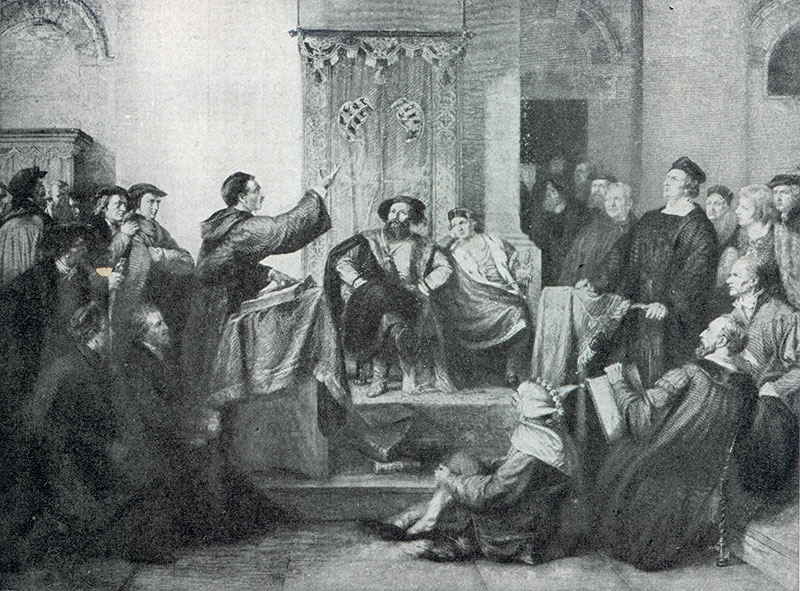
LUTHER-Martin-ECK-Johann-Debate-1

The Leipzig Debate took place 500 years ago in June and July 1519. It was a public debate between three Wittenberg University professors – Martin Luther, Philip Melanchthon and Andreas Bodenstein von Karlstadt on the affirmative against Johann Eck, who supported the status quo, the pope and Roman Catholic theology. The debate opened on June 27 in Pleissenburg Castle in the presence of George the Bearded, the Duke of Saxony who was critical of Martin Luther. Luther entered the debate on July 4, 1519.

XPH308462

Although the debate judges from the University of Paris took two years to decide and the judges from the University of Erfurt never reached a decision, the debate was won by Johann Eck. It marks the defining moment for understanding the authority of the Holy Bible, salvation by faith in Jesus Christ, and God’s grace in our lives. Related arguments include the importance of the Nicene Creed, if faith is a matter of our free will or if we are called to faith by God through the Holy Spirit, and the authority of the church or a pope. Although Eck may have won the debate, Luther’s ideas have prevailed for the past 500 years! Years later, Eck admitted that he could have accepted many of Luther’s arguments, but not on the authority of the pope and the church.

ECK-Johann-2

How will we remember this historic event which involves more than theology?

The Leipzig Debate marks one of the top ten most important events in World History and in the Christian Church. It is significant because it was clear to the people of Europe that the Holy Bible was the truth and divine Word of God. The Bible had authority over the Church, church councils, and the pope. The Bible is the inspired Word of God. While the Reformation resulted in the Ninety-five Theses; the public debate at Leipzig presented the truth and evidence behind these arguments.

Whether you consider your Christian faith as a private and personal matter between God and you or as faith that is evangelical and needs to be shared with others, the Leipzig Debate clearly stated that the good news of God’s grace is for all people and the love of Jesus Christ is the enduring legacy that has changed the world. The Leipzig Debate was a victory for the eternal values of redemption, forgiveness and love!

Map-Leipzig

Top Ten Events in World History (My Suggestions – you can create your own order)

Industrial Revolution

Renaissance

Life, death, resurrection of Jesus Christ

Life of Mohammad

Reformation

9/11 Attack on America

World War 1 and II

Medical Science

French Revolution

Discovery of America

Top Ten Events in Christian Church (My suggestions – you can create your own order)

Conversion of Constantine/Edict of Milan

Nicene Creed

Conversion of St. Augustine

Jerome’s translation of the Bible to Latin

Erasmus’ publication of the New Testament to Greek

Gutenberg’s Printing Press

Reformation and Leipzig Debate

Dead Sea Scrolls

Split between the Roman Catholic and Eastern Orthodox Churches

Summa Theologica by Thomas Aquinas

Comments: hbitten@reverendluther.org

In the year 1519

LETTER FROM LUTHER TO SPALATIN CONCERNING THE LEIPZIG DEBATE

Wittenberg, July 20, 1519

To the Illustrious Georg Spalatin, Court Chaplain and Librarian of His Highness the Elector of Saxony, His Friend in Christ.

Greetings! That our highness the prince and you all have returned safely pleases me, my dear Spalatin. May Christ claim the soul of Pfeffinger, Amen. I should have written you long ago about our famous debate, but I did not know where or about what. Certain people of Leipzig, neither sincere nor upright, are celebrating victory with Eck. It is from this nonsense that rumor has spread, but the truth of the matter will not bring everything to light.

Almost at the very moment of our arrival, even before we had gotten out of our wagon, the Inhibition of the bishop of Merseburg was affixed to the doors of the churches to the effect that the debate should not be held, together with that newly published explanation concerning this matter of indulgences. This Inhibition was disregarded and the person who had posted it was thrown into jail by the city council because he had acted without its knowledge.

Since our enemies got nowhere with this trick, they tried another. Having called Andreas Karlstadt to meet alone with them, they tried hard to get him to agree to hold the debate orally, according to Eck’s wishes, without stenographers taking down the proceedings in writing. Eck hoped that he might carry off the victory by his loud shouting and impressive delivery, means which he had long used to his advantage. Karlstadt, however, opposed this and insisted that they proceed according to a previous agreement, that is, that the statements of the disputants be written down by stenographers. Finally, to attain this, he was compelled to agree that the account of the debate made by the stenographers should not be published prior to a hearing by a court of judged.

At this point a new dispute arose over the choice of the judges. At length they compelled him also to consent to postpone coming to an agreement concerning the judges until after the debate had be concluded. Otherwise they did not wish to permit the debate. Thus they attacked us with the syllogistic horns of a dilemma, so that we should be confounded by both alternatives, whether we gave up the debate or placed the outcome into the hands of unfair judges. So you see how barbarous was their cunning, by means of which they robbed us of the freedom which had been agreed upon. For it is certain that the universities and the people will never make a pronouncement, or they would make one against us, and this is what they want.

The next day they called me to appear before them and proposed the same thing. Suspecting, however, the pope as the instigator of this procedure, I refused to accept these conditions, having been persuaded to do so by my colleagues. Then they proposed other universities as judges, without the pope. I requested that the freedom upon which we had agreed be respected. When they were unwilling to do this, I became reluctant and repudiated the debate. Then the rumor spread that I did not want to risk participating in the debate and, what is particularly unfair, that I wished to have no judges. All these accusations were hatefully and malignantly hurled at me and were interpreted in such a way that now they were turning even our best friends against us; and already permanent disgrace to our university was in prospect. After this, upon the advice of friends, I went to them and indignantly accepted their conditions. I did this in such a way and with the exclusion of the Roman Curia so that my power of appeal would be safeguarded and my case would be not prejudged.

Eck and Karlstadt at first debated for seven days over the freedom of the will. With God’s help Karlstadt advanced his arguments and explanations excellently and in great abundance from books which he had brought with him. Then when Karlstadt had also been given the opportunity of rebuttal, Eck refused to debate unless the books were left at home. Andreas [Karlstadt] had used the books to demonstrate to Eck’s face that he had correctly quoted the words of Scripture and the church fathers that he had not done violence to them as Eck was now shown to have done. This marked the beginning of another uproar until at length it was decided to Eck’s advantage that the books should be left at home. But who was not aware of the fact that if the debate were concerned with the cause of truth, it would be advisable to have all possible books at hand? Never did hatred and ambition show themselves more impudently than here.

Finally this deceitful man conceded everything that Karlstadt had asserted, although he had vehemently attacked it, and agreed with him in everything, boasting that he had led Karlstadt to his own way of thinking. He accordingly rejected Scotus and the Scotuistis and Capreolus and the Thomists, as saying that all other scholastic had thought and taught the same as he. So Scotus and Capreolus toppled to the ground, together with their respective schools, the two celebrated divisions of scholasticism.

The next week Eck debated with me, at first very acrimoniously, concerning the primacy of the pope. His proof rested on the words “You are Peter…” [Matt. 16:18] and “Feed my sheep…follow me” [John 21:17, 22], and “strengthen your brethren” [Luke 22:32], adding to these passages many quotations from the church fathers. What I answered you will soon see. Then, coming to the last point, he rested his case entirely on the Council of Constance which had condemned Huss’s article alleging that papal authority derived from the emperor instead of from God. Then Eck stamped about with much ado as though he were in an arena, holding up the Bohemians before me and publically accusing me of the heresy and support of the Bohemian heretics, for he is a sophist, no less impudent than rash. These accusations tickled the Leipzig audience more than the debate itself.

In rebuttal I brought up the Greek Christians during the past thousand years, and also the ancient church fathers, who had not been under the authority of the Roman pontiff, although I did not deny the primacy of honor due the pope. Finally we also debated the authority of a council. I publically acknowledged that some articles had been wrongly condemned [by the Council of Constance], articles which had been taught in plain and clear words by Paul, Augustine, and even Christ himself. At this point the adder swelled up, exaggerated my crime, and nearly went insane in his adulation of the Leipzig audience. Then I proved by words of the council itself that not all the articles which it condemned were actually heretical and erroneous. So Eck’s proofs had accomplished nothing. There the matter rested.

The third week Eck and I debated penance, purgatory, indulgences, and the power of a priest to grant absolution, for Eck did not like to debate with Karlstadt and asked me to debate alone with him. The debate over indulgences fell completely flat, for Eck agreed with me in nearly all respects and his former defense of indulgences came to appear like mockery and derision, whereas I had hoped that this would be the main topic of the debate. He finally acknowledged his position in public sermons so that even the common people could see that he was not concerned with indulgences. He also is supposed to have said that if I had not questioned the power of the pope, he would readily have agreed with me in all matters. Then he said to Karlstadt, “If I could agree with Martin in as many points as I do with you, I could be his friend.” He is such a fickle and deceitful person that he is ready to do anything. Whereas he conceded to Karlstadt that all the scholastics agreed in their teaching, in debating with me he rejected Gregory of Rimini as one who alone supported my opinion against all other scholastics. Thus he does not seem to consider it wrong to affirm and deny the same thing at different times. The people of Leipzig do not see this, so great is their stupidity. Much more fantastic was the following: He conceded one thing in the disputation hall but taught the people the opposite in church. When confronted by Karlstadt with the reason for his changeableness, the man answered without blinking an eye that it was not necessary to teach the people that which was debatable.

When I had concluded my part of the disputation, Eck debated once more with Karlstadt on new topics during the last three days, again making concessions in all points, agreeing that it is sin to do that which is in one, that free will without grace can do nothing but sin, that there is sin in every good work, and that it is grace itself which enables man to do what is in him in preparing for the reception of grace. All these things the scholastics deny. Therefore virtually nothing was treated in the manner which it deserved except my thirteenth thesis. Meanwhile Eck is pleased with himself, celebrates his victory, and rules the roost; but he will do so only until we have published our side of the debate. Because the debate turned out badly, I shall republish my Explanations Concerning the Value of Indulgences.

The citizens of Leipzig neither greeted nor called on us but treated us as though we were their bitterest enemies. Eck, however, they followed around town, clung to, banqueted, entertained, and finally presented with a robe and added a chamois-hair grown. They also rode horseback with him. In short, they did whatever they could to insult us. Furthermore they persuaded Caesar Pflug [the official host] and the prince [Duke George] that this pleased all concerned. One thing they did for us; they honored us, according to custom, with a drink of wine, which it would not have been safe for them to overlook. Those who were well disposed towards us, on the other hand, came to us in secret. Yet Dr. Auerbach, a very fair and just man, and Pistorious the younger, professor in ordinary, invited us. Even Duke George invited the three of us together on one occasion.

The most illustrious prince also called me to visit him alone and talked with me at length about my writings, especially my exposition of the Lord’s Prayer. He stated that the Bohemians were greatly encouraged by me and also that with my Lord’s Prayer I had caused confusion among many conscientious people who complained that they would not be able to pray one Lord’s Prayer in four days if they were compelled to listen to me, and much of a similar nature. But I was not so dull that I could not distinguish between the pipe and the piper. I was grieved that such a wise and pious prince as open to the influence of others and followed their opinions, especially when I saw and experienced how like a prince he spoke when he spoke his own thoughts.

The most recent exhibition of hatred was this: When on the day of Peter and Paul [June 29] I was summoned by our lord rector, the duke of Pomerania, to preach a sermon before his grace in the chapel of the castle, the report of this quickly filled the city, and men and women gathered in such numbers that I was compelled to preach in the debating hall, where all our professors and hostile observers had been stationed by invitation. The Gospel for this day [Matt. 16:13-19] clearly embraces both subjects of the debate. I got little thanks from the people of Leipzig.

Then Eck, stirred up against me, preached four sermons in different churches, publicly twisting and cutting into pieces what I had said. The would-be theologians had urged him to do this. No further opportunity was given me to preach, however, no matter how many people requested it. I could be accused and incriminated but not cleared. This is the way my enemies also acted in the debate, so that Eck, even though he represented the negative, always had the last word, which I did not have an opportunity to refute.

Finally, when Caesar Pflug heard that I had preached (he had not been present), he said, “I wish that Dr. Martin had saved his sermon for Wittenberg.” In short, I have experienced hatred before, but never more shameless or more impudent.

So here you have the whole tragedy. Dr. Hohannes Plawnitzer will tell you the rest, for he himself was also present and helped not a little in preventing the debate from being a complete fiasco. Since Eck and the people of Leipzig sought their own glory and not the truth at the debate, it is no wonder that it began badly and ended worse. Whereas we had hoped for harmony between the people of Wittenberg and Leipzig, they acted so hatefully that I fear that it will seem that discord and dislike were actually born here. This is the fruit of human glory. I, who really restrain my impetuosity, am still not able to dispel all dislike of them, for I am flesh and their hatred was very shameless and their injustice was very malicious in a matter so sacred and divine.

Farewell and commend me to the most illustrious prince

Your Martin Luther

Wednesday, July 20, 1519.

I met the honorable Vicar Staupitz in Grimma


Hymn Parade – These Are the Days of Elijah

The 500th Anniversary of the New Testament in the Language of the People 1522 – 2022

Bible Verses That Influenced Hymns

Days of Elijah – Robin Mark (1994)

 How do the events of our lifetime show examples of extreme suffering and the presence of evil?

These are the days of Elijah/Declaring the word of the Lord, yeah/And these are the days of Your servant, Moses/Righteousness being restored.

 These are the days of great trials/Of famine and darkness and sword/Still we are the voice in the desert crying/Prepare ye the way of the Lord!

Video: https://www.youtube.com/watch?v=0MtdyRDy4fU (by U.S. Marines)

These are the days of Elijah declaring the Word of the Lord

How, then, can they call on the one they have not believed in? And how can they believe in the one of whom they have not heard? And how can they hear without someone preaching to them? Romans 10:14

And these are the days of Your servant Moses righteousness being restored

Because one person disobeyed God, many became sinners. But because one other person obeyed God, many will be made righteous. Romans 5:19

And though these are days of great trials of famine and darkness and sword

Who shall separate us from the love of Christ? Shall trouble or hardship or persecution or famine or nakedness or danger or sword?  As it is written:  “For your sake we face death all day long;  we are considered as sheep to be slaughtered.” Romans 8:35-36

Still we are the voice in the desert crying prepare ye the way of the Lord

 A voice of one calling: “In the desert prepare the way for the LORD; make straight in the wilderness a highway for our God. Isaiah 40:3

[Chorus] Behold He comes riding on the clouds

 Look, he is coming with the clouds, and every eye will see him, even those who pierced him; and all the peoples of the earth will mourn because of him. So shall it be! Amen. Revelation 1:7

Shining like the sun at the trumpet call

Listen, I tell you a mystery: We will not all sleep, but we will all be changed— in a flash, in the twinkling of an eye, at the last trumpet. For the trumpet will sound, the dead will be raised imperishable, and we will be changed. 1 Corinthians 15:51-52

So lift your voice it’s the year of Jubilee

Then have the trumpet sounded everywhere on the tenth day of the seventh month; on the Day of Atonement sound the trumpet throughout your land. Consecrate the fiftieth year and proclaim liberty throughout the land to all its inhabitants. It shall be a jubilee for you; each one of you is to return to his family property and each to his own clanLeviticus 25:9-10

And out of Zion’s hill salvation comes!

Rejoice greatly, O Daughter of Zion! Shout, Daughter of Jerusalem! See, your king comes to you, righteous and having salvation,  gentle and riding on a donkey, on a colt, the foal of a donkey. Zechariah 9:9

The lyrics to this song were inspired by the tragedy of the Rwandan civil war in 1994, which claimed the lives of 1 million innocent people. The people of Israel felt helpless in the 9th century B.C.E. in a divided country living in a foreign culture under King Ahab and Queen Jezebel. The people of Israel who believed in God faced persecution and death if they did not worship the statue of Baal. Elijah stood up against the false religious system and spoke for God, the Creator of heaven and earth.

I felt in my spirit that He replied to my prayer by saying that indeed He was very much in control and that the days we were living in were special times when He would require Christians to be filled with integrity and to stand up for Him just like Elijah did, particularly with the prophets of Baal. “These are ‘Elijah’ days”. Elijah’s story is in the book of Kings and you can read how he felt isolated and alone in the culture in which he lived. But God told him to stand up and speak for Him. When Elijah called to God for fire and it came, the people realized the truth. Unfortunately for Elijah, he had to hide in the wilderness to escape the wrath of Queen Jezebel.

The references to famine and trials, darkness and swords are the story of world history, including the conflicts in our 21st century world. The song, especially the chorus reminds us of the hope that is ours in Jesus Christ. This is why we worship and desire to be in the presence of God!

Mount-Carmel1

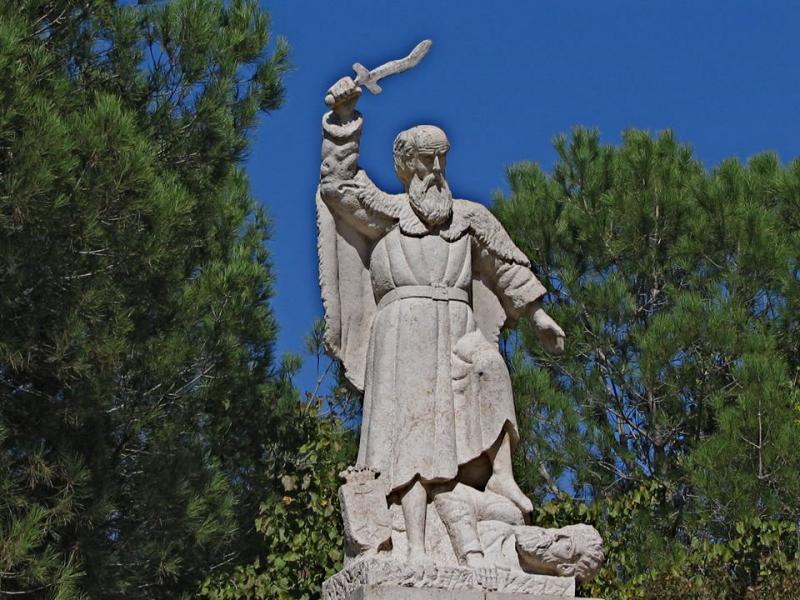
Statue of Elijah at Mt. Carmel in Israel.

Elijah is calling upon God to set fire to the altar to demonstrate His almighty power in heaven and on earth.

In his sermon on Christmas morning in 1525, Martin Luther commented on the “days of Elijah” and his coming to earth before the coming of Christ: “But first we must answer the inquiry liable to be made, If the voice of God today is the last message, why is it said that Elijah and Enoch shall come, opposing Antichrist?

I answer: Concerning the advent of Elijah, I hold that he will not come in a physical manner. As to the coming of Elijah I am suspended between heaven and earth, but I am inclined to believe it will not take place bodily. However, I will not contend hard against the other view. Each may believe or not believe it, as he likes. I well know St. Augustine has somewhere said, ‘The advent of Elijah and of Antichrist is firmly fixed in the belief of all Christians. But I also know there is no statement of Scripture to substantiate his assertion.

Malachi’s prophecy concerning the coming of Elijah (Malachi 4:5) the angel Gabriel makes reference to John the Baptist (Luke 1:17), and Christ does the same even more explicitly where He says in Mark 9:13, ‘But I say unto you that Elijah is come, and they have also done to him whatsoever they would, even as it is written of him, ‘Now, if John is the Elijah of the prophecy, as the Lord here says he was, the prediction of Malachi is already fulfilled. And there is nothing more prophesied concerning the coming of Elijah. The statement the Lord made just previously to the one quoted, ‘Elijah indeed cometh first, and restoreth all things,’ may be fairly interpreted to mean that Christ, referring to the office of John, practically says: ‘Yes, I well know Elijah must first come and restore all things, but he has already come and accomplished it.’

Comments: hbitten@reverendluther.org

The Stoning of Stephen

The Stoning of Stephen and the Big Picture of Pentecost

How did Stephen’s faith give him the freedom to forgive his murderers in the pain of his violent death?

Acts 7: 54-60  54 When the members of the Sanhedrin heard this, they were furious and gnashed their teeth at him. 55 But Stephen, full of the Holy Spirit, looked up to heaven and saw the glory of God, and Jesus standing at the right hand of God. 56 “Look,” he said, “I see heaven open and the Son of Man standing at the right hand of God.”

57 At this they covered their ears and, yelling at the top of their voices, they all rushed at him, 58 dragged him out of the city and began to stone him. Meanwhile, the witnesses laid their coats at the feet of a young man named Saul.

59 While they were stoning him, Stephen prayed, “Lord Jesus, receive my spirit.” 60 Then he fell on his knees and cried out, “Lord, do not hold this sin against them.” When he had said this, he fell asleep.

Stoning of Stephen-Rembrandt-1625

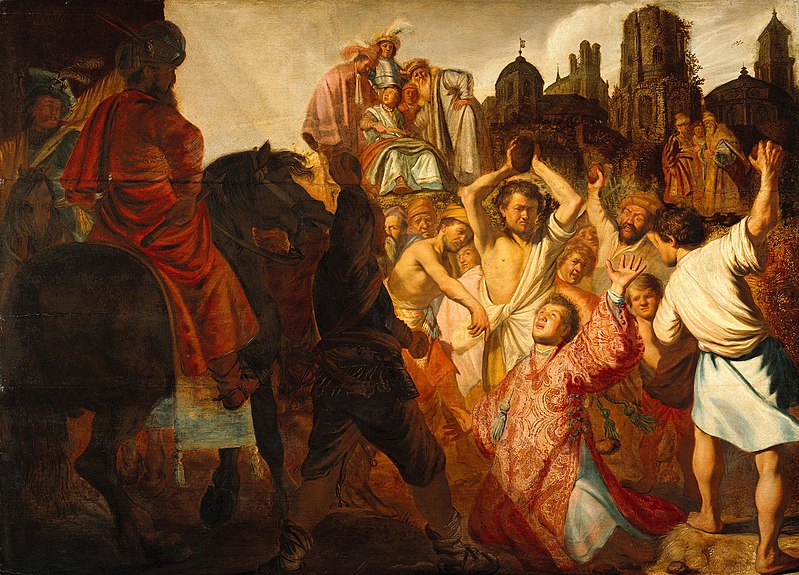
The Stoning of St. Stephen by Rembrandt, 1625

This is Rembrandt’s first painting with a biblical subject. Stephen was a member of the Christian community in Jerusalem. Stephen’s job was to care for Greek widows. “And according to Acts 6:8, Stephen, full of faith and power, did great wonders and miracles among the people.”

A group of Jews became jealous. In front of the high priests they falsely accused Stephen. He defended himself with a long plea that ended with accusing the priests. Stephen claimed they did not uphold the law, and that they betrayed and killed those that announced the coming of the “Just One” who is Jesus Christ.

The crowd in the temple was infuriated and seized Stephen. Outside the city he was stoned to death. That made Stephen into the first Christian martyr: someone who died for the faith. The yet unconverted Saul (Paul) looked on with approval. (Acts 6, 7 and 8:1).

In the background to the right are the priests. In the top center members of the Christian community watch with fear and worry. Stephen wears a fine gown, common among the deacons in Rembrandt’s days. His last words were “lay not this sin to their charge”. The light that shines on Stephen’s face represents the sign that heaven saw all this happen. The man on horseback is probably Saul, the persecutor of Christians, who will soon take a trip to Damascus where he is converted to the Christian faith after being without sight for several days. His name is changed to Paul.

In the selected passages from Martin Luther’s sermon on St. Stephen’s Day, we discover how faith gives us freedom.

Do we need churches?

“There is no other reason for building churches than to afford a place where Christians may assemble to pray, to hear the Gospel and to receive the sacraments; if indeed there is a reason. When churches cease to be used for these purposes they should be pulled down, as other buildings are when no longer of use. As it is now, (1523) the desire of every individual in the world is to establish his own chapel or altar, even his own mass, with a view of securing salvation, of purchasing heaven. Let us, therefore, beloved friends, be wise; wisdom is essential. Let us truly learn we are saved through faith in Christ and that alone. This fact has been made sufficiently manifest.”

The Faith of Stephen

First, we see in Stephen’s conduct love toward God and man. He manifests his love to God by earnestly and severely censuring the Jews, calling them betrayers, murderers and transgressors of the whole Law, yes stiff necked, and saying they resist the fulfillment of the Law and resist also the Holy Spirit. More than that, he calls them “uncircumcised in heart and ears.” How could he have censured them any more severely? So completely does he strip them of every creditable thing, it would seem as if he were moved by impatience and wrath.

Stephen’s love for God constrained him to his act. No one who possesses the same degree of love can be silent and calmly permit the rejection of God’s commandments. He cannot dissemble. He must censure and rebuke everyone who opposes God. Such conduct he cannot permit even if he risks his life to rebuke it. Love of this kind the Scriptures term “zelum Dei,” a holy indignation. For rejection of God’s commands is a slight upon his love and intolerably disparages the honor and obedience due him, honor and obedience which the zealous individual ardently seeks to promote. We have an instance of such a one in the prophet Elijah, who was remarkable for his holy indignation against the false prophets.

Stephen’s conduct is a beautiful example of love for fellowmen in that he entertains no ill-will toward even his murderers. However severely he rebukes them in his zeal for the honor of God, such is the kindly feeling he has for them that in the very agonies of death, having made provision for himself by commending his Spirit to God, he has no further thought about himself but is all concern for them. Under the influence of that love he yields up his spirit. Not undesignedly does Luke place Stephen’s prayer for his murderers at the close of the narrative. Note also, when praying for himself and commending his spirit to God he stood, but he knelt to pray for his murderers. Further, he cried with a loud voice as he prayed for them, which he did not do for himself.

Who can number the virtues illustrated in Stephen’s example? There loom up all the fruits of the Spirit. We find love, faith, patience, benevolence, peace, meekness, wisdom, truth, simplicity, strength, consolation, philanthropy. We see there also hatred and censure for all forms of evil. We note a disposition not to value worldly advantage nor to dread the terrors of death. Liberty, tranquility and all the noble virtues and graces are in evidence. There is no virtue but is illustrated in this example; no vice it does not rebuke. Well may the evangelist say Stephen was full of faith and power. Power here implies activity. Luke would say, “His faith was great; hence his many and mighty works.” For when faith truly exists, its fruits must follow. The greater the faith, the more abundant its fruits.”

hbitten@reverendluther.org


Ascension of Jesus Christ to Heaven!

Ascension of Jesus Christ into Heaven

 How do you understand the perspective of the Ascension of Jesus to Heaven?

 Acts 1: 6-11     So when the apostles were with Jesus, they kept asking him, “Lord, has the time come for you to free Israel and restore our kingdom?”

He replied, “The Father alone has the authority to set those dates and times, and they are not for you to know. But you will receive power when the Holy Spirit comes upon you. And you will be my witnesses, telling people about me everywhere—in Jerusalem, throughout Judea, in Samaria, and to the ends of the earth.”

After saying this, he was taken up into a cloud while they were watching, and they could no longer see him. 10 As they strained to see him rising into heaven, two white-robed men suddenly stood among them. 11 “Men of Galilee,” they said, “why are you standing here staring into heaven? Jesus has been taken from you into heaven, but someday he will return from heaven in the same way you saw him go!”

Dosso_Dossi_022

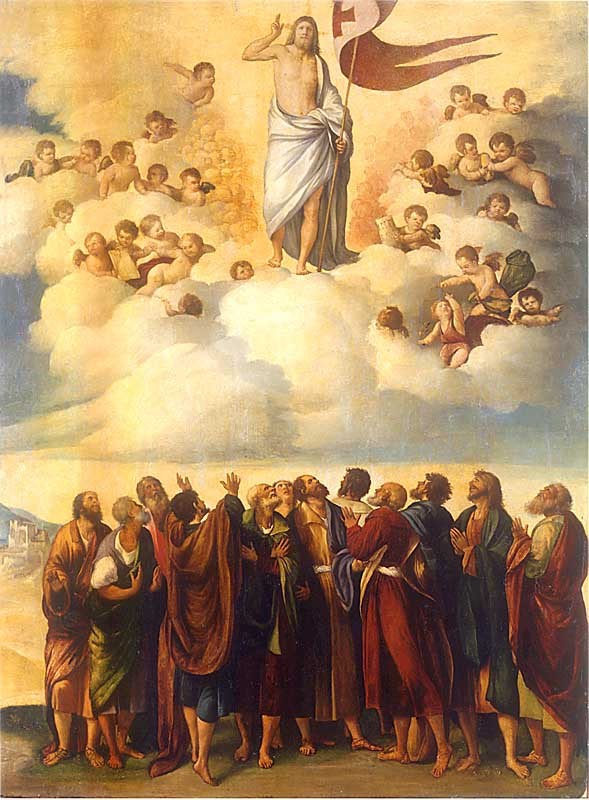
The Ascension by Dosso Dossi, 1520

The Ascension of Jesus Christ into heaven is documented as 40 days after His resurrection on Easter. It is one of the most important dates in the Church and it is a statement of faith in the Apostles’, Nicene, and Athanasian Creeds. It is accepted by Roman Catholics, the Eastern and Russian Orthodox Churches, and Protestants.

He suffered and was buried; and the third day He rose again, according to the Scriptures; and ascended into heaven, and sits on the right hand of the Father; and He shall come again, with glory, to judge the living and the dead; whose kingdom shall have no end.

It is through faith that we understand heaven as the community of all believers or what has been called the invisible church. There are many things we cannot see or understand in this life and perhaps an analogy is that microscopes help us to see molecules, telescopes the depth of space, and magnetic reasoning images the secrets of our body, we are able to see heaven through faith and the reading of God’s Words.

The people of this world will challenge our faith and instincts which is why our understanding, explanation, and actions are powerful illustrations of God’s kingdom and heaven.

Saint Peter wrote in 1 Peter 3:15-16, “Always be ready to give an explanation to anyone who asks you for a reason for your hope, but do it with gentleness and reverence.”

This is Scripture and this is God’s Word, which is greater than all understanding and reason. The Scriptures document the truth – authentic news and not fake news.

 In 1534 Martin Luther preached on Ascension Day. Luther speaks about the history and the fruit of the ascension. This history states what happened, how Christ was taken up and hidden by a cloud. If this is preached only as history, Luther says, it does not benefit us. Yet it is preached for our sake!

As he preaches the fruit and use of the ascension for us, Luther proclaims that Christ has made captive all those things that held us captive. Sin, death, devil, etc. no longer hold us captive. Christ has bound them in captivity on high. Since Christ has captured our captors, we are now free from the things that would hold us captive before God: sin, death, hell, and the devil. Luther is drawing here on Ephesians 4:8.

A key fruit of this for us is that we are free from sin. Luther says that we can now taunt sin. If sin threatens to terrify us, we can say to sin: “You are my servant, I am your lord. This is one component of being free from sin, the freedom from fear before God. Another component is the freedom to turn away from sin. Luther preaches both components:

“If you believe in Christ, then the text says that you believe that He sits above, and that He has taken captive my captivity, that is, my sin. In what way? It should not terrify me before God…. I believe in Him who is above, who has captured sin.

Free in Christ, we can stand against temptations because Christ has led sin into captivity by His ascension.

hbitten@reverendluther.org


Hymn Parade – I Know That My Redeemer Lives!

Hymn Parade – I Know that My Redeemer Lives by Samuel Medley (1865)

How does Jesus Christ change the way we understand life and people?

Job 19:25    I know that my redeemer lives, and that in the end he will stand on the earth.

Video: https://www.youtube.com/watch?v=qgY-da_w36Y

1 I know that my Redeemer lives; what comfort this sweet sentence gives! He lives, He lives, who once was dead; He lives, my everliving Head.

2 He lives triumphant from the grave, He lives eternally to save, He lives all-glorious in the sky, He lives exalted there on high.

3 He lives to bless me with His love, He lives to plead for me above, He lives my hungry soul to feed, He lives to help in time of need.

4 He lives to grant me rich supply, He lives to guide me with His eye, He lives to comfort me when faint, He live to hear my soul’s complaint.

5 He lives to silence all my fears, He lives to wipe away my tears, He lives to calm my troubled heart, He lives all blessings to impart.

6 He lives, my kind, wise, heav’nly friend, He lives and loves me to the end; He lives, and while He lives, I’ll sing; He lives, my Prophet, Priest, and King.

7 He lives and grants me daily breath; He lives and I shall conquer death; He lives my mansion to prepare; He lives to bring me safely there.

8 He lives, all glory to His name! He lives, my Jesus, still the same. Oh, the sweet joy this sentence gives, “I know that my Redeemer lives!”

Women-at-Tomb

Samuel Medley was introduced to the stories of the Bible by his grandfather but gave them little attention. It was during the Seven Years War (1756-1763, also called the French and Indian War in the Americas) when he was injured in a naval battle that he feared for his life. He prayed without stopping throughout the night that his leg would not need to be amputated and his life spared from death by infection. In the morning, his wound showed a miraculous sign of healing. He was retired from the military and attended a worship service at the Baptist Church on Eagle street and following a sermon he wrote the words to I Know that My Redeemer Lives! He opened a school and began a ministry to seamen.

Emma Smith composed the melody in 1835 and titled it “Duke Street,” which was his address in London.

Martin Luther, wrote: Aber ich weiß, daß mein Erlöser lebt, und als der letzte wird er über dem Staub sich erheben. Und ist meine Haut noch so zerschlagen und mein Fleisch dahingeschwunden, so werde ich doch Gott sehen.

 Ich selbst werde ihn sehen, meine Augen werden ihn schauen und kein Fremder. Danach sehnt sich mein Herz in meiner Brust.

Translation: But I know that my Redeemer lives, and as the last He will rise above the dust. And if my skin is still so broken and my flesh is gone, then I will see God.

I’ll see Him myself, my eyes will look at him and not a stranger. After that, my heart is yearning in my chest.

Comments: hbitten@reverendluther.org


Hymn Parade – When I Survey the Wondrous Cross

Hymn Parade: When I Survey the Wondrous Cross by Isaac Watts (1707)

 To what extent is the crucifixion of Jesus Christ the single most important event in world history?

Galatians 6:14     May I never boast except in the cross of our Lord Jesus Christ, through which the world has been crucified to me, and I to the world.

Video: https://www.youtube.com/watch?v=FQlJm-5_Ll4

  1. When I survey the wondrous cross On which the Prince of glory died, My richest gain I count but loss, And pour contempt on all my pride.
  2. Forbid it, Lord, that I should boast, Save in the death of Christ my God! All the vain things that charm me most, I sacrifice them to His blood.
  3. See from His head, His hands, His feet, Sorrow and love flow mingled down! Did e’er such love and sorrow meet, Or thorns compose so rich a crown?
  4. Were the whole realm of nature mine, That were a present far too small; Love so amazing, so divine, Demands my soul, my life, my all.

Isaac Watts (1674–1748) wrote hymns that reflected the theme of the sermon and in a poetic style that was ideal for congregational singing. Before Isaac Watts, hymns often supplemented the Psalms or based on the strict interpretation of Scripture. Isaac Watts is credited with writing 750 hymns! The hymn, When I Survey the Wondrous Cross is inspired by the most important event in human and personal history!

Peter_Paul_Rubens_-_Christ_on_the_Cross

Christ on the Cross was painted in 1627 by Peter Paul Rubens

In this painting, Jesus Christ is shown crucified on a cross with three women beneath him weeping with sympathy. Jesus is based in the center of the painting to clearly state the importance of His sacrifice and that the subject of this painting is religious. The use of darker colors makes the sacrifice of Jesus to appear as sympathetic and personal for the viewer. Imagine the impact of the perspective of this painting around the same time as the Pilgrims and Puritans were coming to Plymouth and Massachusetts Bay colony.

Martin Luther wrote in his commentary on Galatians 6:14: “But God forbid that I should glory, save in the cross of our Lord Jesus Christ. “God forbid,” says the Apostle, “that I should glory in anything as dangerous as the false apostles glory in because what they glory in is a poison that destroys many souls, and I wish it were buried in hell. Let them glory in the flesh if they wish and let them perish in their glory. As for me I glory in the Cross of our Lord Jesus Christ.”

He expresses the same sentiment in the fifth chapter of the Epistle to the Romans, where he (Paul) says: “We glory in tribulations”; and in the twelfth chapter of the Second Epistle to the Corinthians: “Most gladly, therefore, will l rather glory in my infirmities.” According to these expressions the glory of a Christian consists in tribulations, reproaches, and infirmities.

But the Cross of Christ is not to be understood here as the two pieces of wood to which He was nailed, because it is all the afflictions of the believers whose sufferings are Christ’s sufferings. Elsewhere Paul writes: “Who now rejoice in my sufferings for you, and fill up that which is behind of the afflictions of Christ in my flesh for his body’s sake, which is the church.” (Colossians 1:24)

It is good for us to know this lest we sink into despair when our opponents persecute us. Let us bear the cross for Christ’s sake. It will ease our sufferings and make them light as Christ says in Matthew 11:30, “My yoke is easy, and my burden is light.”

By whom the world is crucified unto me, and I unto the world. “The world is crucified unto me,” means that I condemn the world. “I am crucified unto the world,” means that the world in turn condemns me. I detest the doctrine, the self-righteousness, and the works of the world. The world in turn detests my doctrine and condemns me as a revolutionary heretic. Thus the world is crucified unto us and we unto the world.

In this verse Paul expresses his hatred of the world. The hatred was mutual. As Paul, so we are to despise the world and the devil. With Christ on our side we can defy him and say: “Satan, the more you hurt me, the more I oppose you.”

Comments: hbitten@reverendluther.org


Jesus Enters Jerusalem on Palm Sunday

Jesus Enters Jerusalem on Palm Sunday

What question would you ask Jesus if you saw Him?

Matthew 21: 1-11   As they approached Jerusalem and came to Bethphage on the Mount of Olives, Jesus sent two disciples, saying to them, “Go to the village ahead of you, and at once you will find a donkey tied there, with her colt by her. Untie them and bring them to me. If anyone says anything to you, say that the Lord needs them, and he will send them right away.”

This took place to fulfill what was spoken through the prophet: “Say to Daughter Zion, ‘See, your king comes to you, gentle and riding on a donkey, and on a colt, the foal of a donkey.’”

The disciples went and did as Jesus had instructed them. They brought the donkey and the colt and placed their cloaks on them for Jesus to sit on. A very large crowd spread their cloaks on the road, while others cut branches from the trees and spread them on the road. The crowds that went ahead of him and those that followed shouted,

“Hosanna to the Son of David!” “Blessed is he who comes in the name of the Lord!”

“Hosanna in the highest heaven!” 10 When Jesus entered Jerusalem, the whole city was stirred and asked, “Who is this?”   11 The crowds answered, “This is Jesus, the prophet from Nazareth in Galilee.”

Giotto Entry into Jerusalem

The Entry into Jerusalem by Giotto di Bondone (1305)

The Entry into Jerusalem is told in detail in all four gospels indicating its importance for Jesus and our salvation. Although this may not be the most descriptive painting of Palm Sunday, it reminds me of the importance of continuity over time as this fresco was painted over 700 years ago! The historical evidence of Holy Week is in the documented love and grace of Jesus Christ!

Jesus is the center and His face is filled with peace and reflection as the crowds to the left rip off branches and take off their outer garments. This moment is not about Jesus but it is all about the people – the apostles on the left who believed Jesus as their Savior and those on the right who are looking for a savior. The artist is aware of the violent death Jesus will face in a few days. We see the reaction of Martin Luther below in his commentary on Palm Sunday as the people asked: “Who is this?”

Martin Luther’s perspective is one that is likely to appear shocking to us in the 21st century because they should have known who Jesus is! “Therefore, it is truly a disgraceful question when they ask who He is in Matthew 21:10, as if they did not know Him and as if the temple, the city, and everything belonged to them. He answers them with a question, however, and sets before them John the Baptist. He asks them where John’s Baptism is from. The common people and children give them a fine answer and say: ‘Have you not heard of John’s testimony? This is Jesus, the prophet from Galilee’ in Matthew 21:11.

They have to fall silent. They cannot allow themselves to answer Christ’s question by saying that John the Baptist’s Baptism is from men, for the people regarded him as a prophet (v. 26) And as they say here: “The prophet comes from Galilee.” (verse 11). The people say, ‘He is Jesus, the prophet.’ And the very word ‘prophet’ is for them like a clap of thunder. This was not to be trifled with, for the people believed that a prophet held the highest authority in spiritual matters. Whatever he might order of command must be done….

For the Lord did not ride in to stir up a revolt or to usurp the government , but He did want to clean out and reform the temple. (Matthew 21: 12-17) And for that reason He attacks only those who are in the spiritual government, to which He was called, and enters the temple as the true Messiah and Lord.”

Comments: hbitten@reverendluther.org


Joseph Resists the Advances of Potiphar’s Wife

Joseph Resists the Advances of Potiphar’s Wife

Why did God allow Joseph to go to prison after resisting adultery?

Genesis 39:7-23 Now Joseph was well-built and handsome, and after a while his master’s wife took notice of Joseph and said, “Come to bed with me!”

But he refused. “With me in charge,” he told her, “my master does not concern himself with anything in the house; everything he owns he has entrusted to my care. No one is greater in this house than I am. My master has withheld nothing from me except you, because you are his wife. How then could I do such a wicked thing and sin against God?” 10 And though she spoke to Joseph day after day, he refused to go to bed with her or even be with her.

11 One day he went into the house to attend to his duties, and none of the household servants was inside. 12 She caught him by his cloak and said, “Come to bed with me!” But he left his cloak in her hand and ran out of the house.

13 When she saw that he had left his cloak in her hand and had run out of the house, 14 she called her household servants. “Look,” she said to them, “this Hebrew has been brought to us to make sport of us! He came in here to sleep with me, but I screamed. 15 When he heard me scream for help, he left his cloak beside me and ran out of the house.”

16 She kept his cloak beside her until his master came home. 17 Then she told him this story: “That Hebrew slave you brought us came to me to make sport of me. 18 But as soon as I screamed for help, he left his cloak beside me and ran out of the house.”

19 When his master heard the story his wife told him, saying, “This is how your slave treated me,” he burned with anger. 20 Joseph’s master took him and put him in prison, the place where the king’s prisoners were confined.

But while Joseph was there in the prison, 21 the Lord was with him; he showed him kindness and granted him favor in the eyes of the prison warden. 22 So the warden put Joseph in charge of all those held in the prison, and he was made responsible for all that was done there. 23 The warden paid no attention to anything under Joseph’s care, because the Lord was with Joseph and gave him success in whatever he did.

300px-Guido_Reni_(Italian_-_Joseph_and_Potiphar's_Wife_-_Google_Art_Project

Joseph likely came to Egypt around the time of the Hyksos invasion around 1900-1850 B.C.E. or 400 years before the Exodus. He was purchased by Potiphar, the captain of the Pharaoh’s guard. He was recognized for his ability and promoted to manager of the household.

Although Potiphar’s wife tried to seduce him on several occasions, Joseph resisted her temptations. Rembrandt captures this moment of moral strength by raising his left hand to shield himself from her and attempts to leave the room. During a physical struggle, Potiphar’s wife grabs Joseph’s robe and accuses him of rape. Unfortunately for Joseph, his robe was sufficient evidence to convict him or rape and he is sent to prison.

Luther respected Joseph’s resistance to the temptations of seduction and encouraged chaste living in his sermons and lectures. Although he was sent to prison, his trust and faith in God became stronger instead of weaker. Luther understands this as an example of trust.

Comments: hbitten@reverendluther.org