The Wedding at Cana

How many times has God blessed you more than you expected?

John 2: 1-11: On the third day a wedding took place at Cana in Galilee. Jesus’ mother was there, and Jesus and his disciples had also been invited to the wedding. When the wine was gone, Jesus’ mother said to him, “They have no more wine.”

“Woman, why do you involve me?” Jesus replied. “My hour has not yet come.” His mother said to the servants, “Do whatever he tells you.” Nearby stood six stone water jars, the kind used by the Jews for ceremonial washing, each holding from twenty to thirty gallons.

Jesus said to the servants, “Fill the jars with water”; so they filled them to the brim. Then he told them, “Now draw some out and take it to the master of the banquet.”

They did so, and the master of the banquet tasted the water that had been turned into wine. He did not realize where it had come from, though the servants who had drawn the water knew. Then he called the bridegroom aside 10 and said, “Everyone brings out the choice wine first and then the cheaper wine after the guests have had too much to drink; but you have saved the best till now.”

11 What Jesus did here in Cana of Galilee was the first of the signs through which he revealed his glory; and his disciples believed in him.

Marriage-at-Cana-Italian-Renaissance-Tintoretto

The Marriage at Cana by Jacopo Tintoretto (1561)

The wedding at Cana is one of the most popular Biblical stories for artists. This painting emphasizes the culture of a Renaissance wedding with the finest dinnerware and clothing. The use of light and perspective demonstrates Tintoretto’s skill as a master artist. The spiritual importance of the painting is lacking as Jesus just appears as one of the guests and He is not the central theme. The calling of the apostle John is omitted and the presence of Mary, Jesus’ family, and his disciples lacks emphasis.

Luther: Martin Luther analyzed the miracle at Cana in his sermon on the second Sunday in Epiphany in 1525. He took the opportunity to apply the importance of God’s Word, faith, and the responsibility of parents to nurture their children (God’s children) according to God’s command.

“For father and mother are in duty bound, yea, God made them father and mother for this very purpose, not to teach and lead their children to God according to their own notions and devotion, but according to God’s command; as St. Paul declares in Eph 6, 4: “Ye fathers, provoke not your children to wrath: but nurture them in the chastening and admonition of the Lord;” (i. e. teach them God’s command and Word, as you were taught, and not notions of your own.) Thus in this Gospel lesson you see the mother of Christ directing the servants away from herself unto Christ, telling them not: Whatsoever I say unto you, do it; but: “Whatsoever he saith unto you, do it.” To this Word alone you must direct everyone, if You would direct aright; so that this word of Mary (whatsoever he saith, do it) is, and ought to be, a daily saying in Christendom, destroying all doctrines of men and everything not really Christ’s Word. And we ought firmly to believe that what is imposed upon us over and above God’s Word is not, as they boast and lie, the commandment of the church. For Mary says: ‘Whatsoever he saith that, that, that do, (sic) and that alone; for in it there will be enough to do.‘ Here also you see, how faith does not fail, God does not permit that, but gives more abundantly and gloriously than we ask. For here not merely wine is given, but excellent and good wine, and a great quantity of it. By this He again entices and allures us to believe confidently in him, though be a delay. For He is truthful and cannot deny himself; He is good and gracious, that He must of Himself confess and in addition prove it, unless we hinder Him and refuse Him time and place and the means to do so. At last He cannot forsake his work, as little as He can forsake himself–if only we can hold out until His hour comes.”

Comments: hbitten@reverendluther.org


Hymn Parade – Holy, Holy, Holy

Bible Verses That Influenced Hymns

Holy, Holy, Holy by Reginald Heber (1826, England)

Why did John Newton remember the words of King David when faced with death in a storm in the Atlantic Ocean?

Holy, holy, holy! Lord God Almighty! / Early in the morning our song shall rise to thee / Holy, holy, holy! Merciful and mighty / God in three persons, blessed Trinity!” https://www.youtube.com/watch?v=0SHDNs7Dt5M

Revelation 4:8   Each of the four living creatures had six wings and was covered with eyes all around, even under its wings. Day and night they never stop saying: “‘Holy, holy, holy is the Lord God Almighty,’ who was, and is, and is to come.”

Holy, Holy, Holy

Reginald Heber was a bishop in the Anglican Church of England. He wrote this hymn for Trinity Sunday but died unexpectedly at age 43 before the hymn was sung. His wife found the words and passed it on to John Dykes who wrote the melody in 1861.

Luther:  Paul, speaking of Christ in Hebrews 1:3, refers to Him as the express image of God’s substance. Again, in Colossians 1:15 he says of Christ: “Who is the image of the invisible God, the firstborn of all creation.” We must take these words for what they say—that all creatures, even angels and men, are ranked below Christ. This classification leaves room for God only: taking away the creature, only God remains. It is one and the same thing, then, to say that Christ is the firstborn of all creatures and that Christ is true and essential God.

To make the matter as clear as possible Paul uses the expression image of the invisible God.” If Christ be the image of God he must be a person distinct from him whose image he is, but at the same time in one divine essence with the Father. He and the Father are not one person, but two, and yet Christ could not be the express image of the Father’s person, or essence, if he were not equally divine. No creature can be an image of the divine essence, for it does not possess that essence. To repeat, Christ could not be called the express image of God if he and the Father were not distinct persons; there must be one imaged and one who is the image.

Expressed more clearly and according to Scripture, one person is the Father, who in eternity begets the other; the other is the Son, begotten in eternity, yet both are equally eternal, mighty, wise and just.

Comments: hbitten@reverendluther.org

The Struggle of Nicodemus – A Bible Story About Doubt and Faith

The Struggle of Nicodemus 

Do you have unanswered questions about eternal life and faith?

John 3: 1-21:   Now there was a Pharisee, a man named Nicodemus who was a member of the Jewish ruling council. He came to Jesus at night and said, “Rabbi, we know that you are a teacher who has come from God. For no one could perform the signs you are doing if God were not with him.”

Jesus replied, “Very truly I tell you, no one can see the kingdom of God unless they are born again.”

“How can someone be born when they are old?” Nicodemus asked. “Surely they cannot enter a second time into their mother’s womb to be born!”

Jesus answered, “Very truly I tell you, no one can enter the kingdom of God unless they are born of water and the Spirit. Flesh gives birth to flesh, but the Spirit gives birth to spirit. You should not be surprised at my saying, ‘You[c] must be born again.’ The wind blows wherever it pleases. You hear its sound, but you cannot tell where it comes from or where it is going. So it is with everyone born of the Spirit.”

“How can this be?” Nicodemus asked.

10 “You are Israel’s teacher,” said Jesus, “and do you not understand these things? 11 Very truly I tell you, we speak of what we know, and we testify to what we have seen, but still you people do not accept our testimony. 12 I have spoken to you of earthly things and you do not believe; how then will you believe if I speak of heavenly things? 13 No one has ever gone into heaven except the one who came from heaven—the Son of Man. 14 Just as Moses lifted up the snake in the wilderness, so the Son of Man must be lifted up, 15 that everyone who believes may have eternal life in him.”

16 For God so loved the world that he gave his one and only Son, that whoever believes in him shall not perish but have eternal life. 17 For God did not send his Son into the world to condemn the world, but to save the world through him. 18 Whoever believes in him is not condemned, but whoever does not believe stands condemned already because they have not believed in the name of God’s one and only Son.

19 This is the verdict: Light has come into the world, but people loved darkness instead of light because their deeds were evil. 20 Everyone who does evil hates the light, and will not come into the light for fear that their deeds will be exposed. 21 But whoever lives by the truth comes into the light, so that it may be seen plainly that what they have done has been done in the sight of God.
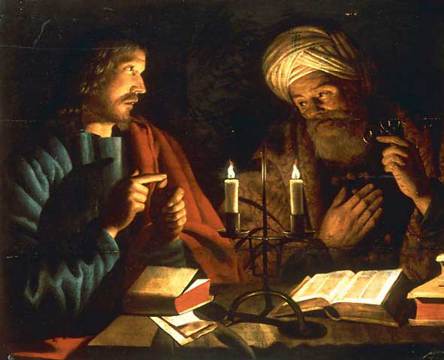
Jesus-NicodemusJesus and Nicodemus, Crijn Hendricksz, Netherlands, 1645

There is limited information about Nicodemus in the Bible, except for the Gospel of John. Nicodemus was a Pharisee or educated religious leader, he likely had a position in the Jewish decision-making institution, the Sanhedrin, was a man who would be considered wealthy, and he is often pictured on a ladder taking Jesus down from the cross. His educational training in debate, inquiry, and reasoning created a struggle for him to answer the question presented by Jesus about being born again to enter God’s kingdom.

Crijn Hendicksz painted this shortly before his early death at the age of 40. He captures the scene in the opening verse that he came to Jesus in the night. (v.2) The gospel for the Sunday after Pentecost, also known as Trinity Sunday, is John 3, the story of Nicodemus followed by one of the most quoted verses in the Bible, John 3:16.

Luther: (Excerpts from Martin Luther’s sermon on John 3) Luther concisely applies the struggle of Nicodemus to our lives in his 1523 sermon to the congregation in Wittenberg:   “In this Gospel you see clearly what reason and free-will can do. You may see it distinctly in Nicodemus, who was the best of the best, a prince and leader of the Pharisees, and the Pharisees held first place in their day.

They were, however, in the highest things — in spiritual life — altogether blind and dead before God, however holy, wise, good and mighty they may have been considered by men. The longer Nicodemus associates with Christ, the less he understands Christ, although he is expected to understand only earthly things and the manner of Christ’s death. Reason is so blind that it can neither perceive nor understand the things of God, nor all things which properly belong to its own sphere. This is a blow to nature and human reason, which have been rated so high by philosophy and the wise men of this world; the wise ones have said that reason always strives to attain the best.

God has here given us an example showing that even the best in nature must fail. In instances where human nature is at its best it is blind, not to speak of its envy and hatred.

Now, Nicodemus, who is a pious and well-meaning man, cannot grasp the work and Word of God; how then would Annas and Caiaphas? He comes to the Lord at night, which he did from fear, not desiring to be

called a heretic by others. From this we may conclude that he was in nature an old Adam, cowardly seeking Christ by night, and that he did not yet possess the true light. If he had been a “new man,” he would have come in the bright light of day, fearing no one.

Because of his hypocrisy, the Lord deals sharply with him, cutting off his salutation and all further speech, as we shall see. Nicodemus approaches the Lord with these words: “Rabbi, we know that thou art a teacher come from God; for no one can do these signs that thou doest, except God be with him.”

Christ’s words are as if to say: No, my dear Nicodemus, I am not moved by your beautiful words. You must give up your old life and become a new man. You have not the faith which you say you have; you are still afraid. Although the natural man hears the Word of God, the Gospel, and delights in it, yet it does not enter the heart. Therefore, we must slay reason and experience the new birth. This is what Christ means when he says that we must be born anew. Reason cannot understand this, wherefore Nicodemus

replies: “How can a man be born when he is old? Can he enter a second time into his mother’s womb, and be born?”

Now, Christ speaks and destroys reason, saying: “Art thou the teacher of Israel, and understandest not these things?” You should teach others the spiritual birth, that they might become righteous, but you yourself do not understand it. He defeats reason and the whole law and says: My friend, do you not know how these things can be? It is plain to me, as it was also to the prophets, who corroborate my words. Renounce your reason and close your eyes; cling only to my Word and believe it.

Again he says: “Marvel not that I said unto thee, Ye must be born anew. The wind bloweth where it will, and thou hearest the voice thereof, but knowest not whence it cometh, and whither it goeth: so is everyone that is born of the Spirit.” As if to say: You presume to judge spiritual things by your reason, and

at the same time you cannot understand the simple things of nature. He calls Nicodemus’ attention to the wind. No philosopher or scientist has ever been able to comprehend and describe the nature of the wind —where it has its beginning or where it ends. We cannot see where the wind comes from, or how it blows past us, or how far it goes. Now, if we cannot by our reason fathom those things which we see daily in nature, much less will we be able to fathom with our reason the divine works which God accomplishes within us….

But if I believe in God and am born anew, I close my eyes and do not grope about. I am willing that the condition of the soul be changed entirely, and I think: O God, my soul is in thy hands; thou hast preserved it during my life and I have never known where thou hast put it. Neither do I wish to know, to which place thou will now assign it. I only know that it is in thy hands and thou wilt take care of it. Thus we must abandon the life of the flesh and enter into a new life, being dead to the old. This is a real dying and not merely a painful sensation, like the scratching off of a scab, as the philosophers have said; and they have compared the entering upon the new life with the rinsing of a pot by the cook. There must be a real change and an entire transformation of nature, for the natural state and natural feeling must be completely overthrown.”

Comments: hbitten@reverendluther.org

The Conviction of Galileo as a Heretic and the Day the Sun Stood Still

Did the sun shine for 24 hours or is this account exaggerated?

Joshua 10:12-14     12 On the day the Lord gave the Amorites over to Israel, Joshua said to the Lord in the presence of Israel: “Sun, stand still over Gibeon, and you, moon, over the Valley of Aijalon.” 13 So the sun stood still, and the moon stopped, till the nation avenged itself on[b] its enemies, as it is written in the Book of Jashar.

The sun stopped in the middle of the sky and delayed going down about a full day. 14 There has never been a day like it before or since, a day when the Lord listened to a human being. Surely the Lord was fighting for Israel!

joshua-stopping-the-sun-by-pauwels-casteels-antwerp-c-1649-1677-1

Joshua Stopping the Sun by Pauwels Casteels (1649-1679)

Pauwels Casteels painting illustrates the story of Joshua at the battle of Gibeon against the alliance of Amorite kings. The Israelites were winning the battle, partly due to God raining hailstones upon the Amorite army, but with the setting of the sun, Joshua commanded that the “‘Sun, stand thou still upon Gibeon!” According to the Bible, the sun stopped in the sky and the day was prolonged until the Israelites could complete their victory over the Amorites. The painting shows the chaos of the battle, the large scale of the battle, and on the upper right side of the painting the people running from the large hailstones. Joshua appears as a commander-in-chief of his army and nature as he rides his white horse.

Luther: In the Table Talk, June 4, 1539, we read of the following regarding this new ideas:

“There was mention of a certain new astrologer who wanted to prove that the earth moves and not the sky, the sun, and the moon. This would be as if somebody were riding on a cart or in a ship and imagined that he was standing still while the earth and the trees were moving. So it goes now. Whoever wants to be clever must agree with nothing that others esteem. He must do something of his own. This is what that fellow does who wishes to turn the whole of astronomy upside down. Even in these things that are thrown into disorder I believe the Holy Scriptures, for Joshua commanded the sun to stand still, and not the earth.”

On April 12, 1633, Galileo was convicted of heresy for teaching that the earth revolves around the sun as Copernicus presented in theory and Galileo confirmed with his telescope. Galileo maintained that his writings were for the purpose of discussion and not belief but his trial ended in conviction.

On June 22, 1633, the Church handed down the following order: “We pronounce, judge, and declare, that you, the said Galileo… have rendered yourself vehemently suspected by this Holy Office of heresy, that is, of having believed and held the doctrine (which is false and contrary to the Holy and Divine Scriptures) that the sun is the center of the world, and that it does not move from east to west, and that the earth does move, and is not the center of the world.”

Along with the order came the following penalty: “We order that by a public edict the book of Dialogues of Galileo Galilei be prohibited, and We condemn thee to the prison of this Holy Office during Our will and pleasure; and as a salutary penance We enjoin on thee that for the space of three years thou shalt recite once a week the Seven Penitential Psalms.”

Galileo agreed not to teach the heresy anymore and spent the rest of his life under house arrest. It took more than 300 years for the Church to admit that Galileo was right and to clear his name of heresy.

http://www.history.com/this-day-in-history/galileo-is-convicted-of-heresy

Some NASA scientists claim computers report a “missing day” in the calendar dating back to this century in history. https://www.uwgb.edu/dutchs/pseudosc/missday.htm

Comments: hbitten@reverendluther.org


The Birth of Jesus

How did the secular celebration of Christ’s birth become more popular than the spiritual celebration?

Luke 2: 1-7: In those days Caesar Augustus issued a decree that a census should be taken of the entire Roman world. (This was the first census that took place while[a] Quirinius was governor of Syria.) And everyone went to their own town to register.

So Joseph also went up from the town of Nazareth in Galilee to Judea, to Bethlehem the town of David, because he belonged to the house and line of David. He went there to register with Mary, who was pledged to be married to him and was expecting a child. While they were there, the time came for the baby to be born, and she gave birth to her firstborn, a son. She wrapped him in cloths and placed him in a manger, because there was no guest room available for them.

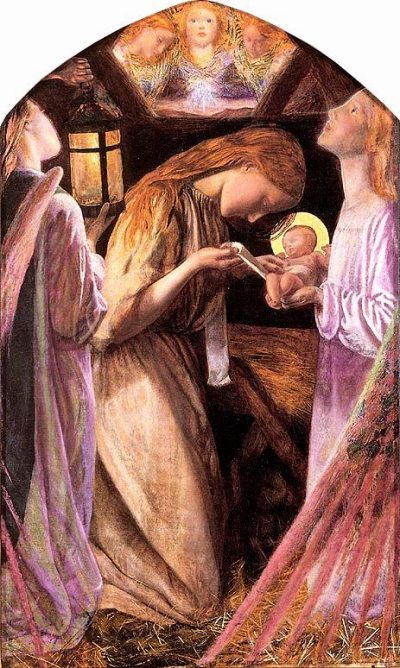
Nativity

The Nativity, Arthur Hughes, 1858

An interesting painting that lacks the religious perspective of Luther’s time with the realistic perspective of 19th century industrial society.  The angels are innocuous, Mary has a sweet face and light complexion, the straw on the floor is trampled and dirty. For Hughes, the birth appears to lack relevance or meaning in a secular world, like ours, that lacks the vigor of spiritual growth.

For Luther, ‘whoever is a Christian must expect to help bear the cross, for God will take him by the scruff of the neck and test him until he is worn out. No one comes to Christ apart from suffering.’ This is how Luther viewed Mary, who at the time of the joy of her child she endured misfortune, pain and anguish.  She gave birth in a stable far away from home, and fled to Egypt, a foreign country.  Her confidence in God was being taken away in the first two years of motherhood as she rationalized God was angry with her and did not want her to be the mother of His son.  This is reality gospel because our faith is more unpredictable with highs and lows and lacking a steady line of monthly incremental growth.


Comments: hbitten@reverendluther.org
 

The Birth of John the Baptist

Was John filled with the Holy Spirit, which is supported by his effective preaching, or will the Holy Spirit first appear in the world when Jesus is baptized by John?

Luke 1: 57-66:  57When Elizabeth’s son was born, 58her neighbors and relatives heard how kind the Lord had been to her, and they too were glad.

59Eight days later they did for the child what the Law of Moses commands.  They were going to name him Zechariah, after his father. 60But Elizabeth said, “No! His name is John.” 61The people argued, “No one in your family has ever been named John.” 62So they motioned to Zechariah to find out what he wanted to name his son.

63Zechariah asked for a writing tablet. Then he wrote, “His name is John.” Everyone was amazed. 64Right away, Zechariah started speaking and praising God.

65All the neighbors were frightened because of what had happened, and everywhere in the hill country people kept talking about these things. 66Everyone who heard about this wondered what this child would grow up to be. They knew that the Lord was with him.

Zechariah's Prophecy

Zechariah’s Prophecy by Rembrandt

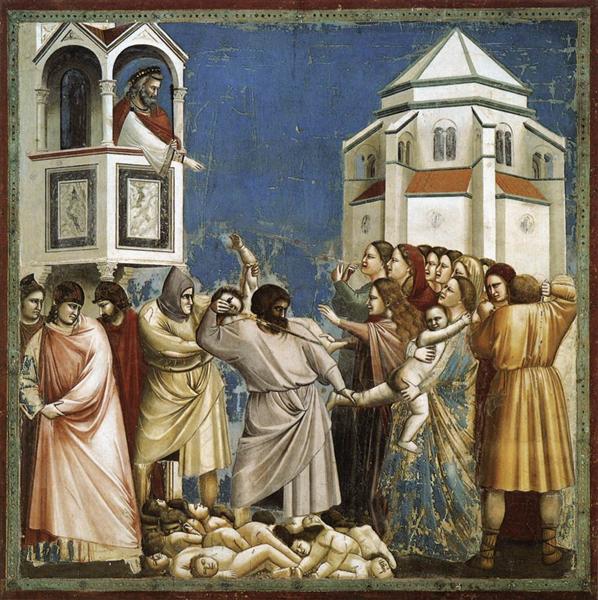
While the Bible does not provide us with details of the early life of John the Baptist, the Muslim Koran and the Apocrypha used by Roman Catholic Christians does. Here we learn that Zechariah and Elizabeth fled to the desert of Judea to protect their son John from the killing of all the male babies by Herod’s soldiers.  During this time Zechariah lied to protect his son, John, during the Massacre of the Innocents.  He was executed and reports are that Elizabeth died forty days later.  The painting below describes his martyred death as extremely cruel with his body parts dismembered.

This would raise a question about how the orphaned young child survived in the desert.  According to Luke 3:2-3 and Matthew 3:1, John developed his belief in the coming of the Son of God baptizing believers in the coming of a Savior.  He will recognize his relative Jesus as the Savior sent from God and baptized him in the Jordan River.

Martin Luther describes John as ‘preparing the way for the Lord,’ so that the people of this time could receive grace and the forgiveness of sins from Jesus, the Son of God. Luther based this on Luke 24:47, Christ’s command to preach repentance and the forgiveness of sins. (Smalcald Articles. Article 3)

John the Baptist’s preaching likely led to the conversion of Andrew, Peter’s brother.  Luther fills in the details omitted in this amazing story in John 1:35-42 by imagining that Andrew (like Peter), had a wife and children and wrestled with all the problems of a family and the responsibilities of supporting a household on an unpredictable income. But Andrew listened to John’s sermons about repentance and was baptized! Although busy and exhausted, Andrew and his family found time for God – as they desired to enter the kingdom of God.  John was an active minister who proclaimed and preached God’s Word, not a passive minister who performed rituals or made sacrifices.

Massacre of the Innocents

The Massacre of the Innocents by Giotto di Bondone with Elizabeth saving her young son, John.(1306)

Comments: hbitten@reverendluther.org
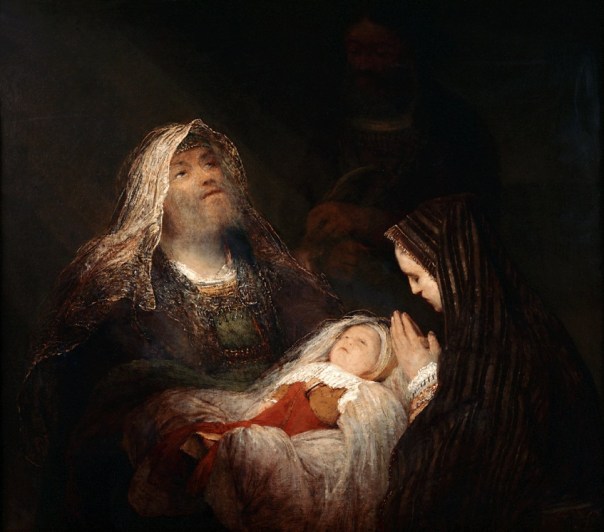


Mary’s Visit with Elizabeth

What motivated Mary to walk 80 miles for days to visit her relative in the hill country of Judah? Why is this story important for us?

Luke 1:11-20:  “Then an angel of the Lord appeared to him, standing at the right side of the altar of incense.  When Zechariah saw him he was startled and gripped with fear.  But the angel said to him: ‘Do not be afraid, Zechariah; your prayer has been heard.  Your wife Elizabeth will bear you a son, and you are to give him the name John.  He will be a joy and delight to you, and many will rejoice because of his birth, for he will be great in the sight of the Lord.  He is never to take wine or other fermented drink, and he will be filled with the Holy Spirit even from birth.  Many of the people of Israel will he bring back to the Lord their God.  And he will go on before the Lord, in the spirit and power of Elijah, to turn the hearts of their fathers to their children and the disobedient to the wisdom of the righteous – to make ready a people prepared for the Lord.’

Zechariah asked the angel, ‘How can I be sure of this?  I am an old man and my wife is well along in years.

The angel answered, ‘I am Gabriel.  I stand in the presence of God, and I have been sent to speak to you and to tell you this good news.  And now you will be silent and not able to speak until the day this happens, because you did not believe my words, which will come true at their proper time.’

Luke 1: 24-25: After this his wife Elizabeth became pregnant and for five months remained in seclusion.  ‘The Lord has done this for me,’ she said. ‘In these days he has shown his favor and taken away my disgrace among the people.’

Luke 1: 39-45: At that time Mary got ready and hurried to a town in the hill country of Judea, where she entered Zechariah’s home and greeted Elizabeth.  When Elizabeth heard Mary’s greeting, the baby leaped in her womb, and Elizabeth was filled with the Holy Spirit.  In a loud voice she exclaimed: ‘Blessed are you among women, and blessed is the child you will bear!  But why am I so favored, that the mother of my Lord should come to me?  As soon as the sound of your greeting reached my ears, the baby in my womb leaped for joy.  Blessed is she who has believed that what the Lord has said to her will be accomplished!’

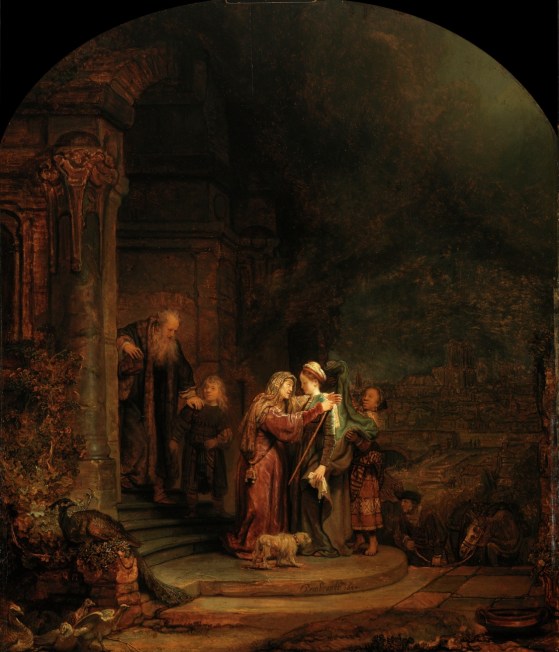
MarysVisit

The Visitation, 1640 by Rembrandt van Rijn

This story is the dramatic and happy reunion of two cousins – the Virgin Mary and her older cousin, Elizabeth, the mother of John the Baptist.  Both women are pregnant because of a miracle.  In the background we see Joseph, the man Mary is engaged to and Zechariah, the husband of Elizabeth who is speechless. We also see two servants and the family pet!

This is one of Rembrandt’s best paintings because of the way he uses light to show the purity and youthful face of Mary.  The light is also said to illustrate Rembrandt’s understanding of the redemption that comes with Jesus Christ! Rembrandt knows how to tell a story by intimately engaging the viewer with a scene in the darkness of the night.

For Luther, Mary in this visit with her cousin is an excellent pattern for praising God in signing her song of thanks (the Magnificent).  Mary expresses thanks through her words and experiences of how to know, love, and praise God despite that she is a teenager, uneducated, and poor.  She follows the words of King David in Psalm 44:7-8, ‘that God’s saints should praise God.’ (Robert Kolb, Luther and the Stories of God, 136)

Luther loved this story because it demonstrates a faithful relationship between human beings. He emphasized Mary’s faithfulness to her family and God in his in his 1532 sermon. In this sermon he describes Mary’s journey to visit her cousin singing the Magnificat along the way while she is walking over rugged terrain and mountainous hills.  He views her making this trip like a faithful servant, heading straight to her destination to help her cousin, Elizabeth.  Without question, the lesson of this story for Luther is one of serving others willingly and humbly, even should one consider themselves are more important or entitled than the person in need. (Robert Kolb, Luther and the Stories of God, 165)

Comments: hbitten@reverendluther.org