Calling of Andrew and Peter

The Calling of the Disciples

How does one become filled with the Holy Spirit?

Matthew 4:18-21: 18 While walking by the Sea of Galilee, he saw two brothers, Simon (who is called Peter) and Andrew his brother, casting a net into the sea, for they were fishermen. 19 And he said to them, “Follow me, and I will make you fishers of men.”[a] 20 Immediately they left their nets and followed him. 21 And going on from there he saw two other brothers, James the son of Zebedee and John his brother, in the boat with Zebedee their father, mending their nets, and he called them. 22 Immediately they left the boat and their father and followed him.

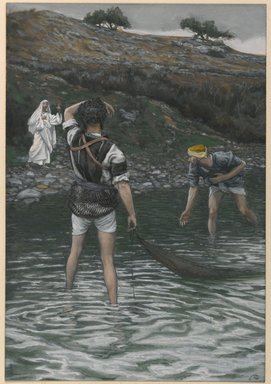
Calling of Simon and Andrew-2The Calling of Simon and Andrew by James Tissot (1886-1894)

James Tissot, a French artist sees Simon Peter and Andrew fishing in shallow water and close enough to the shore to hear the voice of Jesus. Tissot visited the Holy Land in 1880 and observed local fishermen wearing nets around their waste.

Calling of Simon and Andrew

The Calling of Saint Peter and Andrew by Bernardo Struzzo but more recently (2006) verified that this was painted by Caravaggio.

In this painting Caravaggio pictures a youthful Jesus without a beard leading two older brothers. Peter is holding a fish in his right hand and Andrew and Peter still appear confused about what they have just experienced regarding the large number of fish they caught after Jesus directed them to fish in the deeper water.

Martin Luther: In Luther’s sermon on Matthew in 1521, he marks the calling of the disciples as the time for grace to be preached throughout the world. The disciples will minister to people in need, preach to the heathen, forgive sinners, be witnesses that Jesus Christ is the Son of God.

In his sermon on the Monday after Easter in 1525 (Luke 24:13-25), Martin Luther describes the disciples as ignorant fishermen who came to know Jesus Christ through the Holy Spirit.

“‘The apostles likewise, being ignorant fishermen, learned to know the Scriptures, not in the schools of the great scribes, but through the revelation by which Christ led them into the Scriptures. Thus they were enabled to understand and to write on the basis of a single passage a book or a sermon the world cannot understand. And if I had the same Spirit Isaiah or Paul had, I could take this passage and develop from it a New Testament, if that were not already written.

 How did St. Peter know, or where is written in Moses that which he says in 1 Peter 10-11: “Concerning which salvation the prophets sought and searched diligently, who prophesied of the grace that should come unto you, searching what time or what manner of time the Spirit of Christ which was in them did point unto?” Who told him that the Spirit of Christ existed and prophesied of Christ, before there were prophets and, above all, before Christ and the Holy Ghost were present? Are these the words of a fisherman, or of a learned, wise scribe? Nay, it is the revelation of the Holy Spirit who had also revealed it to the prophets before.’”

Comments: hbitten@reverendluther.org


The Parable of the Sower

The Parable of the Sower

How does this story from Jesus support anyone who is overwhelmed by the challenges of daily living and troubles of this world?

 Matthew 13:1-24  That same day Jesus went out of the house and sat by the lake. Such large crowds gathered around him that he got into a boat and sat in it, while all the people stood on the shore. Then he told them many things in parables, saying: “A farmer went out to sow his seed. As he was scattering the seed, some fell along the path, and the birds came and ate it up. Some fell on rocky places, where it did not have much soil. It sprang up quickly, because the soil was shallow. But when the sun came up, the plants were scorched, and they withered because they had no root. Other seed fell among thorns, which grew up and choked the plants. Still other seed fell on good soil, where it produced a crop—a hundred, sixty or thirty times what was sown. Whoever has ears, let them hear.”

10 The disciples came to him and asked, “Why do you speak to the people in parables?”

11 He replied, “Because the knowledge of the secrets of the kingdom of heaven has been given to you, but not to them. 12 Whoever has will be given more, and they will have an abundance. Whoever does not have, even what they have will be taken from them. 13 This is why I speak to them in parables:

“Though seeing, they do not see; though hearing, they do not hear or understand.

14 In them is fulfilled the prophecy of Isaiah:

“‘You will be ever hearing but never understanding; you will be ever seeing but never perceiving. 15 For this people’s heart has become calloused; they hardly hear with their ears, and they have closed their eyes. Otherwise they might see with their eyes, hear with their ears, understand with their hearts and turn, and I would heal them.’

16 But blessed are your eyes because they see, and your ears because they hear. 17 For truly I tell you, many prophets and righteous people longed to see what you see but did not see it, and to hear what you hear but did not hear it.

18 “Listen then to what the parable of the sower means: 19 When anyone hears the message about the kingdom and does not understand it, the evil one comes and snatches away what was sown in their heart. This is the seed sown along the path. 20 The seed falling on rocky ground refers to someone who hears the word and at once receives it with joy. 21 But since they have no root, they last only a short time. When trouble or persecution comes because of the word, they quickly fall away. 22 The seed falling among the thorns refers to someone who hears the word, but the worries of this life and the deceitfulness of wealth choke the word, making it unfruitful. 23 But the seed falling on good soil refers to someone who hears the word and understands it. This is the one who produces a crop, yielding a hundred, sixty or thirty times what was sown.”
 Sower-VanGogh

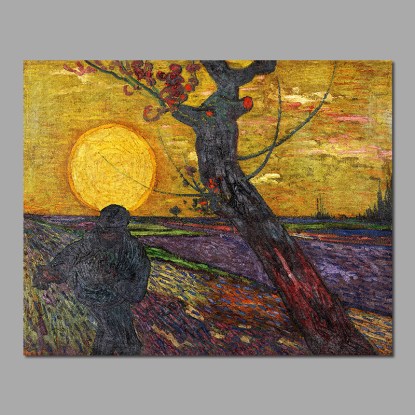
Sower with Setting Sun, Vincent Van Gogh (1888)

 Sower with Setting Sun is a personal and introspective work for Vincent Van Gogh. He saw in the painting, Sower, by another French artist, Jean Francois Millet, the story of Christ’s parable in Matthew 13. Van Gogh understood this parable as the presence of Jesus Christ in a troubled world. Van Gogh studied theology and regarded his art as a form of ministry for connecting people with Jesus Christ. He hoped that his paintings would give hope to the people who are living in spiritually and socially infertile soil. Instead of seeing things in the two dimensions of a painting, Van Gogh believed that God gives us the capacity to understand the infinite dimensions or perspective of living a spiritual world.

Although many who read this story are familiar with it, Van Gogh allows us to engage in his work of art with both our eyes (visual literacy) and heart (spiritual literacy). When we do this, the painting and the words of Christ’s parable have the capacity for changing our life! We see the humble sower on the left whose work is blessed by the sun and the growing tree on the right. The tree represents life, and Van Gogh gives us this tree as an image of Christ’s resurrection and the life changing power of faith! Note the Word of God in John 12: “I tell you the truth, unless a kernel of wheat falls to the ground and dies, it remains only a single seed. But if it dies, it produces many seeds. The man who loves his life will lose it, while the man who hates his life in this world will keep it for eternal life.”

Martin Luther preached a sermon on this parable in 1525 at the height of the violence in the Peasants War:  “The Savior himself explained this parable in the same chapter upon the request of his disciples and says: He that soweth the good seed is the Son of man; and the field is the world; and the good seed, these are the children of the kingdom; and the tares are the sons of the evil one; and the enemy that sowed them is the devil; and the harvest is the end of the world; and the reapers are the angels. These seven points of explanation comprehend and clearly set forth what Christ meant by this parable. But who could have discovered such an interpretation, seeing that in this parable He calls people the seed and the world the field; although in the parable preceding this one he defines the seed to be the Word of God and the field the people or the hearts of the people. If Christ Himself had not here interpreted this parable everyone would have imitated his explanation of the preceding parable and considered the seed to be the Word of God, and thus the Savior’s object and understanding of it would have been lost….  Today’s Gospel also teaches by this parable that our free will amounts to nothing, since the good seed is sowed only by Christ, and Satan can sow nothing but evil Seed; as we also see that the field of itself yields nothing but tares, which the cattle eat, although the field receives them and they make the field green as if they were wheat. In the same way the false Christians among the true Christians are of no use but to feed the world and be food for Satan, and they are so beautifully green and hypocritical, as if they alone were the saints, and hold the place in Christendom as if they were lords there, and the government and highest places belonged to them; and for no other reason than that they glory that they are Christians and are   among Christians in the church of Christ, although they see and confess that they live unchristian lives.      In that the Savior pictures here also Satan scattering his seed while the people sleep and no one sees who did it, he shows how Satan adorns and disguises himself so that he cannot be taken for Satan. As we experienced when Christianity was planted in the world Satan thrust into its midst false teachers. People securely think here God is enthroned without a rival and Satan is a thousand miles away, and no one sees anything except how they parade the Word, name and work of God. That course proves beautifully effective. But when the wheat springs up, then we see the tares, that is, if we are conscientious with God’s Word and teach faith, we see that it brings forth fruit, then they go about and antagonize it, and wish to be masters of the field and fear lest only wheat grows in the field, and their interests be overlooked.” 

Thanks to Dr. James Romaine, Associate Professor of Art History at Nyack College and cofounder of the Association of Scholars of Christianity in the History of Art, www.christianityhistoryart.org for his contribution to the research of this blog.

Comments: hbitten@reverendluther.org
Baptism of Jesus

The Baptism of Jesus

If baptism is important why is it not stated in the Apostles’ or Nicene Creed?

 Mark 1:4-11: And so John the Baptist appeared in the wilderness, preaching a baptism of repentance for the forgiveness of sins. The whole Judean countryside and all the people of Jerusalem went out to him. Confessing their sins, they were baptized by him in the Jordan River. John wore clothing made of camel’s hair, with a leather belt around his waist, and he ate locusts and wild honey. And this was his message: “After me comes the one more powerful than I, the straps of whose sandals I am not worthy to stoop down and untie. I baptize you with water, but he will baptize you with the Holy Spirit.”

At that time Jesus came from Nazareth in Galilee and was baptized by John in the Jordan. 10 Just as Jesus was coming up out of the water, he saw heaven being torn open and the Spirit descending on him like a dove. 11 And a voice came from heaven: “You are my Son, whom I love; with you I am well pleased.”

The_Baptism_of_Christ_(Verrocchio_&_Leonardo)[1]

The Baptism of Christ by Andrea del Verrocchio (1472)

Andrea del Verrocchio was the master teacher of Leonardo da Vinci. Leonardo, at the age of 23, painted the kneeling angels. Several students contributed to this famous work of art including Botticelli and Credi. Leonardo’s angels bring life and spirit to the kickoff of the ministry of Jesus Christ with his baptism. What a powerful confession of faith for everyone involved in creating this masterpiece!

Luther: Luther in his sermon on January 6, 1534 preached:At the Jordan, in his thirtieth year, Christ reveals himself fully for the first time. John is shocked by his desire to be baptized and says, “Shall I baptize you? I am not worthy.” But Jesus responds, “Be content; this is the way it should be.” The Son, who is without sin, allows himself to be baptized for our example and our comfort. He does something here that is not required of him, whereas we do nothing that is not required of us. More, we do what is evil. How will we ever get to the point of doing something not required? Christ is holier even than baptism, yet still allows Himself to be baptized. Thereby he institutes baptism. So those accursed people who despise or ridicule baptism are banished to the depths of hell. May God blight them and blind them, since they don’t have the ears and eyes to see what is going on here. Although they do not choose baptism, God’s Son does! Are we so arrogant that we should despise baptism? Even if it offered us nothing at all, we should honor baptism simply for Christ’s name’s sake, and be baptized to honor him. But [something is offered]: God in heaven poured himself out when Christ was baptized.

John indeed saw that the heavens were opened. That was a sign that our Lord God holds baptism dear—baptism that was sanctified by the Son of God himself in his own body. The heavens, previously closed, are now opened, becoming a clear gateway and window for us to see into heaven itself. There is no longer a dividing line between God and us, for he has descended into the [baptismal] water. Isn’t this a great revelation? That is why we call [this festival] Epiphany, because God—Father, Son, and Holy Spirit—has revealed himself with all his angels.The Holy Spirit comes like an innocent dove. Among all birds, the dove is known for its kind heart and lack of anger. Thus, the Holy Spirit presents itself in this friendly form. Here [too] there is no anger. The Son of God, who did not need [to be baptized], reveals himself to us not only as example but also as grace itself. The Father makes himself heard in the voice: “This is my Son, the Beloved, with whom I am well pleased.”

It would not be surprising if the heavens and the earth shook before this voice, the speaking of our Lord God himself. If our Lord God spoke, I would fall on my face. But, for all that, the voice comes with nothing but kindness, grace, and mercy, saying, “There you have it: One who has been baptized!” So, do you want to know who [our God] is? He does not come with a sword, or with the noisy clamor of Sinai; he comes with nothing but the images and appearance of friendship. The Son is an innocent man who does more than is required of him; the Holy Spirit comes in a friendly form; the Father has a friendly voice: “I am not sending you prophets or apostles or angels; instead you have my Son, with whom I am completely pleased.”

Comments: hbitten@reverendluther.org

Hymn Parade – Awesome God

Awesome God – Rich Mullins and Michael W. Smith (1988)

How great is our God?

 Nehemiah 1:5-7: Then I said: “Lord, the God of heaven, the great and awesome God, who keeps his covenant of love with those who love him and keep his commandments, let your ear be attentive and your eyes open to hear the prayer your servant is praying before you day and night for your servants, the people of Israel. I confess the sins we Israelites, including myself and my father’s family, have committed against you. We have acted very wickedly toward you. We have not obeyed the commands, decrees and laws you gave your servant Moses.”

Awesome God

When He rolls up His sleeves/He ain’t just putting on the ritz There’s thunder in His footsteps/And lightning in His fists The Lord wasn’t joking/When He kicked ’em out of Eden It wasn’t for no reason/That He shed His blood His return is very close/And so you better be believing that Our God is an awesome God/Our God is an awesome God
He reigns from heaven above/With wisdom, power, and love Our God is an awesome God/And when the sky was starless In the void of the night/(God is an awesome God) He spoke into the darkness/And created the light/(God is an awesome God) Judgment and wrath He poured out on Sodom/Mercy and grace He gave us at the cross

I hope that we have not/Too quickly forgotten that Our God is an awesome God

Video: https://www.youtube.com/watch?v=38V8jnN1Kpw

Awesome God

Martin Luther said: “Pray as if everything depends on God, then work as if everything depends on you.” Nehemiah (445 B.C.E.) prayed both day and night for the sinful actions and complacency of the people of Israel. Nehemiah was the cupbearer to the king and his main job was to taste the king’s wine first to make sure it was not poisoned. It was a dangerous job! It also gave him intimate access to royalty, political standing and a place to live in the palace. Based on the reports Nehemiah heard in the palace he was concerned about what was happening to his countrymen in Jerusalem.

The report was that the survivors were in great trouble and disgrace, that the wall of Jerusalem was in shambles and that its gates had been burned with fire.  They were living in ruins and they accepted it. Nehemiah understood that before you can ask God to rebuild, you must first become concerned about the problem. First, he admits admit his sin and then the sins of his people. Nehemiah boldly and persistently asks God to hear his prayer and confession of sin. He cries, fasts, and persists in prayer. Nehemiah knows that the captivity was due to the disobedience of the people but that God had promised He would bring them back to Jerusalem. Nehemiah is willing and ready to get involved! He asked God to use him at risk to his well-being and life.

Our God is an Awesome God because He loves us when we are in ruins, lost, anxious, helpless. Everyone experiences difficult times and unhappiness but the power of this praise hymn is that God is all-powerful, all-loving, and always ready to help us. As Nehemiah prayed to rebuild Jerusalem, we pray to rebuild our lives or the life of someone in need of help. Just turn to Jesus in prayer, pray boldly and pray consistently! ‘He gave us grace on the cross!”

Comments: hbitten@reverendluther.org


Hymn Parade – How Great Thou Art

How Great Thou Art – Carl Gustav Boberg (1885, Sweden)

Did Carl Boberg write the words to this hymn during a time when he felt blessed or during a time of trial and anxiety?

 O Lord my God, When I in awesome wonder / Consider all the worlds Thy Hands have made / I see the stars, I hear the rolling thunder / Thy power throughout the universe displayed.

https://www.youtube.com/watch?v=q2T1csHUgF4

1 Chronicles 29:10-13 (David’s Prayer)   10 David praised the Lord in the presence of the whole assembly, saying, “Praise be to you, Lord, the God of our father Israel, from everlasting to everlasting. 11 Yours, Lord, is the greatness and the power and the glory and the majesty and the splendor, for everything in heaven and earth is yours. Yours, Lord, is the kingdom; you are exalted as head over all.

12 Wealth and honor come from you; you are the ruler of all things. In your hands are strength and power to exalt and give strength to all.

13 Now, our God, we give you thanks, and praise your glorious name.

elvis-how-great-thou-art

Carl Boberg was a sailor and left his job to become a lay-minister in the Lutheran Church of Sweden. In 1885, after hearing the sound of church bells ringing during either a thunderstorm or funeral service, he wrote the words to “O Great God”.

At first, his nine-verse poem was not very popular. In 1890, someone published his poem in the paper with a Swedish melody. During the Great Depression decade of the 1930s, Stuart Hine, an English missionary, heard the song in Russian while in Poland and brought it back with him to England. In the 1950s the hymn became very popular through the Billy Graham crusades and has continued as one of the top five most popular hymns in the world.

“Martin Luther saw prayer as crucial to human life, a life created by the relationship to God. In this relationship God starts a conversation, communicating God’s words of law and promise. Prayer is a part of the human response to God’s speaking, a response itself shaped by the words of command and promise. Luther thought that God’s promise to hear prayer defines both the nature of God and the nature of the human relationship to God, as well as the human approach to life. Luther’s comments and instructions on prayer permeated his work. Luther sought to build an evangelical prayer practice that reflected the key insights of his theology: just as God redeems the unworthy human, so God promises to hear and respond to the one praying, despite his or her unworthiness. Humans respond to God’s actions in law and promise when they pray regularly, forthrightly, honestly, and frequently. Freedom in Christ sets humans free to use prayer practices that help them to do this.” (Mary Jane Haemig)

http://religion.oxfordre.com/view/10.1093/acrefore/9780199340378.001.0001/acrefore-9780199340378-e-358

Comments: hbitten@reverendluther.org

Hymn Parade – Great is Thy Faithfulness

Great is Thy Faithfulness by Thomas Chisholm (1923)

How many situations in life have challenged your faith in God?

Great is Thy faithfulness O God my Father / There is no shadow of turning with Thee / Thou changest not, Thy compassions, they fail not / As Thou hast been Thou forever wilt be. https://www.youtube.com/watch?v=dTKIqmdfHSk

Lamentations 3:22:23: “The steadfast love of the Lord never ceases, his mercies never come to an end; they are new every morning; great is your faithfulness.”

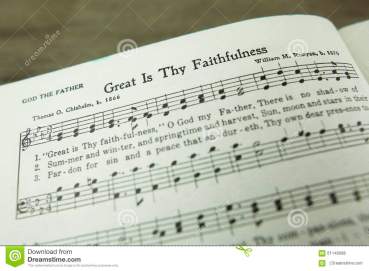
great-thy-faithfulness-christian-worship-hymn-thomas-chisholm-classic-extolling-god-s-faithful-dealings-his-people-61146998

Thomas Chisholm was born in Franklin, Kentucky in 1866. He was educated in a small country schoolhouse and at age 16 began teaching at the same school. He became a Christian at age 27, and with no college or seminary training was ordained a Methodist minister at age 36. Within a year of his ordination he became ill, left the ministry and moved to Vineland, NJ. Although he had many health issues and a limited income, his faith in God’s promises was strong throughout his life. He also lived until age 94 and died in Ocean Grove, NJ in 1960.

His friend, William Runyan wrote the tune for this popular hymn. The hymn became popular with the Billy Graham crusade and is one of the most popular hymns in England.

Martin Luther wrote the following about faith in his introduction to Romans in his translation of the New Testament in 1522: “Faith is not what some people think it is. Their human dream is a delusion. Because they observe that faith is not followed by good works or a better life, they fall into error, even though they speak and hear much about faith. “Faith is not enough,” they say, “You must do good works, you must be pious to be saved.” They think that, when you hear the gospel, you start working, creating by your own strength a thankful heart which says, “I believe.” That is what they think true faith is. But, because this is a human idea, a dream, the heart never learns anything from it, so it does nothing and reform doesn’t come from this `faith,’ either.

Instead, faith is God’s work in us, that changes us and gives new birth from God. (John 1:13). It kills the Old Adam and makes us completely different people. It changes our hearts, our spirits, our thoughts and all our powers. It brings the Holy Spirit with it. Yes, it is a living, creative, active and powerful thing, this faith. Faith cannot help doing good works constantly. It doesn’t stop to ask if good works ought to be done, but before anyone asks, it already has done them and continues to do them without ceasing. Anyone who does not do good works in this manner is an unbeliever. He stumbles around and looks for faith and good works, even though he does not know what faith or good works are. Yet he gossips and chatters about faith and good works with many words.

Faith is a living, bold trust in God’s grace, so certain of God’s favor that it would risk death a thousand times trusting in it. Such confidence and knowledge of God’s grace makes you happy, joyful and bold in your relationship to God and all creatures. The Holy Spirit makes this happen through faith. Because of it, you freely, willingly and joyfully do good to everyone, serve everyone, suffer all kinds of things, love and praise the God who has shown you such grace. Thus, it is just as impossible to separate faith and works as it is to separate heat and light from fire! Therefore, watch out for your own false ideas and guard against good-for-nothing gossips, who think they’re smart enough to define faith and works, but really are the greatest of fools. Ask God to work faith in you, or you will remain forever without faith, no matter what you wish, say or can do.”

Comments: hbitten@reverendluther.org