Hymn Parade – Silent Night – 199th anniversary in 2017

Hymn Parade – Silent Night by Rev. Joseph Mohr and Franz Gruber (1818)

How does this song inspire your faith in the real news that Jesus Christ lived with us here on earth?

Video: https://vimeo.com/151626980

Video: https://www.youtube.com/watch?v=hbm8IQ_G_-c (Guitar version from St. Nicholas’ Church in Obendorf)

Silent night! holy night! All is calm, all is bright, ‘Round yon virgin mother and Child! Holy Infant, so tender and mild, Sleep in heavenly peace, Sleep in heavenly peace. 

Stille Nacht, heilige Nacht! Alles schläft, einsam wacht nur das traute hochheilige Paar, Holder Knabe mit lockigem Haar, schlaf im himmlischer Ruh. 

This is the 199th anniversary year of the hymn Silent Night, which UNESCO declared as a global cultural icon in 2011. It is the world’s most popular Christmas song and proclaims the historic birth of Jesus Christ. The hymn was first sung in St. Nicholas’ Roman Catholic Church in Oberndorf, a village near Salzburg, Austria in 1818. A group of actors presented a play about the Christmas story in a small home because the organ in the church was not functional.

Silent night, holy night! All are asleep; alone awake only the faithful and most holy pair, Gentle boy with curly hair, sleep in heavenly peace.  (The original poem)

The young priest, Josef Mohr asked Franz Gruber, the organist at St. Nicholas to write a melody and to include the song as part of the Christmas Eve worship. Since the church organ was broken, the song was sung with a guitar. Austria and Europe were rebuilding three years after the defeat of Napoleon in 1815.

It was sometime in January when the organ was repaired by Karl Mauracher that Franz Gruber played the simple melody to test the repairs on the organ. Karl Mauracher took a copy of the music with him and shared it with another family singing group, the Strasser sisters. The hymn did not go viral until 1840 when it was performed for King William IV of Prussia in Berlin. In 1839, the hymn was sung (in German) outside Trinity Church in New York City at the gravesite of Alexander Hamilton. In 1863, the same year that President Lincoln proclaimed Thanksgiving a national holiday following the battle of Gettysburg, Silent Night was translated to English. Today it has been translated into over 300 languages!
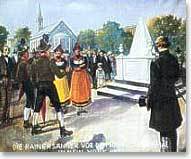
rainer     Silent Night at the gravesite of Alexander Hamilton at Trinity Church, NYC

From the Introduction in the sermon Martin Luther preached on the afternoon of December 25, 1530:

“You have heard today the story from the Gospel of St. Luke of how it came to pass that our Lord Christ was born and then also the message of the angel, who announced who the boy was who was born. Now we shall go on and take up the message of the angel. So for today you have heard only that the child was born that he is the Lord and Savior. Thus we spoke of the story, how it unfolded, and who the persons in it were. This article is so high that even today it is believed by only a few. Nevertheless, God has preserved it even through those who have not believed it. For at all times in the monasteries and lectures which dealt with the fact that Christ the Lord, born of Mary, is true man and God. But it went no further than saying and hearing it. But this belief is held by the devil too and Turks and all the godless among the Christians, and is the kind of belief which everybody believes that it is true but would not die for it, as Eck and many others show today. If they had as much from Christ and the teaching of the gospel as from the devil, they would also think as much of Christ. The Turk too admits that Christ was born of the Virgin Mary, that Mary was an immaculate virgin, and that Christ was more than a man; but the Word of God, as it is given in the gospel, he denies, and yet I fear that the Turk believes more of this article than does the pope. Therefore it is a high article to believe that this infant, born of Mary, is true God; for nobody’s reason can ever accept the fact that he who created heaven and earth and is adored by the angels was born of a virgin. That is the article. Nobody believes it except he who also knows this faith, namely, that this child is the Lord and Savior.

But for whom was he born and whose Lord and Savior is he? The angels declare that he was born Lord and Savior. The Turks, the pope, and the scholars say the same thing, but only to the extent that it brings in money and honor. But that anyone could say “to you is born,” as the angel says, this is the faith which we must preach about. But we cannot preach about it as we would like to do.

Indeed, who could ever grasp (the full meaning of) these words of the evangelist: “a Savior, who is the Lord,” and, “to you”! I know well enough how to talk about it and what to believe about it, just as others do. So there are many who have this belief and do not doubt this first belief that Christ is the Lord, the Savior, and the virgin’s Son. This I too have never doubted. But if these words are planted no higher than in my thoughts, then they have no firm roots. We are certain that this was proclaimed by the angel, but the firm faith does not follow. For the reason does not understand both sides of this faith, first that Christ is a man, but also the Savior and Lord or King. This needs to be revealed from heaven. One who really has the first faith also has the other.

Who, then, are those to whom this joyful news is to be proclaimed? Those who are faint-hearted and feel the burden of their sins, like the shepherds, to whom the angels proclaim the message, letting the great lords in Jerusalem, who do not accept it go on sleeping. Beyond the first faith there must be the second faith, that Christ is not only the virgin’s Son, but also the Lord of angels and the Savior of men. The words anyone can understand, anti-sacramentarians, fanatics, sectarians, and Turks; but they do not proceed from the heart, they come only from hearing and go no farther than hearing. This is not faith, however, but only a memory of what has been heard, that one knows that he has heard it. Nobody ventures it, so as to stake goods, life, and honor upon it. And yet we must preach it for the sake of those who are in the multitude to whom the angel preached.

This is our theology, which we preach in order that we may understand what the angel wants. Mary bore the child, took it to her breast and nursed it, and the Father in heaven has his Son, lying in the manger and the mother’s lap. Why did God do all this? Why does Mary guard the child as a mother should? And reason answers: in order that we may make an idol of her, that honor may be paid to the mother. Mary becomes all this without her knowledge and consent, and all the songs and glory and honor are addressed to the mother. And yet the text does not sound forth the honor of the mother, for the angel says, “I bring to you good news of great joy; for to you is born this day the Savior” (Luke 2:10,11). I am to accept the child and his birth and forget the mother, as far as this is possible, although her part cannot be forgotten, for where there is a birth there must also be a mother. Nevertheless, we dare not put our faith in the mother but only in the fact that the child was born. And the angel desired that we should see nothing but the child which is born, just as the angels themselves, as though they were blind, which is born, just as the angels themselves, as though they were blind, saw nothing but the child born of the virgin, and desired that all created things should be as nothing compared with this child, that we should see nothing, be it harps, gold, goods, honor, power, and the like, which we would prefer before their message.

For if I receive even the costliest and best in the world, it still does not have the name of Savior. And if the Turk were ten times stronger than he is, he could not for one moment save me from my infirmity, to say nothing of the peril of death, and even less from the smallest sin or from death itself. In my sin, my death, I must take leave of all created things. No, sun, moon, stars, all creatures, physicians, emperors, kings, wise men and potentates cannot help me. When I die I shall see nothing but black darkness, and yet that light, “To you is born this day the Savior” (Luke 2:11), remains in my eyes and fills all heaven and earth. The Savior will help me when all have forsaken me. And when the heavens and the stars and all creatures stare at me with horrible mien, I see nothing in heaven and earth but this child. So great should that light which declares that He is my Savior become in my eyes….”

(From the Conclusion) “What we have said, then, has been about that second faith, which is not only to believe in Mary’s Son, but rather that he who lies in the virgin’s lap is our Savior, that you accept this and give thanks to God, who so loved you that he gave you a Savior who is yours. And for a sign he sent the angel from heaven to proclaim him, in order that nothing else should be preached except that this child is the Savior and far better than heaven and earth. Him, therefore, we should acknowledge and accept confess him as our Savior in every need, call upon him, and never doubt that he will save us from all misfortune. Amen.”

Comments: hbitten@reverendluther.org

Jesus Heals Ten Lepers

Healing the Ten Lepers

Why did Jesus heal these lepers and how does He heal us?

Luke 17:11-18: 11 Now on his way to Jerusalem, Jesus traveled along the border between Samaria and Galilee. 12 As he was going into a village, ten men who had leprosy met him. They stood at a distance 13 and called out in a loud voice, “Jesus, Master, have pity on us!”

14 When he saw them, he said, “Go, show yourselves to the priests.” And as they went, they were cleansed.

15 One of them, when he saw he was healed, came back, praising God in a loud voice. 16 He threw himself at Jesus’ feet and thanked him—and he was a Samaritan.

17 Jesus asked, “Were not all ten cleansed? Where are the other nine? 18 Has no one returned to give praise to God except this foreigner?”

Brooklyn_Museum_-_The_Healing_of_Ten_Lepers_(Guérison_de_dix_lépreux)_-_James_Tissot_-_overallThe Healing of the Ten Lepers by James Tissot (1896) Brooklyn Museum

The watercolor of James Tissot may have taken him ten years to complete. He captures the unworthiness of the lepers and the response of love and mercy by Jesus Christ who hears their cry from the road He was walking along. In 1521 on the 14th Sunday after Trinity Sunday (September) Luther uses the example of the healing of the ten lepers to emphasize how Jesus called them to faith without any conditions and with the example of the leper from Samaria to show how our faith motivates us to show the love and mercy of God in the way we live.

Luther: “These lepers here prove this clearly, who hope for the grace of Christ without the least merit. What good had they ever done to Him before? They had never seen Him, how then could they have served Him? Besides they were lepers, whom he could justly have avoided according to the law, Leviticus 13:1, and kept Himself free from them as was just and right.

For in reality and truth there was unworthiness, and reason why He should have nothing to do with them nor they with Him. For this cause they also stand far off, like those who well knew their unworthiness.

Thus faith also stands far from God, and yet it goes to meet Him and cries out, for it knows itself in the reality of truth to be unworthy of His goodness, and has nothing on which to depend, except His highly renowned and loudly praised goodness. And such a soul also seeks Christ’s favor, while it stands far off and is empty; for it cannot in the least tolerate in its company our merit and work, and comes freely like Christ into this village to the lepers, in order that its praise may be free and pure.

Observe how everything agrees perfectly that God’s love gives its favor freely, does not take nor seek anything for it, and how faith also receives quite freely and pays nothing for it, and thus the rich and the poor meet together, as the Psalms say, To this their words also testify when they say: Have mercy on us! He who seeks mercy of course neither buys nor sells anything, but seeks pure grace and mercy, as one unworthy of it, and evidently having greatly deserved the contrary.

Behold, here is a good, real, living and true example of Christian faith, that sufficiently teaches us how we must be disposed if we would find grace, piety and salvation. Now, in addition to this doctrine follows the incentive or inducement to faith, that we should gladly believe as we are at present taught to believe. This incentive, however, consists in that we observe how such faith never fails, that as it believes so it comes to pass, and that it is certainly heard and answered. For Luke describes how graciously and willingly Christ beheld and heard the lepers, and says:

“And when he saw them, he said unto them, Go and show yourselves unto the priests.”

How very friendly and lovingly the Lord invites all hearts to Himself in this example, and stirs them to believe in Him! For there is no doubt that he desires to do for all what He here does for these lepers, if we only freely surrender ourselves to Him for all His favor and grace. Just as true faith and a Christian heart should do and delight to do; so these lepers also do and teach us to do. For how earnestly the Lord desires that we should joyfully and freely venture to build on His favor before we experience or feel it, He has here sufficiently testified that He hears them willingly, without any hesitation, that He does not first say He will do it, but as though it were already done, he did as they wished.

For He does not say: Yes, I will have mercy on you, ye shall be cleansed; but merely: “Go and show yourselves unto the priests.” As though He would say: There is no use of asking, your faith has already acquired and obtained it, before you began to ask; you were already cleansed in my sight when you began to expect such things of me; it is no longer necessary, only go and show your purity to the priests; as I consider you and as you believe, so you are and shall be. For He would not have sent them to the priests, if He had not considered them clean, and so wished to deal thus with them, as those who had become cleansed.

Now we must also examine the other part of this example of the nature of Christianity, love. The lepers have instructed us how to believe; Christ teaches us to love. Love does to our neighbor as it sees Christ has done to us, as he says in John 13:15: “For I have given you an example, that ye also should do as I have done to you.” And immediately afterwards He says in verse 34: “A new commandment I give unto you, that ye love one another; even as I have loved you, that ye also love one another. By this shall all men know that ye are my disciples, if ye have love one to another.”

What else does this mean than to say: Through me in faith you now have everything that I am and have: I am your own, you are now rich and satisfied through me; for all I do and love I do and love not for my but only for your sake, and I only think how to be useful and helpful to you, and accomplish whatever you need and should have. Therefore consider this example, to do to each other as I have done to you, and only consider how to be useful to your neighbor, and do what is useful and necessary for him. Your faith has enough in my love and grace; so your love shall also give enough to others.”

Comments: hbitten@reverendluther.org


Hymn Parade – Jesus Loves Me

Jesus Loves Me – Anna Bartlett Warner 1862

Why is this short and simple hymn timeless and popular with every culture?

Jesus loves me—this I know, For the Bible tells me so; Little ones to him belong,—They are weak, but he is strong.

Jesus loves me—loves me still, Though I’m very weak and ill; From his shining throne on high, Comes to watch me where I lie.

Jesus loves me—he will stay, Close beside me all the way. Then his little child will take, Up to heaven for his dear sake.

Hymn by William Batchelder Bradbury

Jesus loves me—this I know, For the Bible tells me so; Little ones to Him belong—They are weak, but He is strong.

Refrain: Yes, Jesus loves me! Yes, Jesus loves me! Yes, Jesus loves me! The Bible tells me so.

Jesus loves me—He who died, Heaven’s gate to open wide; He will wash away my sin, Let His little child come in. Jesus loves me—loves me still, Though I’m very weak and ill;

From His shining throne on high, Comes to watch me where I lie. Jesus loves me—He will stay, Close beside me all the way, Then His little child will take, Up to Heaven for His dear sake.

Video: https://www.youtube.com/watch?v=-jABcYKhDrI

Psalm 19: 7, 8     The law of the Lord is perfect, refreshing the soul. The statutes of the Lord are trustworthy making wise the simple. The precepts of the Lord are right, giving joy to the heart. The commands of the Lord are radiant, giving light to the eyes.

The song Jesus Loves Me is timeless. Parents sing this hymn to their children at nap and bedtime, and it has probably been sung in every country since it was published in 1862. The history of the song is about 25 miles from where I live but its history touches all of us.

800px-Warner_House,_Constitution_Island_31_July_2010

The Warner House

Anna and Susan Warner lived on Constitution Island in the Hudson River and many cadets from West Point Military Academy came by rowboat to their cottage to attend their Sunday School classes. (Sunday Schools date back to Brooklyn in 1816 and Rally Day parades began in 1829.)As a result of the economic crisis in 1857, the sisters began to write novels to supplement the family’s income. Anna wrote the verses to Jesus Loves Me as part of the novel about a young boy who was dying with no chance for recovery. In 1862, when a William Bradbury read their novel, Say and Seal, he added the refrain and composed the melody. Bradbury’s company also provided the pianos for the White House, beginning in 1857.

Say and Seal


The novel and short hymn became popular in both the north and south during the American Civil War. It was preached in pulpits and sung at funerals. The simplicity of the poem made it easy to memorize. Although the novel, Say and seal was a national best seller in 1860, few have heard of it today. However, the simplistic poem, Jesus Loves Me, is known by almost everyone and two million copies were sold in 1862.

OLYMPUS DIGITAL CAMERA

Psalm 19 reveals to us the love of God! Martin Luther said, “The Bible is alive, it speaks to me. It has feet, it runs after me. It has hands, it lays hold of me.”

The central question in religion is how do we know that God is real or how and where has he revealed Himself to us? The hymn, Jesus Loves Me, answers this essential question emphatically!

Comments: hbitten@reverendluther.org

Constitution Island

Constitution Island in the Hudson River looking towards West Point Military Academy. During the American Revolution, a chain was laid across the river in 1778 to prevent the British ships from advancing north from New York City.

The Good Samaritan

Does this story from Jesus relate to the way we think about refugees or people looking for a safer place to live?

Luke 10:25-37   25 On one occasion an expert in the law stood up to test Jesus. “Teacher,” he asked, “what must I do to inherit eternal life?”

26 “What is written in the Law?” he replied. “How do you read it?”

27 He answered, “‘Love the Lord your God with all your heart and with all your soul and with all your strength and with all your mind’; and, ‘Love your neighbor as yourself.’”

28 “You have answered correctly,” Jesus replied. “Do this and you will live.”

29 But he wanted to justify himself, so he asked Jesus, “And who is my neighbor?”

30 In reply Jesus said: “A man was going down from Jerusalem to Jericho, when he was attacked by robbers. They stripped him of his clothes, beat him and went away, leaving him half dead. 31 A priest happened to be going down the same road, and when he saw the man, he passed by on the other side. 32 So too, a Levite, when he came to the place and saw him, passed by on the other side. 33 But a Samaritan, as he traveled, came where the man was; and when he saw him, he took pity on him. 34 He went to him and bandaged his wounds, pouring on oil and wine. Then he put the man on his own donkey, brought him to an inn and took care of him. 35 The next day he took out two denarii and gave them to the innkeeper. ‘Look after him,’ he said, ‘and when I return, I will reimburse you for any extra expense you may have.’

36 “Which of these three do you think was a neighbor to the man who fell into the hands of robbers?”

37 The expert in the law replied, “The one who had mercy on him.”

Jesus told him, “Go and do likewise.” (one denarii should be considered as a day’s wage)

the-good-samaritan-after-delacroix-1890

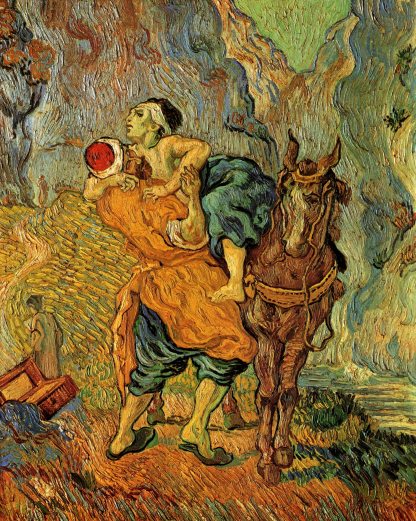
The Good Samaritan by Vincent Van Gogh (1890)

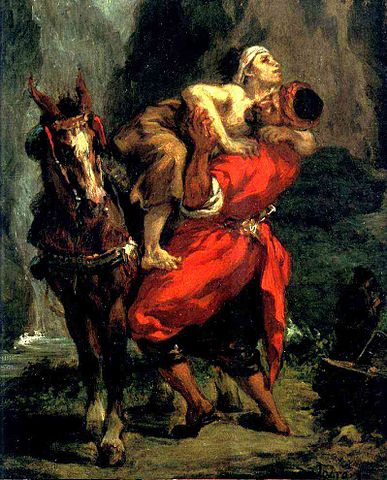
Van Gogh painted this while staying in an institution for the mentally ill. It is a mirror copy of an earlier painting by Eugene Delacroix in 1849. When we compare Van Gogh’s painting with the earlier one by Delacroix we observe an obvious difference in the use of light.

The man from Samaria pushes the robbed man onto his horse. In the background to the left, two men can be seen who let the wounded man lay on the road when they passed him by. They were a priest and a man from the house of Levi. This is a deliberate choice by both men and Van Gogh pictures them as lifeless as they walk away lost in their own world of self-interest. Only the Samaritan, (a non-Jewish person or foreigner) helped the wounded man.

As you look to the left of the painting there is an open box with a garment next to it.  Our eye returns frequently to this open box and the painting the eye returns over and over again to this open box and to the blue garment that is next to it. Why? Does this symbolically represent to us the importance of being open and accepting of others, especially strangers or people with needs? To think about this in another way, is the wounded man a stranger or our brother? It makes us think about the words of Jesus Christ about “Love your neighbor as yourself!” (verse 27)

387px-The_Good_Samaritan_(Delacroix_1849)

The Good Samaritan by Edward Delacroix (1890)

Rembrandt-Good Samaritan

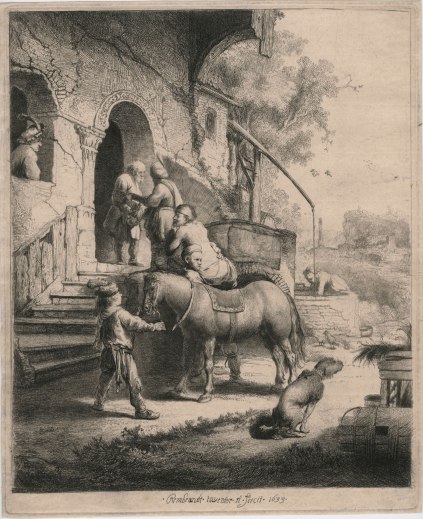
The Good Samaritan by Rembrandt (1633)

Rembrandt’s drawing gives us the reality of an every day scene with the dog, and characters of the woman drawing water from a well, someone looking through the window. When we look closely we see the pain of the wounded man who clutches his hands as the “porter” carries him inside the inn as he might a piece of luggage. It is a humble illustration of the Samaritan who risked his life and paid a sum of money for the care of the injured man. To me, Rembrandt’s engraving describes this as “business as usual.”

Martin Luther preached on the parable of the Good Samaritan on the 13th Sunday in Trinity (sometime in September):

This Samaritan of course is our Lord Jesus Christ himself, who has shown his love toward God and his neighbor. Toward God, in that he was obedient to him, came down from heaven and became man, and thus fulfilled the will of His Father; toward his neighbor, in that he immediately after His baptism began to preach, to do wonders, to heal the sick. And in short, He did no work that centered in Himself alone, but all His acts centered in his neighbor. And this He did with all His powers, and thus He became our servant, who could have well remained in heaven and been equal to God, (Philippians 2:6). But all this He did because He knew that this pleased God and was his Father’s will.

When He entered upon that high mission to prove that He loved God with all His heart, He laid down His bodily life with all He had, and said: ‘Father, here you have all, my bodily life, my glory and honor, which I had among the people; all this I give as it is for thy sake, that the world may know how I love thee. My Father, let my wisdom perish, so that the world may look upon me as most foolish. Let me be the most despised, who was heretofore praised by all the world. Now I am the worst murderer, who before was friendly, useful and serviceable to the whole world. Dear Father, all this I despise, only that I may not be disobedient to thee.’

This is the Samaritan who came uninvited, and fulfilled the law with his whole heart. For only he fulfilled the law, and no one can deprive him of this honor. He alone merits it, and well maintains it all alone. Now this would be no special comfort for us; but that he has compassion on the poor wounded man, takes him under his care, binds his wounds, takes him into the inn and waits on him, this avails for us.

The man who here lies half dead, wounded and stripped of his clothing, is Adam and all mankind. The murderers are the devils who robbed and wounded us, and left us lying prostrate half dead. We still struggle a little for life; but there lies horse and man, we cannot help ourselves to our feet, and if we were left thus lying we would have to die by reason of our great anguish and lack of nourishment; maggots would grow in our wounds, followed by great misery and distress.

The parable stands in bold relief, and pictures us perfectly, what we are and can do with our boasted reason and free will. If the poor wounded man had desired to help himself, it would only have been worse for him, he would only have done harm to himself and irritated his wounds, and only prepared more misery and distress for himself. Had he remained lying quiet, he would have had as much suffering. Thus it is when we are left to ourselves. We are always lost, we may lay hold where we will. Hitherto man has always acted thus, he has thought out many ways and methods how we might reform our lives and get to heaven.

One found this way, another that, therefore so many kinds of orders arose: in like manner the letters of indulgence and crusades originated; but they have only made evil worse. Such is the world, and it is thus finely portrayed in this wounded man, it lies in sins over head and ears and cannot help itself.”

Comments: hbitten@reverendluther.org


Hymn Parade – 10,000 Reasons

10,000 Reasons – by Matt Redman, England (2011)

 How does this song motivate us to worship?

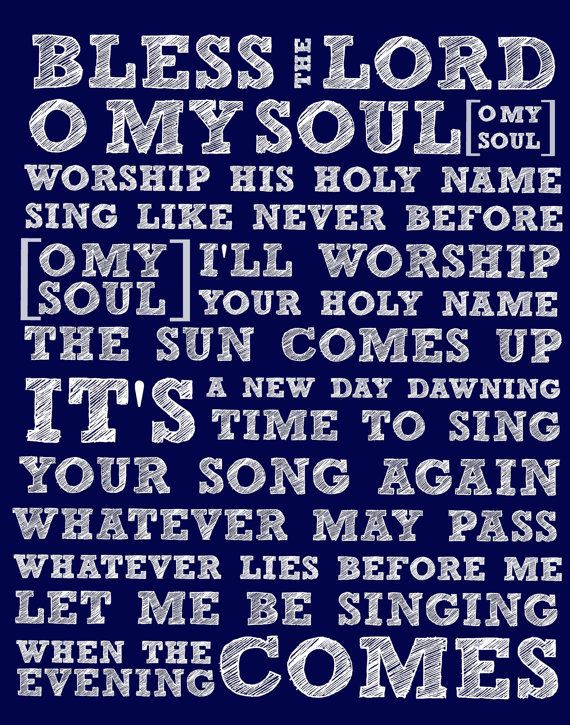
Bless the Lord, O my soul O my soul / Worship His holy name / Sing like never before, O my soul / I’ll worship Your holy name.

Video: https://www.youtube.com/watch?v=RtL_xeRoyVU

Psalm 103:   Praise the Lord, my soul; all my inmost being, praise his holy name. Praise the Lord, my soul, and forget not all his benefits— who forgives all your sins and heals all your diseases, who redeems your life from the pit and crowns you with love and compassion, who satisfies your desires with good things so that your youth is renewed like the eagle’s.

The Lord works righteousness and justice for all the oppressed.

He made known his ways to Moses, his deeds to the people of Israel: The Lord is compassionate and gracious, slow to anger, abounding in love. He will not always accuse, nor will he harbor his anger forever; 10 he does not treat us as our sins deserve or repay us according to our iniquities. 11 For as high as the heavens are above the earth, so great is his love for those who fear him; 12 as far as the east is from the west, so far has he removed our transgressions from us.

10000 Reasons

Martin Luther once had a dream in which he saw a book that contained a record of all his sins. The devil came and looked through the book and said: “Martin, here is one of your sins. Look at it. And here is another and another.” Luther replied to the devil: “Take a pen and write these words over them: “The blood of Jesus Christ, God’s Son, cleanses us from all sin.”

Martin Luther wrote about Psalm 103:11-12 that, “It is the grace of God, which is as high above us as the heaven is above the earth, or as far removed as the east is from the west.” He said it is a wonderful thing to be a child of God. We are children only because Jesus Christ came to earth, was born of a woman, and was sentenced to death under the laws of the Romans.

All the works of God are amazing because they fill us with joy and courage giving us the ability to confront every challenge!

Comments: hbitten@reverendluther.org

Healing the Deaf Man

Time for a checkup?

Are your ears open and is your Facebook post about God’s love?

Mark 7:31-37 31 Then Jesus left the vicinity of Tyre and went through Sidon, down to the Sea of Galilee and into the region of the Decapolis 32 There some people brought to him a man who was deaf and could hardly talk, and they begged Jesus to place his hand on him.

33 After he took him aside, away from the crowd, Jesus put his fingers into the man’s ears. Then he spit and touched the man’s tongue. 34 He looked up to heaven and with a deep sigh said to him, “Ephphatha!” (which means “Be opened!”). 35 At this, the man’s ears were opened, his tongue was loosened and he began to speak plainly.

36 Jesus commanded them not to tell anyone. But the more he did so, the more they kept talking about it. 37 People were overwhelmed with amazement. “He has done everything well,” they said. “He even makes the deaf hear and the mute speak.”

Blind Man-louvre-jesus-guerissant

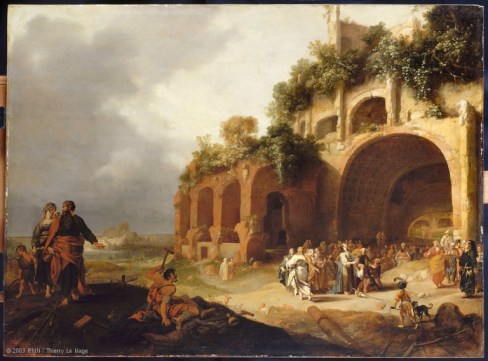
 The Healing of the Deaf and Dumb Man by the Dutch artist Bartholomew Breenbergh (1599-1657)

Bartholomew Breenbergh illustrates this miraculous healing in a supernatural setting that is more similar to an ancient Roman city of Tivoli than Tyre in northern Israel. (Tyre is about 85 miles north of Tel Aviv in southern Lebanon) Although he takes liberty with the scene, he recounts Mark’s Gospel literally with Jesus taking the man away from the crowd and putting his fingers in his ears and touching his tongue. Breenbergh uses contrasting images of light and darkness to place the deaf man in the spotlight as others ( a boy with a dog, a man with crutches) witness this miracle.

Martin Luther:  In his sermon on Mark 7 in 1533, Martin Luther emphasized the importance of opening our ears and loosening our tongue. We hear God’s Word and confess our sins! Here are selected passages from Martin Luther’s sermon:

“Christ shows us that He opens ears and unbinds tongues. He seeks to perform this work daily in his church. . . . It is a physical fact that God gives sound ears and tongues also to the heathen; but only for Christians is this spiritual fact true, that he opens ears and looses tongues. For we Christians must hear His Word with our ears and confess with our lips.

“This is sure, that we have our salvation alone through the Word of God. What would we otherwise know about God, about our Lord Christ, his sacrifice, and the Holy Spirit? To this day the greatest miracle and mightiest work is giving a person ears that gladly hear God’s Word and a tongue that honors God and does not blaspheme.

“Many people are a thousand times worse off than this poor deaf and dumb man. They have ears that are really stopped up. They hear God’s Word and yet really do not hear it, nor do they want to. But those who hear God’s Word gladly and to whom Christ says, as to the deaf man, ‘Ephphatha (Be opened),’ are helped. . . God has shown us no other way by which we can come into heaven than through his precious Word, the Holy Gospel. Whoever gladly and diligently hears and receives it and who loves and delights in it will be helped.

“God also stirs our tongues and causes us to speak. . . . Through faith in Christ we come to have the forgiveness of sins; confession should also follow. We must not be mute, but speak what we believe in our hearts.”

“Our tongues will not be loosed, our ears opened, faith in our hearts begun, without the outward, oral preaching of the Word and external Sacraments. For parish pastors and preachers are the fingers of our Lord God, the servants and spittle through which he looses our tongues and opens our ears. When you hear them, God says to your heart, as to this deaf man, ‘Ephphatha!’ so that your ears are opened, your tongue unsticks, and you become a hearing, speaking person, no longer deaf and mute.”

“Then they praise God, saying: “He hath done all things well, he has made the deaf to hear and the dumb to speak.” For wherever there is true faith, there the Spirit will not allow you any rest; you will break forth, become a priest, teach other people also, as we read Ps. 116:10: “I believe, for I will speak.” There the heart is full, and the mouth must run over. Then when they are persecuted, they will not care.

But the part of the story, that Christ took the man apart from the others, looks up to heaven, has this meaning: If God do not take me alone to a separate place, and give me the Holy Spirit, so that I cling to the Word which I have heard, then all preaching is in vain. But why does this require so much that he looks up to heaven and makes use of divine power, calling upon God’s grace to come and to act? By this he teaches us that such power must come from heaven, working in the heart of man by divine strength; then help comes to him.

Thus have you learned, from the story and from its spiritual or secret meaning, that we must first hear the Word of God and thus, through the intercession of Christ, obtain a faith of our own, and then we come out, confessing this and praising God forever.”

Comments: hbitten@reverendluther.org


Hymn Parade – What a Friend we Have in Jesus

How does the Bible describe the image of God in Jesus Christ?

What a friend we have in Jesus, all our sins and grief to bear! / What a privilege to carry everything to God in prayer! / O what peace we often forfeit, O what needless pain we bear / All because we do not carry everything to God in prayer.

Video: https://www.youtube.com/watch?v=cwi_qKVI8lQ

John 15:13 Greater love has no one than this: to lay down one’s life for one’s friends.

original.5043

Joseph Scriven Monument in Port Hope, Ontario, Canada

 Joseph Scriven was born on Sept. 10, 1819, in Ireland. He graduated from Trinity College in Dublin with a bachelor’s degree. While traveling with his bride on the day before their wedding, his bride fell from her horse while crossing a bridge over the River Bann and drowned in the water below.

In an effort to overcome his sorrow, Joseph travel to Ontario and settled in Port Hope, Canada (about 70 miles east of Toronto) where he joined the Plymouth Brethren. He was engaged to Elisa Roche but she died of pneumonia before they were married. He tutored children, organized a private school, and did some preaching (although not ordained), visited the sick and assisted the poor.

When he was ill, a friend discovered the words to the poem and asked if he could share it with his ailing mother in Ireland. Charles Converse wrote the musical setting. Joseph Scriven body was pulled from Rice Lake near Bewdly, Ontario (about 10 miles north of Port Hope) on August 10, 1886.

joseph scriven home

Home of Joseph Scriven in Port Hope, Ontario, Canada

Martin Luther said you must know God as an enemy before you can know Him as a friend. It seems to me we must be known by God as servants before He would call us friends.

Comments: hbitten@reverendluther.org


The Calling of Matthew (Levi)

Why did Matthew (and others) immediately decide to follow Jesus?

Matthew: 9:9-12:   As Jesus went on from there, he saw a man named Matthew sitting at the tax collector’s booth. “Follow me,” he told him, and Matthew got up and followed him.

10 While Jesus was having dinner at Matthew’s house, many tax collectors and sinners came and ate with him and his disciples. 11 When the Pharisees saw this, they asked his disciples, “Why does your teacher eat with tax collectors and sinners?”

12 On hearing this, Jesus said, “It is not the healthy who need a doctor, but the sick. But go and learn what this means: ‘I desire mercy, not sacrifice. For I have not come to call the righteous, but sinners.”

Luke 5:27: 27 After this, Jesus went out and saw a tax collector by the name of Levi sitting at his tax booth. “Follow me,” Jesus said to him, 28 and Levi got up, left everything and followed him.

Caravaggio_calling_Matthew

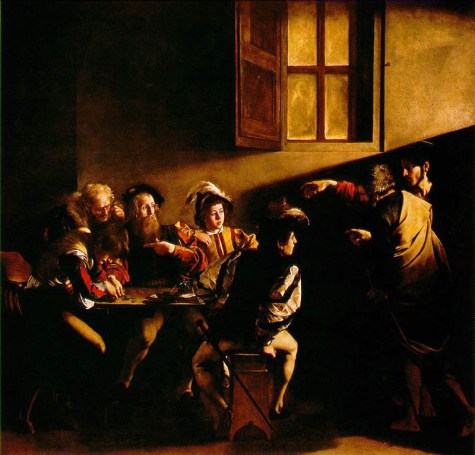
The Calling of Saint Matthew by Caravaggio (1600)

The Calling of Saint Matthew is one of the first works of Michelangelo Caravaggio and is located in the chapel of the French congregation’s church in Rome, San Luigi dei Francesi. Matthew was a Jewish tax collector in Capernaum, and is also known as Levi. Matthew was considered greedy and rich and Jesus asked him to give up his worldly possessions and take to the straight and narrow path.

In this painting, Caravaggio depicts the very moment when Matthew first realizes he is being called. Although it is difficult to see, Jesus appears outside of the room through a window. This is the artist’s way of respecting the literal interpretation of what is written in the Bible that “Jesus saw Matthew sitting at his booth.”

Martin Luther interpreted the calling of the Matthew, Andrew and others as examples of ministers of God’s Word who are called to proclaim the message of forgiveness and salvation. Jesus called common and ordinary people (day laborers, fishermen, and sinful tax collectors) to preach that Jesus came to save and to announce the forgiveness of sins. He did this because forgiveness brings life and salvation and creates the environment for how the Holy Spirit leads people to trust God, grow in faith, and respond with praise, prayer, love, and service for others! (Robert Kolb. Luther and the Stories of God, 135)

Comments: hbitten@reverendluther.org

When Sarah Doubted God

Have you ever doubted God’s hidden presence in your life or experienced an “impossible dream” because of God’s love for you?

Genesis 18:1-15 (Sarah’s laugh) 18 The Lord appeared to Abraham near the great trees of Mamre while he was sitting at the entrance to his tent in the heat of the day. Abraham looked up and saw three men standing nearby. When he saw them, he hurried from the entrance of his tent to meet them and bowed low to the ground.

He said, “If I have found favor in your eyes, my lord,[a] do not pass your servant by. Let a little water be brought, and then you may all wash your feet and rest under this tree. Let me get you something to eat, so you can be refreshed and then go on your way—now that you have come to your servant.” “Very well,” they answered, “do as you say.”

So Abraham hurried into the tent to Sarah. “Quick,” he said, “get three seahs of the finest flour and knead it and bake some bread.” Then he ran to the herd and selected a choice, tender calf and gave it to a servant, who hurried to prepare it. He then brought some curds and milk and the calf that had been prepared, and set these before them. While they ate, he stood near them under a tree.

“Where is your wife Sarah?” they asked him. “There, in the tent,” he said. 10 Then one of them said, “I will surely return to you about this time next year, and Sarah your wife will have a son.”

Now Sarah was listening at the entrance to the tent, which was behind him. 11 Abraham and Sarah were already very old, and Sarah was past the age of childbearing. 12 So Sarah laughed to herself as she thought, “After I am worn out and my lord is old, will I now have this pleasure?”

13 Then the Lord said to Abraham, “Why did Sarah laugh and say, ‘Will I really have a child, now that I am old?’ 14 Is anything too hard for the Lord? I will return to you at the appointed time next year, and Sarah will have a son.”

15 Sarah was afraid, so she lied and said, “I did not laugh.” But he said, “Yes, you did laugh.”

Rembrandt_Abraham_Serving_the_Three_Angels

Abraham and the Three Angels by Rembrandt (1646)

Rembrandt is bold in his illustration of this divine encounter when God speaks directly to Abraham and Sarah regarding His promise of a son and His plan for salvation. He uses light and presents God as an angel in a very personal way. We see an elderly Abraham and Sarah (at the door) with expressions of disbelief. Rembrandt thought deeply about God’s interactions with people as told in the book of Genesis.

Martin Luther wrote in his lecture on Genesis 18 in 1539, “Sarah was now eighty-nine years old, and during so many years she ha been hoping for the blessing of the Lord. When she sees that her hope is futile, she submits everything to God. Yet she does not utterly despair. For this reason the Lord puts up with her weakness and is not offended by her laughter, which has its origin in her thinking about something that is impossible. For what further hope could there be for a barren and exhausted woman? Therefore the Lord brings her to faith with a very friendly reproof.

Furthermore, I stated that not only Sarah but also Abraham himself supposed that these guests of his were foreigners and that he had no thought either of angels or of prophets. Therefore when they promise a child, Sarah thought: ‘Who would be telling them this? They are not speaking from the heart; they want to ingratiate themselves, because they suppose that women hear such things with pleasure.’

These were Sarah’s thoughts when she laughed. But after she heard Him who sees and has before Him all things, new thoughts arise n her; for she notices that these are not ordinary men, but they are men full of the Holy Spirit, who sees the secrets of the hearts and reveals them.

Therefore this is a cheerful and friendly reproof. From it Sarah concluded that these were men from God and prophets, because they are aware of her laughter and her thoughts even though she is not in their presence.”

Comments: hbitten@reverendluther.org

The Lord’s Prayer


 The Lord’s Prayer

Does Martin Luther deserve full credit for the popularity of this prayer?

Matthew 6:9-15:   “This, then, is how you should pray:  “‘Our Father in heaven, hallowed be your name, 10 your kingdom come, your will be done, on earth as it is in heaven. 11 Give us today our daily bread. 12 And forgive us our debts, as we also have forgiven our debtors. 13 And lead us not into temptation, but deliver us from the evil one.’14 For if you forgive other people when they sin against you, your heavenly Father will also forgive you. 15 But if you do not forgive others their sins, your Father will not forgive your sins.

The_Lord's_Prayer-_James_TissotJames Tissot – The Lord’s Prayer (Le Pater Noster) – Brooklyn Museum

James Tissot illustrates Jesus teaching his disciples how to pray. The disciples are gathered around Jesus and ask Him the question about how to pray. The arms of Jesus are open wide as He acknowledges His Father in heaven with the introduction, “Our Father…” which has become the most famous invocation in history. The setting on the top of a hill and the colors of the sky enhance the significance of Jesus Christ as both human and divine. James Tissot is a French impressionist artist who traveled to the Holy Land to research the places where Jesus walked and taught.

Luther included The Lord’s Prayer in The Deutsche Mass for the first time (1526) as it was not part of the Latin Mass in the Roman Catholic Church before the Reformation. This was also a revolutionary change from the understanding of forgiveness in Judaism, which differentiates between sins against God, rules, and other persons. Jews also expect forgiveness first from the one who committed the act (i.e. gossip, stealing) first before they would forgive the other person. In The Lord’s Prayer, people have a new standard when they pray, ‘forgive us our sins, as we forgive those who sin against us’!

Luther: Here, now, learn how great need there is of such prayer. For because we see how full the world is of sects and false teachers, who all wear the holy name as a cover and sham for their doctrines of devils, we ought by all means to pray without ceasing, and to cry and call upon God against all such as preach and believe falsely and whatever opposes and persecutes our Gospel and pure doctrine, and would suppress it, as bishops, tyrants, enthusiasts, etc. Likewise also for ourselves who have the Word of God, but are not thankful for it, nor live as we ought according to the same. If now you pray for this with your heart, you can be sure that it pleases God; for He will not hear anything more dear to Him than that His honor and praise is exalted above everything else, and His Word is taught in its purity and is esteemed precious and dear.” (The Large Catechism by Martin Luther)

Comments: hbitten@reverendluther.org