The Good Samaritan

Does this story from Jesus relate to the way we think about refugees or people looking for a safer place to live?

Luke 10:25-37   25 On one occasion an expert in the law stood up to test Jesus. “Teacher,” he asked, “what must I do to inherit eternal life?”

26 “What is written in the Law?” he replied. “How do you read it?”

27 He answered, “‘Love the Lord your God with all your heart and with all your soul and with all your strength and with all your mind’; and, ‘Love your neighbor as yourself.’”

28 “You have answered correctly,” Jesus replied. “Do this and you will live.”

29 But he wanted to justify himself, so he asked Jesus, “And who is my neighbor?”

30 In reply Jesus said: “A man was going down from Jerusalem to Jericho, when he was attacked by robbers. They stripped him of his clothes, beat him and went away, leaving him half dead. 31 A priest happened to be going down the same road, and when he saw the man, he passed by on the other side. 32 So too, a Levite, when he came to the place and saw him, passed by on the other side. 33 But a Samaritan, as he traveled, came where the man was; and when he saw him, he took pity on him. 34 He went to him and bandaged his wounds, pouring on oil and wine. Then he put the man on his own donkey, brought him to an inn and took care of him. 35 The next day he took out two denarii and gave them to the innkeeper. ‘Look after him,’ he said, ‘and when I return, I will reimburse you for any extra expense you may have.’

36 “Which of these three do you think was a neighbor to the man who fell into the hands of robbers?”

37 The expert in the law replied, “The one who had mercy on him.”

Jesus told him, “Go and do likewise.” (one denarii should be considered as a day’s wage)
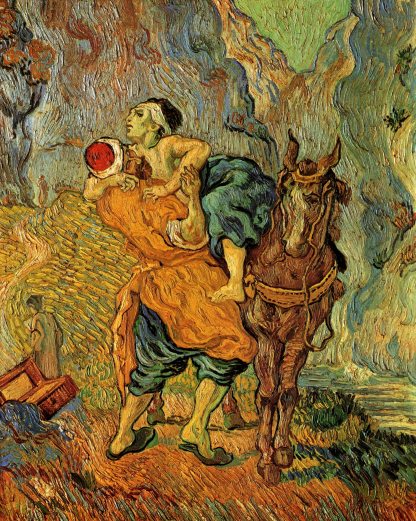
the-good-samaritan-after-delacroix-1890

The Good Samaritan by Vincent Van Gogh (1890)

Van Gogh painted this while staying in an institution for the mentally ill. It is a mirror copy of an earlier painting by Eugene Delacroix in 1849. When we compare Van Gogh’s painting with the earlier one by Delacroix we observe an obvious difference in the use of light.

The man from Samaria pushes the robbed man onto his horse. In the background to the left, two men can be seen who let the wounded man lay on the road when they passed him by. They were a priest and a man from the house of Levi. This is a deliberate choice by both men and Van Gogh pictures them as lifeless as they walk away lost in their own world of self-interest. Only the Samaritan, (a non-Jewish person or foreigner) helped the wounded man.

As you look to the left of the painting there is an open box with a garment next to it.  Our eye returns frequently to this open box and the painting the eye returns over and over again to this open box and to the blue garment that is next to it. Why? Does this symbolically represent to us the importance of being open and accepting of others, especially strangers or people with needs? To think about this in another way, is the wounded man a stranger or our brother? It makes us think about the words of Jesus Christ about “Love your neighbor as yourself!” (verse 27)
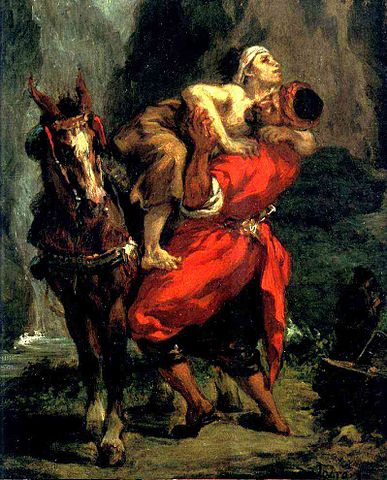
387px-The_Good_Samaritan_(Delacroix_1849)

The Good Samaritan by Edward Delacroix (1890)
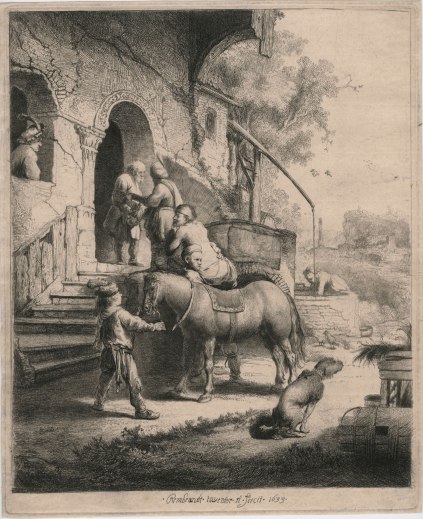
Rembrandt-Good Samaritan

The Good Samaritan by Rembrandt (1633)

Rembrandt’s drawing gives us the reality of an every day scene with the dog, and characters of the woman drawing water from a well, someone looking through the window. When we look closely we see the pain of the wounded man who clutches his hands as the “porter” carries him inside the inn as he might a piece of luggage. It is a humble illustration of the Samaritan who risked his life and paid a sum of money for the care of the injured man. To me, Rembrandt’s engraving describes this as “business as usual.”

Martin Luther preached on the parable of the Good Samaritan on the 13th Sunday in Trinity (sometime in September):

This Samaritan of course is our Lord Jesus Christ himself, who has shown his love toward God and his neighbor. Toward God, in that he was obedient to him, came down from heaven and became man, and thus fulfilled the will of His Father; toward his neighbor, in that he immediately after His baptism began to preach, to do wonders, to heal the sick. And in short, He did no work that centered in Himself alone, but all His acts centered in his neighbor. And this He did with all His powers, and thus He became our servant, who could have well remained in heaven and been equal to God, (Philippians 2:6). But all this He did because He knew that this pleased God and was his Father’s will.

When He entered upon that high mission to prove that He loved God with all His heart, He laid down His bodily life with all He had, and said: ‘Father, here you have all, my bodily life, my glory and honor, which I had among the people; all this I give as it is for thy sake, that the world may know how I love thee. My Father, let my wisdom perish, so that the world may look upon me as most foolish. Let me be the most despised, who was heretofore praised by all the world. Now I am the worst murderer, who before was friendly, useful and serviceable to the whole world. Dear Father, all this I despise, only that I may not be disobedient to thee.’

This is the Samaritan who came uninvited, and fulfilled the law with his whole heart. For only he fulfilled the law, and no one can deprive him of this honor. He alone merits it, and well maintains it all alone. Now this would be no special comfort for us; but that he has compassion on the poor wounded man, takes him under his care, binds his wounds, takes him into the inn and waits on him, this avails for us.

The man who here lies half dead, wounded and stripped of his clothing, is Adam and all mankind. The murderers are the devils who robbed and wounded us, and left us lying prostrate half dead. We still struggle a little for life; but there lies horse and man, we cannot help ourselves to our feet, and if we were left thus lying we would have to die by reason of our great anguish and lack of nourishment; maggots would grow in our wounds, followed by great misery and distress.

The parable stands in bold relief, and pictures us perfectly, what we are and can do with our boasted reason and free will. If the poor wounded man had desired to help himself, it would only have been worse for him, he would only have done harm to himself and irritated his wounds, and only prepared more misery and distress for himself. Had he remained lying quiet, he would have had as much suffering. Thus it is when we are left to ourselves. We are always lost, we may lay hold where we will. Hitherto man has always acted thus, he has thought out many ways and methods how we might reform our lives and get to heaven.

One found this way, another that, therefore so many kinds of orders arose: in like manner the letters of indulgence and crusades originated; but they have only made evil worse. Such is the world, and it is thus finely portrayed in this wounded man, it lies in sins over head and ears and cannot help itself.”

Comments: hbitten@reverendluther.org


When Sarah Doubted God

Have you ever doubted God’s hidden presence in your life or experienced an “impossible dream” because of God’s love for you?

Genesis 18:1-15 (Sarah’s laugh) 18 The Lord appeared to Abraham near the great trees of Mamre while he was sitting at the entrance to his tent in the heat of the day. Abraham looked up and saw three men standing nearby. When he saw them, he hurried from the entrance of his tent to meet them and bowed low to the ground.

He said, “If I have found favor in your eyes, my lord,[a] do not pass your servant by. Let a little water be brought, and then you may all wash your feet and rest under this tree. Let me get you something to eat, so you can be refreshed and then go on your way—now that you have come to your servant.” “Very well,” they answered, “do as you say.”

So Abraham hurried into the tent to Sarah. “Quick,” he said, “get three seahs of the finest flour and knead it and bake some bread.” Then he ran to the herd and selected a choice, tender calf and gave it to a servant, who hurried to prepare it. He then brought some curds and milk and the calf that had been prepared, and set these before them. While they ate, he stood near them under a tree.

“Where is your wife Sarah?” they asked him. “There, in the tent,” he said. 10 Then one of them said, “I will surely return to you about this time next year, and Sarah your wife will have a son.”

Now Sarah was listening at the entrance to the tent, which was behind him. 11 Abraham and Sarah were already very old, and Sarah was past the age of childbearing. 12 So Sarah laughed to herself as she thought, “After I am worn out and my lord is old, will I now have this pleasure?”

13 Then the Lord said to Abraham, “Why did Sarah laugh and say, ‘Will I really have a child, now that I am old?’ 14 Is anything too hard for the Lord? I will return to you at the appointed time next year, and Sarah will have a son.”

15 Sarah was afraid, so she lied and said, “I did not laugh.” But he said, “Yes, you did laugh.”

Rembrandt_Abraham_Serving_the_Three_Angels

Abraham and the Three Angels by Rembrandt (1646)

Rembrandt is bold in his illustration of this divine encounter when God speaks directly to Abraham and Sarah regarding His promise of a son and His plan for salvation. He uses light and presents God as an angel in a very personal way. We see an elderly Abraham and Sarah (at the door) with expressions of disbelief. Rembrandt thought deeply about God’s interactions with people as told in the book of Genesis.

Martin Luther wrote in his lecture on Genesis 18 in 1539, “Sarah was now eighty-nine years old, and during so many years she ha been hoping for the blessing of the Lord. When she sees that her hope is futile, she submits everything to God. Yet she does not utterly despair. For this reason the Lord puts up with her weakness and is not offended by her laughter, which has its origin in her thinking about something that is impossible. For what further hope could there be for a barren and exhausted woman? Therefore the Lord brings her to faith with a very friendly reproof.

Furthermore, I stated that not only Sarah but also Abraham himself supposed that these guests of his were foreigners and that he had no thought either of angels or of prophets. Therefore when they promise a child, Sarah thought: ‘Who would be telling them this? They are not speaking from the heart; they want to ingratiate themselves, because they suppose that women hear such things with pleasure.’

These were Sarah’s thoughts when she laughed. But after she heard Him who sees and has before Him all things, new thoughts arise n her; for she notices that these are not ordinary men, but they are men full of the Holy Spirit, who sees the secrets of the hearts and reveals them.

Therefore this is a cheerful and friendly reproof. From it Sarah concluded that these were men from God and prophets, because they are aware of her laughter and her thoughts even though she is not in their presence.”

Comments: hbitten@reverendluther.org

The Lord’s Prayer


 The Lord’s Prayer

Does Martin Luther deserve full credit for the popularity of this prayer?

Matthew 6:9-15:   “This, then, is how you should pray:  “‘Our Father in heaven, hallowed be your name, 10 your kingdom come, your will be done, on earth as it is in heaven. 11 Give us today our daily bread. 12 And forgive us our debts, as we also have forgiven our debtors. 13 And lead us not into temptation, but deliver us from the evil one.’14 For if you forgive other people when they sin against you, your heavenly Father will also forgive you. 15 But if you do not forgive others their sins, your Father will not forgive your sins.

The_Lord's_Prayer-_James_TissotJames Tissot – The Lord’s Prayer (Le Pater Noster) – Brooklyn Museum
James Tissot illustrates Jesus teaching his disciples how to pray. The disciples are gathered around Jesus and ask Him the question about how to pray. The arms of Jesus are open wide as He acknowledges His Father in heaven with the introduction, “Our Father…” which has become the most famous invocation in history. The setting on the top of a hill and the colors of the sky enhance the significance of Jesus Christ as both human and divine. James Tissot is a French impressionist artist who traveled to the Holy Land to research the places where Jesus walked and taught.

Luther included The Lord’s Prayer in The Deutsche Mass for the first time (1526) as it was not part of the Latin Mass in the Roman Catholic Church before the Reformation. This was also a revolutionary change from the understanding of forgiveness in Judaism, which differentiates between sins against God, rules, and other persons. Jews also expect forgiveness first from the one who committed the act (i.e. gossip, stealing) first before they would forgive the other person. In The Lord’s Prayer, people have a new standard when they pray, ‘forgive us our sins, as we forgive those who sin against us’!

Luther: Here, now, learn how great need there is of such prayer. For because we see how full the world is of sects and false teachers, who all wear the holy name as a cover and sham for their doctrines of devils, we ought by all means to pray without ceasing, and to cry and call upon God against all such as preach and believe falsely and whatever opposes and persecutes our Gospel and pure doctrine, and would suppress it, as bishops, tyrants, enthusiasts, etc. Likewise also for ourselves who have the Word of God, but are not thankful for it, nor live as we ought according to the same. If now you pray for this with your heart, you can be sure that it pleases God; for He will not hear anything more dear to Him than that His honor and praise is exalted above everything else, and His Word is taught in its purity and is esteemed precious and dear.” (The Large Catechism by Martin Luther)

Comments: hbitten@reverendluther.org

Calling of Andrew and Peter

The Calling of the Disciples

How does one become filled with the Holy Spirit?

Matthew 4:18-21: 18 While walking by the Sea of Galilee, he saw two brothers, Simon (who is called Peter) and Andrew his brother, casting a net into the sea, for they were fishermen. 19 And he said to them, “Follow me, and I will make you fishers of men.”[a] 20 Immediately they left their nets and followed him. 21 And going on from there he saw two other brothers, James the son of Zebedee and John his brother, in the boat with Zebedee their father, mending their nets, and he called them. 22 Immediately they left the boat and their father and followed him.

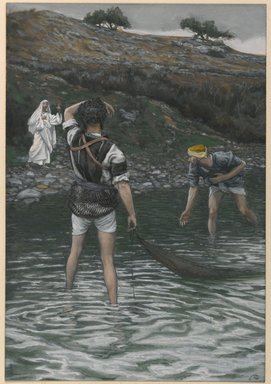
Calling of Simon and Andrew-2The Calling of Simon and Andrew by James Tissot (1886-1894)

James Tissot, a French artist sees Simon Peter and Andrew fishing in shallow water and close enough to the shore to hear the voice of Jesus. Tissot visited the Holy Land in 1880 and observed local fishermen wearing nets around their waste.

Calling of Simon and Andrew

The Calling of Saint Peter and Andrew by Bernardo Struzzo but more recently (2006) verified that this was painted by Caravaggio.

In this painting Caravaggio pictures a youthful Jesus without a beard leading two older brothers. Peter is holding a fish in his right hand and Andrew and Peter still appear confused about what they have just experienced regarding the large number of fish they caught after Jesus directed them to fish in the deeper water.

Martin Luther: In Luther’s sermon on Matthew in 1521, he marks the calling of the disciples as the time for grace to be preached throughout the world. The disciples will minister to people in need, preach to the heathen, forgive sinners, be witnesses that Jesus Christ is the Son of God.

In his sermon on the Monday after Easter in 1525 (Luke 24:13-25), Martin Luther describes the disciples as ignorant fishermen who came to know Jesus Christ through the Holy Spirit.

“‘The apostles likewise, being ignorant fishermen, learned to know the Scriptures, not in the schools of the great scribes, but through the revelation by which Christ led them into the Scriptures. Thus they were enabled to understand and to write on the basis of a single passage a book or a sermon the world cannot understand. And if I had the same Spirit Isaiah or Paul had, I could take this passage and develop from it a New Testament, if that were not already written.

 How did St. Peter know, or where is written in Moses that which he says in 1 Peter 10-11: “Concerning which salvation the prophets sought and searched diligently, who prophesied of the grace that should come unto you, searching what time or what manner of time the Spirit of Christ which was in them did point unto?” Who told him that the Spirit of Christ existed and prophesied of Christ, before there were prophets and, above all, before Christ and the Holy Ghost were present? Are these the words of a fisherman, or of a learned, wise scribe? Nay, it is the revelation of the Holy Spirit who had also revealed it to the prophets before.’”

Comments: hbitten@reverendluther.org


The Conviction of Galileo as a Heretic and the Day the Sun Stood Still

Did the sun shine for 24 hours or is this account exaggerated?

Joshua 10:12-14     12 On the day the Lord gave the Amorites over to Israel, Joshua said to the Lord in the presence of Israel: “Sun, stand still over Gibeon, and you, moon, over the Valley of Aijalon.” 13 So the sun stood still, and the moon stopped, till the nation avenged itself on[b] its enemies, as it is written in the Book of Jashar.

The sun stopped in the middle of the sky and delayed going down about a full day. 14 There has never been a day like it before or since, a day when the Lord listened to a human being. Surely the Lord was fighting for Israel!

joshua-stopping-the-sun-by-pauwels-casteels-antwerp-c-1649-1677-1

Joshua Stopping the Sun by Pauwels Casteels (1649-1679)

Pauwels Casteels painting illustrates the story of Joshua at the battle of Gibeon against the alliance of Amorite kings. The Israelites were winning the battle, partly due to God raining hailstones upon the Amorite army, but with the setting of the sun, Joshua commanded that the “‘Sun, stand thou still upon Gibeon!” According to the Bible, the sun stopped in the sky and the day was prolonged until the Israelites could complete their victory over the Amorites. The painting shows the chaos of the battle, the large scale of the battle, and on the upper right side of the painting the people running from the large hailstones. Joshua appears as a commander-in-chief of his army and nature as he rides his white horse.

Luther: In the Table Talk, June 4, 1539, we read of the following regarding this new ideas:

“There was mention of a certain new astrologer who wanted to prove that the earth moves and not the sky, the sun, and the moon. This would be as if somebody were riding on a cart or in a ship and imagined that he was standing still while the earth and the trees were moving. So it goes now. Whoever wants to be clever must agree with nothing that others esteem. He must do something of his own. This is what that fellow does who wishes to turn the whole of astronomy upside down. Even in these things that are thrown into disorder I believe the Holy Scriptures, for Joshua commanded the sun to stand still, and not the earth.”

On April 12, 1633, Galileo was convicted of heresy for teaching that the earth revolves around the sun as Copernicus presented in theory and Galileo confirmed with his telescope. Galileo maintained that his writings were for the purpose of discussion and not belief but his trial ended in conviction.

On June 22, 1633, the Church handed down the following order: “We pronounce, judge, and declare, that you, the said Galileo… have rendered yourself vehemently suspected by this Holy Office of heresy, that is, of having believed and held the doctrine (which is false and contrary to the Holy and Divine Scriptures) that the sun is the center of the world, and that it does not move from east to west, and that the earth does move, and is not the center of the world.”

Along with the order came the following penalty: “We order that by a public edict the book of Dialogues of Galileo Galilei be prohibited, and We condemn thee to the prison of this Holy Office during Our will and pleasure; and as a salutary penance We enjoin on thee that for the space of three years thou shalt recite once a week the Seven Penitential Psalms.”

Galileo agreed not to teach the heresy anymore and spent the rest of his life under house arrest. It took more than 300 years for the Church to admit that Galileo was right and to clear his name of heresy.

http://www.history.com/this-day-in-history/galileo-is-convicted-of-heresy

Some NASA scientists claim computers report a “missing day” in the calendar dating back to this century in history. https://www.uwgb.edu/dutchs/pseudosc/missday.htm

Comments: hbitten@reverendluther.org