The Temptation of Christ

Do temptations always test our faith?

Matthew 4: 1-11: Then Jesus was led by the Spirit into the wilderness to be tempted by the devil. After fasting forty days and forty nights, he was hungry. The tempter came to him and said, “If you are the Son of God, tell these stones to become bread.”

Jesus answered, “It is written: ‘Man shall not live on bread alone, but on every word that comes from the mouth of God.’”

Then the devil took him to the holy city and had him stand on the highest point of the temple. “If you are the Son of God,” he said, “throw yourself down. For it is written: “‘He will command his angels concerning you, and they will lift you up in their hands, so that you will not strike your foot against a stone.’”

Jesus answered him, “It is also written: ‘Do not put the Lord your God to the test.’”

Again, the devil took him to a very high mountain and showed him all the kingdoms of the world and their splendor. “All this I will give you,” he said, “if you will bow down and worship me.”

10 Jesus said to him, “Away from me, Satan! For it is written: ‘Worship the Lord your God, and serve him only.’” 11 Then the devil left him, and angels came and attended him.

temptations-of-christ

The Temptations of Christ Fresco in Sistine Chapel 1480-1482 by Sandro Botticello

The Temptations of Christ depicts three scenes from the gospels. The story takes place in the midst of people rather than in the isolation of the desert. This application about sin and temptation in our daily lives would speak directly to the hearts of the people and to the clergy in the Sistine Chapel as it calls for repentance.

On the left, Jesus who has been fasting, is confronted by Satan who is disguised as a hermit, to turn the stones in the desert to bread. The second scene in the close-up below, Satan tempts Jesus to challenge God’s promise that the angels will protect Him. He tempts Jesus to jump from the cliff. In the third scene, Satan promises Jesus all the beauties and wealth of the world if He will deny God.
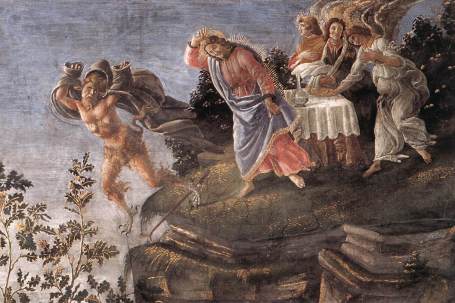
Temptation in Detail-Sandro_Botticelli

Close-up view of the upper right section of the painting

Luther, in his sermon in 1525 during the Peasants’ Revolt said: “But in spiritual matters this temptation is powerful when one has to do with the nourishment not of the body but of the soul. Here God has held before us the person and way, by which the soul can be forever nourished in the richest manner possible without any want, namely Christ, our Savior. But this way, this treasure, this provision no one desires. Everybody seeks another way, other provisions to help their souls.

The real guilty ones are those who would be saved through their own work; these the devil sets conspicuously on the top of the temple. They follow him and go down where there is no stairway; they believe and trust in their own work where there is no faith nor trust, no way nor bridge, and break their necks. But Satan makes use of and persuades them through the Scriptures to believe that the angels will protect them, and that their way, works and faith are pleasing to God, and who called them through the Scriptures to do good works; but they do not care how falsely they explain the Scriptures.

Who these are, we have identified often enough and very fully, namely, work righteous persons and unbelieving hypocrites under the name of being Christians and among the congregation of Christian people. For the temptation must take place in the holy city and one temptation is seldom against another.

In the first temptation want and hunger are the reasons that we should not believe; and by which we become anxious to have a full sufficiency, so that there is no chance for us to believe.

In the second temptation, however, the abundance and the full sufficiency are the reasons that we do not believe, by which we become tired of the common treasure, and every one tries to do something through his own powers to provide for his soul. So we do; if we have nothing, then we doubt God and believe not; if we have abundance, then we become tired of it and wish to have something different, and again we fail to believe. There we flee and turn against want and seek abundance: here we seek want and flee from the abundance we have. No, whatever God does for us, is never right. Such is the bottomless, wickedness of our unbelief.”

Comments: hbitten@reverendluther.org
 

The Parable of the Workers in the Vineyard

How are wages, wealth, and inheritance understood in this story?

 Matthew 20:1-16  “For the kingdom of heaven is like a landowner who went out early in the morning to hire workers for his vineyard. He agreed to pay them a denarius for the day and sent them into his vineyard.

“About nine in the morning he went out and saw others standing in the marketplace doing nothing. He told them, ‘You also go and work in my vineyard, and I will pay you whatever is right.’ So they went.

“He went out again about noon and about three in the afternoon and did the same thing. About five in the afternoon he went out and found still others standing around. He asked them, ‘Why have you been standing here all day long doing nothing?’

“‘Because no one has hired us,’ they answered. “He said to them, ‘You also go and work in my vineyard.’

“When evening came, the owner of the vineyard said to his foreman, ‘Call the workers and pay them their wages, beginning with the last ones hired and going on to the first.’

“The workers who were hired about five in the afternoon came and each received a denarius. 10 So when those came who were hired first, they expected to receive more. But each one of them also received a denarius. 11 When they received it, they began to grumble against the landowner. 12 ‘These who were hired last worked only one hour,’ they said, ‘and you have made them equal to us who have borne the burden of the work and the heat of the day.’

13 “But he answered one of them, ‘I am not being unfair to you, friend. Didn’t you agree to work for a denarius? 14 Take your pay and go. I want to give the one who was hired last the same as I gave you. 15 Don’t I have the right to do what I want with my own money? Or are you envious because I am generous?’ 16 “So the last will be first, and the first will be last.”

This Gospel reading is traditionally read in churches on the third Sunday before Ash Wednesday, which is also the ninth Sunday before Easter. (Septuagesima Sunday) It tells us that we are all sinners and in need of the Grace of Jesus Christ!

Rembrandt_-_Parable_of_the_Laborers_in_the_Vineyard

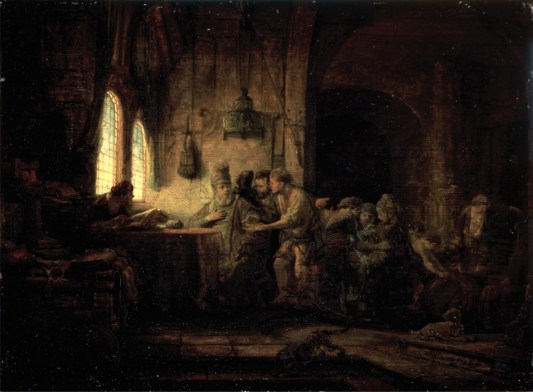
The Parable of the Laborers in the Vineyard by Rembrandt (1637)

Rembrandt uses darkness to engage the viewer in this scene of two laborers arguing with the landlord about their pay as the workers to the right talk among themselves. The wife of the landlord is the accountant and sits at the table with the open ledger book. This parable is only found in the Gospel of Matthew (a former tax collector) a landowner is paying his workers at the end of the day. The controversy developed when the workers who labored all day received the same wages as part time workers who worked for only a few hours. The perspective Rembrandt creates is for the viewer to look at the scene from the outside, perhaps through a window. This painting is at The Hermitage in St. Petersburg, Russia.

The excerpt below is from a sermon Martin Luther preached on Septuagesima Sunday in 1528, the third Sunday before Ash Wednesday and the ninth Sunday before Easter.

“Hence the substance of the parable in today’s Gospel consists not in the penny, what it is, nor in the different hours; but in earning and acquiring, or how one can earn the penny; that as here the first presumed to obtain the penny and even more by their own merit, and yet the last received the same amount because of the goodness of the householder. Thus God will show it is nothing but mercy that He gives and no one is to arrogate to himself more than another. Therefore He says I do thee no wrong, is not the money Mine and not thine; if I had given away thy property, then thou wouldst have reason to murmur; is it not lawful for me to do what I will with mine own ?

Now in this way Christ strikes a blow first against the presumption of those who would storm their way into heaven by their good works; as the Jews did and wished to be next to God; as hitherto our own clergy have also done. These all labor for definite wages, that is, they take the law of God in no other sense than that they should fulfill it by certain defined works for a specified reward, and they never understand it correctly, and know not that before God all is pure grace. This signifies that they hire themselves out for wages, and agree with the householder for a penny a day; consequently their lives are bitter and they lead a career that is indeed hard.

Now when the Gospel comes and makes all alike, as Paul teaches in Romans 3:23, so that they who have done great works are no more than public sinners, and must also become sinners and tolerate the saying: “All have sinned”, Romans 3:23, and that no one is justified before God by his works; then they look around and despise those who have done nothing at all, while their great worry and labor avail no more than such idleness and reckless living. Then they murmur against the householder, they imagine it is not right; they blaspheme the Gospel, and become hardened in their ways; then they lose the favor and grace of God, and are obliged to take their temporal reward and trot from him with their penny and be condemned; for they served not for the sake of mercy but for the sake of reward, and they will receive that and nothing more, the others however must confess that they have merited neither the penny nor the grace, but more is given to them than they had ever thought was promised to them. These remained in grace and besides were saved, and besides this, here in time they had enough; for all depended upon the good pleasure of the householder.”

Comments: hbitten@reverendluther.org
The Calling of Matthew (Levi)

Why did Matthew (and others) immediately decide to follow Jesus?

Matthew: 9:9-12:   As Jesus went on from there, he saw a man named Matthew sitting at the tax collector’s booth. “Follow me,” he told him, and Matthew got up and followed him.

10 While Jesus was having dinner at Matthew’s house, many tax collectors and sinners came and ate with him and his disciples. 11 When the Pharisees saw this, they asked his disciples, “Why does your teacher eat with tax collectors and sinners?”

12 On hearing this, Jesus said, “It is not the healthy who need a doctor, but the sick. But go and learn what this means: ‘I desire mercy, not sacrifice. For I have not come to call the righteous, but sinners.”

Luke 5:27: 27 After this, Jesus went out and saw a tax collector by the name of Levi sitting at his tax booth. “Follow me,” Jesus said to him, 28 and Levi got up, left everything and followed him.

Caravaggio_calling_Matthew

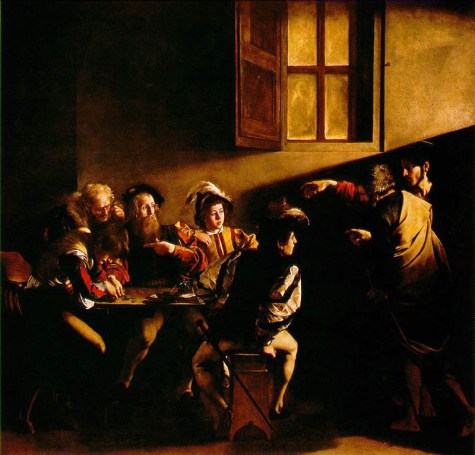
The Calling of Saint Matthew by Caravaggio (1600)

The Calling of Saint Matthew is one of the first works of Michelangelo Caravaggio and is located in the chapel of the French congregation’s church in Rome, San Luigi dei Francesi. Matthew was a Jewish tax collector in Capernaum, and is also known as Levi. Matthew was considered greedy and rich and Jesus asked him to give up his worldly possessions and take to the straight and narrow path.

In this painting, Caravaggio depicts the very moment when Matthew first realizes he is being called. Although it is difficult to see, Jesus appears outside of the room through a window. This is the artist’s way of respecting the literal interpretation of what is written in the Bible that “Jesus saw Matthew sitting at his booth.”

Martin Luther interpreted the calling of the Matthew, Andrew and others as examples of ministers of God’s Word who are called to proclaim the message of forgiveness and salvation. Jesus called common and ordinary people (day laborers, fishermen, and sinful tax collectors) to preach that Jesus came to save and to announce the forgiveness of sins. He did this because forgiveness brings life and salvation and creates the environment for how the Holy Spirit leads people to trust God, grow in faith, and respond with praise, prayer, love, and service for others! (Robert Kolb. Luther and the Stories of God, 135)

Comments: hbitten@reverendluther.org