
The 500th Anniversary of the Lyrics to A Mighty Fortress is Our God

A Mighty Fortress is our God

2027 marks the 500th anniversary of the lyrics for the popular hymn, A Mighty Fortress is our God. Reformation Day is celebrated in Lutheran and many Protestant churches on October 31 to commemorate the posting of the 95 Theses at the Castle Church in Wittenberg, Germany.

The ten years following the posting of the Ninety-five Theses provide an important perspective for this hymn. Martin Luther was excommunicated on January 3, 1521 by Pope Leo X and summoned to a public hearing in Worms where the electors of the Holy Roman Empire were meeting. At the Diet of Worms, Martin Luther was declared a heretic.  He had the support of several German nobles who arranged for his ‘kidnap’ and taken to a safe place to live at the Wartburg Castle.

On July 1, 1523, two Augustinian monks, Heinrick Voes and Johann Esch were executed.  They were burned in Brussels for their refusal to recant their public statements that people were saved by faith in Jesus Christ. Their death disturbed Martin Luther, especially since he was also condemned to death by the Edict of Worms on May 25, 1521.

The lyrics below were written by Martin Luther following the death of these two young martyrs.

“A new song here shall be begun—
The Lord God help our singing!—
Of what our God himself hath done,
Praise, honor to him bringing:
At Brussels in the Netherlands,
By two young boys, He gracious
Displays the wonders of his hands,
Giving them gifts right precious,
And richly them adorning.”

During the years of 1523-27, Martin Luther feared for his life, struggled with the death of more than a million peasants in their revolt against German nobles, and experienced the plaque in the province of Saxony. His daughter, Elisabeth, died on December 10, 1527.  Understanding the context of these events is important because Psalm 46 was a comfort to Martin Luther during these years and is considered to be influential in the writing of the lyrics to A Mighty Fortress is our God in 1527, especially the reference that God is our refuge and strength.

46 God is our refuge and strength, a very present help in trouble.
Therefore we will not fear though the earth give way,

though the mountains be moved into the heart of the sea,
though its waters roar and foam, though the mountains tremble at its swelling.

There is a river whose streams make glad the city of God, the holy habitation of the Most High.
God is in the midst of her; she shall not be moved; God will help her when morning dawns.
The nations rage, the kingdoms totter; he utters his voice, the earth melts.
The Lord of hosts is with us; the God of Jacob is our fortress.

Come, behold the works of the Lord, how he has brought desolations on the earth.
He makes wars cease to the end of the earth; he breaks the bow and shatters the spear;
    he burns the chariots with fire.
10 “Be still, and know that I am God. I will be exalted among the nations, I will be exalted in the earth!”
11 The Lord of hosts is with us; the God of Jacob is our fortress.

Most historians agree that the lyrics to A Mighty Fortress is our God were written by Martin Luther in 1527. The melody was written or adapted from familiar songs in 1529.  The hymn was likely first published in the 1531 hymnal and later translated into other languages.  The first translation into English was by Miles Coverdale in 1535, who also translated the Holy Bible into English in this year. (Coverdale Bible) The words many people are familiar with today were translated in 1852 by Frederick Hedge. The words below are the version from The Lutheran Church Missouri Synod in 1868 which is considered the most literal translation from German to English.

Lyrics to A Mighty Fortress

1. A mighty Fortress is our God,
A trusty Shield and Weapon;
He helps us free from every need
That hath us now o’ertaken.
The old evil Foe
Now means deadly woe;
Deep guile and great might
Are his dread arms in fight;
On Earth is not his equal.

2. With might of ours can naught be done,
Soon were our loss effected;
But for us fights the Valiant One,
Whom God Himself elected.
Ask ye, Who is this?
Jesus Christ it is.
Of Sabaoth Lord,
And there’s none other God;
He holds the field forever.

3. Though devils all the world should fill,
All eager to devour us.
We tremble not, we fear no ill,
They shall not overpower us.
This world’s prince may still
Scowl fierce as he will,
He can harm us none,
He’s judged; the deed is done;
One little word can fell him.

4. The Word they still shall let remain
Nor any thanks have for it;
He’s by our side upon the plain
With His good gifts and Spirit.
And take they our life,
Goods, fame, child and wife,
Let these all be gone,
They yet have nothing won;
The Kingdom ours remaineth.

The first verse is based on Psalm 46. The second verse is based on Ephesians 6: 10-17 (12 For our struggle is not against flesh and blood, but against the rulers, against the authorities, against the powers of this dark world and against the spiritual forces of evil in the heavenly realms), the third verse is based on Revelation 19: 11-16 (13 He is dressed in a robe dipped in blood, and his name is the Word of God) andMatthew 4:1-11 (Jesus said to him, “Away from me, Satan!) and the last verse is based on Romans 8:31-39 (38 For I am convinced that neither death nor life, neither angels nor demons,[b] neither the present nor the future, nor any powers, 39 neither height nor depth, nor anything else in all creation, will be able to separate us from the love of God that is in Christ Jesus our Lord.)

Ephesians 6:10-17

10 Finally, be strong in the Lord and in his mighty power. 11 Put on the full armor of God, so that you can take your stand against the devil’s schemes. 12 For our struggle is not against flesh and blood, but against the rulers, against the authorities, against the powers of this dark world and against the spiritual forces of evil in the heavenly realms. 13 Therefore put on the full armor of God, so that when the day of evil comes, you may be able to stand your ground, and after you have done everything, to stand. 14 Stand firm then, with the belt of truth buckled around your waist, with the breastplate of righteousness in place, 15 and with your feet fitted with the readiness that comes from the gospel of peace. 16 In addition to all this, take up the shield of faith, with which you can extinguish all the flaming arrows of the evil one. 17 Take the helmet of salvation and the sword of the Spirit, which is the word of God.

Revelation 19:11-16

11 I saw heaven standing open and there before me was a white horse, whose rider is called Faithful and True. With justice he judges and wages war. 12 His eyes are like blazing fire, and on his head are many crowns. He has a name written on him that no one knows but he himself. 13 He is dressed in a robe dipped in blood, and his name is the Word of God. 14 The armies of heaven were following him, riding on white horses and dressed in fine linen, white and clean. 15 Coming out of his mouth is a sharp sword with which to strike down the nations. “He will rule them with an iron scepter.”[a] He treads the winepress of the fury of the wrath of God Almighty. 16 On his robe and on his thigh he has this name written:

Matthew 4: 1-11

10 Jesus said to him, “Away from me, Satan! For it is written: ‘Worship the Lord your God, and serve him only.’”

Romans 8:31-39

31 What, then, shall we say in response to these things? If God is for us, who can be against us? 32 He who did not spare his own Son, but gave him up for us all—how will he not also, along with him, graciously give us all things? 33 Who will bring any charge against those whom God has chosen? It is God who justifies. 34 Who then is the one who condemns? No one. Christ Jesus who died—more than that, who was raised to life—is at the right hand of God and is also interceding for us. 35 Who shall separate us from the love of Christ? Shall trouble or hardship or persecution or famine or nakedness or danger or sword? 36 As it is written: “For your sake we face death all day long; we are considered as sheep to be slaughtered.” 37 No, in all these things we are more than conquerors through him who loved us. 38 For I am convinced that neither death nor life, neither angels nor demons,[b] neither the present nor the future, nor any powers, 39 neither height nor depth, nor anything else in all creation, will be able to separate us from the love of God that is in Christ Jesus our Lord.

The words to A Mighty Fortress is our God include a powerful reference to the power of God’s Word in defeating sin, death, and the devil. There are different theories relating to the evolution of the lyrics and how they were chanted or sung. One theory is that the words were sung by Martin Luther as he entered the city of Worms on April 16, 1521 for his appearance before Charles V at the Diet of Worms.

Another theory is that Martin Luther finalized the words as a tribute to his friend, Leonhard Kaiser who was martyred on August 16, 1527. Father Kaiser was an ordained priest who recanted his teaching in Passau that faith alone leads to salvation. He then left Passau and enrolled in the University of Wittenberg and became a student of Martin Luther. He went to visit his terminally ill father in Passau in July 1527 and was arrested, accused of heresy for teaching salvation by faith, receiving the two elements of bread and wine for Holy Communion, and teaching that only baptism, communion, and confession were holy sacraments.  

Perhaps Luther wrote the lyrics in 1527 during the plaque in August. Most of the Wittenberg population left the city for safety since the death toll from plaques in Paris and Zurich claimed about 30% of the population.  Martin Luther and his wife and son remained in Wittenberg. Luther also was adamant in his teaching that the plaque was not evidence of God’s wrath or punishment for sins. Luther was also dismayed by the reckless behavior of the Holy Roman Emperor’s troops, which began their sack on Rome on May 6, 1527.

Some scholars claim that the hymn was first sung at the Dier of Speyer in 1529 when the German princes stated their beliefs in Luther’s teachings. The Diet of Speyer was a meeting of the government to discuss the threat of Suleiman the Magnificent and the Ottoman Turks who had taken Hungary in 1526 and were now threatening to seize Vienna. In addition to the Islamic threat to Europe, the Roman Catholic princes were advocating that Charles V end his policy of religious toleration. Others think it was first sung at the Diet of Augsburg in 1530.

The theories are an opportunity for further research and discussion as is the reference to Psalm 46. One question to consider is if this hymn and its melody were written as a song of comfort or a rallying hymn against the forces that threatened the Christian Church in the 16th century? Another question is how relevant are these words for people living in the 21st century?  As you discuss the lyrics of this hymn, ask if they apply to the death of Christian martyrs, are a statement of God’s love and care for people, a message that Jesus is with us during the challenges we face in this world, or if they are a theological statement about faith, grace, and salvation?  

Other activities might be to rewrite the lyrics for the challenges the world is facing today regarding climate, artificial intelligence, injustice, persecution, epidemics, underemployment, marriage, and anxiety.  Also, consider discussing which of the four verses is the most important to you and writing your own fifth verse. If you have musical talent, consider rewriting this popular hymn has a contemporary music for a praise band.

https://www.umcdiscipleship.org/resources/history-of-hymns-a-mighty-fortress-is-our-god

https://www.staugustine.com/story/lifestyle/faith/2015/07/17/story-behind-song-mighty-fortress-our-god/16270416007

https://www.desiringgod.org/articles/the-marching-song-of-the-reformation
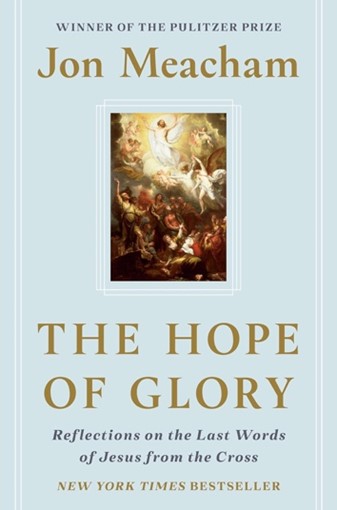
Discussion on the Last Words of Jesus from the Cross

Written by Jon Meacham

Discussion Guide by Hank Bitten, Bethlehem Lutheran Church, Ridgewood, NJ

The Hope of Glory by Jon Meacham is a concise perspective of his personal understanding of the Christian faith, his scholarly research of distinguished individuals across several centuries, his years of nurture through Episcopalian clergy, and an understanding of Jesus Christ as an historical and spiritual leader. I have read most of his books and enjoyed the privilege of attending a seminar with him at Ridgewood High School.

The purpose of this review is to encourage discussions among Christians about the meaning of the mystery of faith. The message of the Christian faith is one of mystery.  It is the only major religion that is for everyone in the world (the Gentiles).  Jon Meacham states it cleverly: “We are all in a sense, like the Greek philosophers who came to Paul in Athens seeking clarity about the Christian message. ‘May we know what this new teaching is that you are presenting?’ they asked him in the Areopagus. ‘It sounds rather strange to us, so we would like to know what it means.’ The apostle then preached the gospel, saying that God through Jesus, ‘will have the world judged in righteousness by a man whom he has appointed, and of this he has given assurance to all of this he has given assurance to all by raising him from the dead.” (Pages 11,12)

The historical context of a Messiah begins in Judaism. In The Hope of Glory, the thread of this context continues into the Roman Empire and the establishment of the teachings of the Christian (Roman Catholic) church.

“Paul admitted the difficulty” ‘But we preach Christ crucified, unto the Jews a stumbling block, and unto the Greeks foolishness.’ A king who died a slave’s death? A human atoning sacrifice? A resurrected messiah?  As Paul asserted in one of the earliest known writings in the New Testament, however, the heart of the matter was just that: Jesus ‘gave himself for our sins, that he might deliver us from the present evil world, according to the will of God and our Father.’  Why invent something with no historical basis in the preaching of Jesus himself?  The Christian salvation story was singular and specific, offering a peculiar religious riff on the extent symphony of Judaism.  That the disciples understood Jesus so poorly at the time of the Passion is evidence of the power and prevalence of the existing theology of God’s kingdom, a theology that anticipated an imminent final struggle between the forces of good and evil.” (Pages 22,23)

It is helpful to begin a discussion about how to read and understand sacred writings. The sacred writings are expressed prophetically, poetically, historically and perhaps with another form of expression. Context matters, questions engage thinking, analysis, and interpretation, and reason and faith are helpful starting points for conversation.

“It’s certainly true that for the searcher or the believer; the point of reading sacred writings is not the same as reading, say the history of the Punic Wars or of World War II.  The texts are directive documents.  As the second Epistle of Timothy says, ‘All Scripture is God-breathed and is useful for teaching, rebuking, correcting and training in righteousness, so that the servant of God may be thoroughly equipped for every good work.”

Your role is to ask deeper questions about why Jesus spoke these words, why they were written into the gospels, and how they lead us to an understanding of the eternal presence of God. One way to understand time is Chronos or through the chronology of hours, days, years, and centuries.  Kairos is another way to look at the dimension of time. It is ‘God’s time’ or the critical moment for understanding.  The creation of the world, God’s speaking to Abraham, the virgin birth, baptism, crucifixion, resurrection, and ascension are examples of Kairos. We also see Kairos in our lives as God reveals Himself to us through the Holy Spirit. Also, encourage members in your group to share their miracles, conversations with God, and understanding God’s presence in their lives.

The thesis of the book is based on the words of Jesus from the cross on Good Friday. The first words spoken from the cross are found only in the gospel of Luke 23:34:

“Father, forgive them; for they know not what they do.”

The second words are from Luke: 23:43:

“Assuredly, I say to you, today you will be with Me in Paradise.

The context of Jesus entrance into Jerusalem for the celebration of the Passover gave reason to speculate over a political or militant uprising to challenge the power of the Roman government in Israel. Jesus was popular and his preaching about the arrival of the kingdom provided hope to the Jewish people in Jerusalem.  However, if this was a political plot of revolutionaries, why were none of the followers who were with Jesus in the Garden of Gethsemane on Thursday night arrested or executed? These words of Jesus are beyond our imagination or comprehension as they speak to the depth of His mercy and grace. 

The third words are spoken to Mary, Jesus’ mother,

“Woman, behold thy son!”  They are followed by the words,

 “Behold thy mother!”  (John 19: 25-27)

These words are spoken as commands, a charge to care for another person.  The application of these words from the cross speaks to how we understand the meaning and purpose of love.

“When the Son of Man comes in his glory, and all the angels with him, then he will sit on his glorious throne. 32 Before him will be gathered all the nations, and he will separate people one from another as a shepherd separates the sheep from the goats. 33 And he will place the sheep on his right, but the goats on the left. 34 Then the King will say to those on his right, ‘Come, you who are blessed by my Father, inherit the kingdom prepared for you from the foundation of the world. 35 For I was hungry and you gave me food, I was thirsty and you gave me drink, I was a stranger and you welcomed me, 36 I was naked and you clothed me, I was sick and you visited me, I was in prison and you came to me.’ 37 Then the righteous will answer him, saying, ‘Lord, when did we see you hungry and feed you, or thirsty and give you drink? 38 And when did we see you a stranger and welcome you, or naked and clothe you? 39 And when did we see you sick or in prison and visit you?’ 40 And the King will answer them, ‘Truly, I say to you, as you did it to one of the least of these my brothers, you did it to me.’”

The fourth words speak to the human suffering of Jesus on the cross.

“My God, my God, why hast thou forsaken me?” (Matthew 27: 45,46)

There is no other religious teacher associated with the major religious beliefs who experienced the pain and fear of Jesus. Confucius died a normal death, very little is known about the biography of Lao Tzu, Abraham lived beyond a full age of people in 1800 B.C.E., Siddhartha likely died from illness after reaching Nirvana, and Mohammed died peacefully in his home. If Jesus knew that He would return to life in three days, what is the meaning of these words? This is the power of the invisible and the mystery of the unknown. In this context, how do we understand the meaning of this question and the context of how it was spoken.

My God, my God, why have you forsaken me?  Why are you so far from saving me, from the words of my groaning?
O my God, I cry by day, but you do not answer, and by night, but I find no rest.

Yet you are holy, enthroned on the praises[a] of Israel.
In you our fathers trusted; they trusted, and you delivered them.
To you they cried and were rescued; in you they trusted and were not put to shame.

The fifth words spoken are:

I thirst.” (John 19: 28,29)

Jesus was given vinegary wine on a hyssop branch with a sponge attached to it. The symbolism of hyssop is an important connection to the Passover in Judaism as it was used to sprinkle the blood of the lamb on the doorposts to guarantee God’s protection.  Kind David was cleansed in Psalm 51:7 with the hyssop plant.  In this context, it is the spiritual cleansing of forgiveness and protection from death and evil.  The thirst is connected to the Passover in Judaism, the importance of how forgiveness changes our lives, and how the church forgives sins through confession, baptism, and the Lord’s Supper. The Sermon on the Mount, especially the words of Matthew 5:6, “Blessed Are Those Who Hunger and Thirst for Righteousness” support a meaningful discussion with questions for deeper inquiry.

The next to last words spoken from the cross are written in John 19:30

“It is finished”

The meaning of these words for 21st century Christians is different than what the words likely meant for the first century followers and the eyewitnesses at Calvary. The Greek word, tetelestai means finished, completed, or accomplished. Paul preached to the Romans, “But now the righteousness of God has been manifested…through faith in Jesus Christ for all who believe.  For there is no distinction: since all have sinned and fall short of the glory of God, they are justified by his grace as a gift, through the redemption which is in Christ Jesus, whom God put forward as an expiation by his blood, to be received by faith.” (Page 86)

“Then I saw a new heaven and a new earth, for the first heaven and the first earth had passed away, and the sea was no more. 2 And I saw the holy city, New Jerusalem, coming down out of heaven from God, prepared as a bride adorned for her husband. 3 And I heard a loud voice from the throne saying, “Behold, the dwelling place[a] of God is with man. He will dwell with them, and they will be his people, and God himself will be with them as their God.[c] 4 He will wipe away every tear from their eyes, and death shall be no more, neither shall there be mourning, nor crying, nor pain anymore, for the former things have passed away.”

    “Lest you be wise in your own sight, I do not want you to be unaware of this mystery, brothers: a partial hardening has come upon Israel, until the fullness of the Gentiles has come in. 26 And in this way all Israel will be saved, as it is written,

    “The Deliverer will come from Zion, he will banish ungodliness from Jacob”; “and this will be my covenant with them when I take away their sins.”

    However, the creeds of the church that were written after the death and resurrection of Jesus have believers professing that all is not finished because Jesus is to return from heaven. Heaven in the Bible is not a future destiny or a distant place. Instead, it is a dimension of our life. Another way to think about heaven is that it is ‘God’s space’. (Page 88) Each of us has questions about heaven, hell, eternity, war, sickness, and the list will continue.  These questions are important.  It is also important to understand that answers are determined by knowledge and the only clear knowledge we have in the Christian religion is to love God and to love one another as ourselves. There is mystery in all the major religions and students need to understand this difficult concept.

    The final words spoken by Jesus are written in Luke 23:46:

    “Father, into thy hands I commend my spirit.”

    The eyewitnesses watching the hours of Jesus dying were left with sadness and confusion. They expected a kingdom, a new earth and a new heaven. They only saw darkness. The most scholarly theologians will never fully explain the meaning of redemption.  The religions of Judaism, Hinduism, Buddhism, Islam, and the teachings of Daoism and Confucius also leave students with unanswered questions.  The common thread in each religion is the universal search for grace, a better world, and hope!

    I might also suggest that reading the Prologue (pages 5-31) was very helpful to my understanding of faith, the cross, historical context, and thread of forgiveness.  The Prologue also includes helpful Bible verses linking the tenets of Judaism and Christianity. Perhaps the most important value of the book, The Hope of Glory, is the authenticity of the witness of the author, Jon Meacham, who writes from the perspective of a layman whose life has been defined by Jesus Christ.