The Hope of Glory
Reflections on the Last Words of Jesus from the Cross
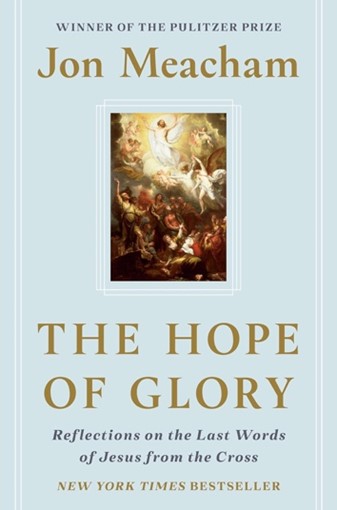
Written by Jon Meacham
Discussion Guide by Hank Bitten, Bethlehem Lutheran Church, Ridgewood, NJ
The Hope of Glory by Jon Meacham is a concise perspective of his personal understanding of the Christian faith, his scholarly research of distinguished individuals across several centuries, his years of nurture through Episcopalian clergy, and an understanding of Jesus Christ as an historical and spiritual leader. I have read most of his books and enjoyed the privilege of attending a seminar with him at Ridgewood High School.
The purpose of this review is to encourage discussions among Christians about the meaning of the mystery of faith. The message of the Christian faith is one of mystery. It is the only major religion that is for everyone in the world (the Gentiles). Jon Meacham states it cleverly: “We are all in a sense, like the Greek philosophers who came to Paul in Athens seeking clarity about the Christian message. ‘May we know what this new teaching is that you are presenting?’ they asked him in the Areopagus. ‘It sounds rather strange to us, so we would like to know what it means.’ The apostle then preached the gospel, saying that God through Jesus, ‘will have the world judged in righteousness by a man whom he has appointed, and of this he has given assurance to all of this he has given assurance to all by raising him from the dead.” (Pages 11,12)
The historical context of a Messiah begins in Judaism. In The Hope of Glory, the thread of this context continues into the Roman Empire and the establishment of the teachings of the Christian (Roman Catholic) church.
“Paul admitted the difficulty” ‘But we preach Christ crucified, unto the Jews a stumbling block, and unto the Greeks foolishness.’ A king who died a slave’s death? A human atoning sacrifice? A resurrected messiah? As Paul asserted in one of the earliest known writings in the New Testament, however, the heart of the matter was just that: Jesus ‘gave himself for our sins, that he might deliver us from the present evil world, according to the will of God and our Father.’ Why invent something with no historical basis in the preaching of Jesus himself? The Christian salvation story was singular and specific, offering a peculiar religious riff on the extent symphony of Judaism. That the disciples understood Jesus so poorly at the time of the Passion is evidence of the power and prevalence of the existing theology of God’s kingdom, a theology that anticipated an imminent final struggle between the forces of good and evil.” (Pages 22,23)
It is helpful to begin a discussion about how to read and understand sacred writings. The sacred writings are expressed prophetically, poetically, historically and perhaps with another form of expression. Context matters, questions engage thinking, analysis, and interpretation, and reason and faith are helpful starting points for conversation.
“It’s certainly true that for the searcher or the believer; the point of reading sacred writings is not the same as reading, say the history of the Punic Wars or of World War II. The texts are directive documents. As the second Epistle of Timothy says, ‘All Scripture is God-breathed and is useful for teaching, rebuking, correcting and training in righteousness, so that the servant of God may be thoroughly equipped for every good work.”
Your role is to ask deeper questions about why Jesus spoke these words, why they were written into the gospels, and how they lead us to an understanding of the eternal presence of God. One way to understand time is Chronos or through the chronology of hours, days, years, and centuries. Kairos is another way to look at the dimension of time. It is ‘God’s time’ or the critical moment for understanding. The creation of the world, God’s speaking to Abraham, the virgin birth, baptism, crucifixion, resurrection, and ascension are examples of Kairos. We also see Kairos in our lives as God reveals Himself to us through the Holy Spirit. Also, encourage members in your group to share their miracles, conversations with God, and understanding God’s presence in their lives.
The thesis of the book is based on the words of Jesus from the cross on Good Friday. The first words spoken from the cross are found only in the gospel of Luke 23:34:
“Father, forgive them; for they know not what they do.”
- Why do you think these are the first words spoken by Jesus in His final hours?
- Did Jesus speak these first words by coincidence or were they spoken as an enduring message for all people and across all eras of chronological time?
- Did Jesus speak these words to remind the world of the prophetic message of John the Baptist, to repent and prepare for the kingdom of God?
- Why are these words only recorded by Luke?
- Were these words spoken to remind us of God’s mercy?
- In the days and weeks following the crucifixion and the empty tomb, do you think people focus on Jesus’ words of forgiveness; or did they live in fear of the Roman authorities?
- If we understand the death of Jesus on the cross as essential to our redemption, why does Luke have Jesus forgiving his tormentors?
- Is the meaning of these words for the purpose of having Jews and Gentiles accept Jesus as their Savior by forgiving them of any guilt or association with his death?
- How do we understand the words of Jesus in Matthew 24:35: “Heaven and earth shall pass away but my words shall not pass away.”?
- How do we apply these words to our situations in life?
The second words are from Luke: 23:43:
“Assuredly, I say to you, today you will be with Me in Paradise.”
The context of Jesus entrance into Jerusalem for the celebration of the Passover gave reason to speculate over a political or militant uprising to challenge the power of the Roman government in Israel. Jesus was popular and his preaching about the arrival of the kingdom provided hope to the Jewish people in Jerusalem. However, if this was a political plot of revolutionaries, why were none of the followers who were with Jesus in the Garden of Gethsemane on Thursday night arrested or executed? These words of Jesus are beyond our imagination or comprehension as they speak to the depth of His mercy and grace.
- How important is the word, “Assuredly” in the words spoken by Jesus?
- Do these words have a connection to Matthew 20:16? “So, the last will be first, and the first last.”
- How do these words of Jesus speak to the enormous power of God?
- Do these words speak to the meaning of Kairos, a critical moment in God’s time when He speaks with us? In this context, how should we explain the meaning of the word, “today”?
- In what ways do these words of Jesus provide both clarity and confusion to the mystery of the grace of Jesus Christ?
- Are you able to comprehend why Jesus spoke these words?
- Do you have the courage to call out to Jesus for help or forgiveness?
- How should we explain or interpret the word Paradise? Is it a place or a space?
- Do we experience communion with Jesus in this life or do we need to wait until our death?
- What do you think is the fate of the other man crucified on Good Friday?
The third words are spoken to Mary, Jesus’ mother,
“Woman, behold thy son!” They are followed by the words,
“Behold thy mother!” (John 19: 25-27)
These words are spoken as commands, a charge to care for another person. The application of these words from the cross speaks to how we understand the meaning and purpose of love.
- Were these words spoken directly to Mary and John who were at Calvary or were they spoken to a wider audience, perhaps us?
- How do we see people we have disagreements with because of their lifestyle, harmful words or actions, crimes of injustice, etc.
- Are the possibilities of love limited or endless?
- Did Jesus speak these words to us in the context of Matthew 25:31-40?
“When the Son of Man comes in his glory, and all the angels with him, then he will sit on his glorious throne. 32 Before him will be gathered all the nations, and he will separate people one from another as a shepherd separates the sheep from the goats. 33 And he will place the sheep on his right, but the goats on the left. 34 Then the King will say to those on his right, ‘Come, you who are blessed by my Father, inherit the kingdom prepared for you from the foundation of the world. 35 For I was hungry and you gave me food, I was thirsty and you gave me drink, I was a stranger and you welcomed me, 36 I was naked and you clothed me, I was sick and you visited me, I was in prison and you came to me.’ 37 Then the righteous will answer him, saying, ‘Lord, when did we see you hungry and feed you, or thirsty and give you drink? 38 And when did we see you a stranger and welcome you, or naked and clothe you? 39 And when did we see you sick or in prison and visit you?’ 40 And the King will answer them, ‘Truly, I say to you, as you did it to one of the least of these my brothers, you did it to me.’”
5. What does Good Friday mean to you? Is this an historical date, a moment in time that transcends time as you know it, a call to the cross to follow the example of the unselfish love of Jesus, an invitation to change behaviors, or a time of personal and inward reflection?
6. Is Jesus speaking these words in a direct and personal way to you? Is this an invitation from God to you to dive deeper into your faith and relationship with Jesus?
7. What does your acceptance of an invitation to ‘behold’ a mother, son, others in your family or circle of friends, or people who are not connected with Jesus mean to you?
8. Is love essential to understanding the cross, to understanding God?
9. What is our motivation to care for others?
10. How is your faith in Jesus conflicted by paradoxes? Is it helpful or harmful to have questions about faith or Jesus?
The fourth words speak to the human suffering of Jesus on the cross.
“My God, my God, why hast thou forsaken me?” (Matthew 27: 45,46)
There is no other religious teacher associated with the major religious beliefs who experienced the pain and fear of Jesus. Confucius died a normal death, very little is known about the biography of Lao Tzu, Abraham lived beyond a full age of people in 1800 B.C.E., Siddhartha likely died from illness after reaching Nirvana, and Mohammed died peacefully in his home. If Jesus knew that He would return to life in three days, what is the meaning of these words? This is the power of the invisible and the mystery of the unknown. In this context, how do we understand the meaning of this question and the context of how it was spoken.
- Read Psalm 22 and comment on the meaning of the word ‘cry’ in the selected verses below:
My God, my God, why have you forsaken me? Why are you so far from saving me, from the words of my groaning?
2 O my God, I cry by day, but you do not answer, and by night, but I find no rest.
3 Yet you are holy, enthroned on the praises[a] of Israel.
4 In you our fathers trusted; they trusted, and you delivered them.
5 To you they cried and were rescued; in you they trusted and were not put to shame.
2. Why would Jesus say these words with such emotion if He was aware of His resurrection?
3. How do we understand these words from the cross in the context of Matthew 26:39, spoken the night before in the Garden of Gethsemane? “And going a little farther he fell on his face and prayed, saying, “My Father, if it be possible, let this cup pass from me; nevertheless, not as I will, but as you will.”
4. Do these words speak to your alienation from other people or from God as your Creator?
5. Were these words spoken to help us understand the pain we experience in the struggles of life? Do these words draw us closer to understanding the meaning of the cross?
6. How do you understand the words of John 1:14 in the context of the words Jesus spoke from the cross? “And the Word became flesh and dwelt among us, and we have seen his glory, glory as of the only Son from the Father, full of grace and truth.”
7. Are the words of Jesus from the cross part of a message from despair to hope? (Read all of Psalm 22)
8. Love and Jesus are invisible and at times we have questions about love and faith. Do you believe in love? Do you believe in Jesus?
9. Do these words from Jesus on the cross provide a critical reset button for us when we are experiencing alienation, questions, or feeling an absence of love?
10. Is the pain and suffering of the cross or the image of the empty tomb, the image that enables you to identify with God as Your Father and Jesus as Your brother?
The fifth words spoken are:
“I thirst.” (John 19: 28,29)
Jesus was given vinegary wine on a hyssop branch with a sponge attached to it. The symbolism of hyssop is an important connection to the Passover in Judaism as it was used to sprinkle the blood of the lamb on the doorposts to guarantee God’s protection. Kind David was cleansed in Psalm 51:7 with the hyssop plant. In this context, it is the spiritual cleansing of forgiveness and protection from death and evil. The thirst is connected to the Passover in Judaism, the importance of how forgiveness changes our lives, and how the church forgives sins through confession, baptism, and the Lord’s Supper. The Sermon on the Mount, especially the words of Matthew 5:6, “Blessed Are Those Who Hunger and Thirst for Righteousness” support a meaningful discussion with questions for deeper inquiry.
- Are these words related to the Last Supper and how Christ intended the sacrament of bread and wine to be received by us?
- Do we become one in communion with God, even for only a moment, when we hunger and thirst for His forgiveness, peace, and love?
- Read Matthew 5:3-6: “Blessed are the poor in spirit, for theirs is the kingdom of heaven. 4 “Blessed are those who mourn, for they shall be comforted. 5 “Blessed are the meek, for they shall inherit the earth. 6 “Blessed are those who hunger and thirst for righteousness, for they shall be satisfied.” Do these words have any relationship to what Jesus is saying on the cross or are His words, “I thirst” about his physical dehydration?
- Are the words, ‘I thirst’ mostly related to our need for forgiveness or do they speak to a wider need for righteousness and justice in a broken world?
- Do the words of Jesus from the cross have the same importance as the words spoken by God when His words created the earth and human life as we know it.?
- When we speak the words, ‘I thirst’, what do we receive from Jesus?
- Identify a time when you were spiritually dehydrated and how you were able to satisfy your thirst.
- Are you able to describe your feelings about your relationship with Jesus when you confess sins, pray, receive Holy Communion, attend a funeral, worship, listen to religious music, receive horrible news, participate in a discussion about faith, or something else?
- What does righteousness mean to you?
- Why does Jesus call us to Holy Communion when we continue to doubt, disappoint, and fall short of obedience to Him?
The next to last words spoken from the cross are written in John 19:30
“It is finished”
The meaning of these words for 21st century Christians is different than what the words likely meant for the first century followers and the eyewitnesses at Calvary. The Greek word, tetelestai means finished, completed, or accomplished. Paul preached to the Romans, “But now the righteousness of God has been manifested…through faith in Jesus Christ for all who believe. For there is no distinction: since all have sinned and fall short of the glory of God, they are justified by his grace as a gift, through the redemption which is in Christ Jesus, whom God put forward as an expiation by his blood, to be received by faith.” (Page 86)
- What did Jesus mean by these words?
- What is the meaning of the completion of the work of redemption?
- In the Creed we profess that Jesus will come again. Does this change the meaning of His words, “It is finished?”
- How do you understand the ‘New Jerusalem’ in Revelation 21?
“Then I saw a new heaven and a new earth, for the first heaven and the first earth had passed away, and the sea was no more. 2 And I saw the holy city, New Jerusalem, coming down out of heaven from God, prepared as a bride adorned for her husband. 3 And I heard a loud voice from the throne saying, “Behold, the dwelling place[a] of God is with man. He will dwell with them, and they will be his people, and God himself will be with them as their God.[c] 4 He will wipe away every tear from their eyes, and death shall be no more, neither shall there be mourning, nor crying, nor pain anymore, for the former things have passed away.”
5. Does the ‘New Jerusalem’ come to us or do we go to it?
6. As believers in Jesus, are we called to continue His work of justice, peace, and love? How do we do this?
7. What do you think Paul means when he writes in Romans 11:25-27?
“Lest you be wise in your own sight, I do not want you to be unaware of this mystery, brothers: a partial hardening has come upon Israel, until the fullness of the Gentiles has come in. 26 And in this way all Israel will be saved, as it is written,
“The Deliverer will come from Zion, he will banish ungodliness from Jacob”; “and this will be my covenant with them when I take away their sins.”
8. How do you understand these words from Paul in 1 Corinthians15:58? “Therefore, my beloved brothers, be steadfast, immovable, always abounding in the work of the Lord, knowing that in the Lord your labor is not in vain.” Even though Jesus said on the cross, “It is finished” are we expected to work arduously and persistently to complete the work that needs to be done on this earth as God has planned?
9. Provide examples of the work you (or others) are doing to make our world into the “New Jerusalem?”
10. What work needs to be done and how can we get started?
However, the creeds of the church that were written after the death and resurrection of Jesus have believers professing that all is not finished because Jesus is to return from heaven. Heaven in the Bible is not a future destiny or a distant place. Instead, it is a dimension of our life. Another way to think about heaven is that it is ‘God’s space’. (Page 88) Each of us has questions about heaven, hell, eternity, war, sickness, and the list will continue. These questions are important. It is also important to understand that answers are determined by knowledge and the only clear knowledge we have in the Christian religion is to love God and to love one another as ourselves. There is mystery in all the major religions and students need to understand this difficult concept.
The final words spoken by Jesus are written in Luke 23:46:
“Father, into thy hands I commend my spirit.”
The eyewitnesses watching the hours of Jesus dying were left with sadness and confusion. They expected a kingdom, a new earth and a new heaven. They only saw darkness. The most scholarly theologians will never fully explain the meaning of redemption. The religions of Judaism, Hinduism, Buddhism, Islam, and the teachings of Daoism and Confucius also leave students with unanswered questions. The common thread in each religion is the universal search for grace, a better world, and hope!
- Do these words of Jesus speak to a passive ending of the story of salvation or an action-packed ending calling people to an assignment?
- Are these words of unconditional surrender or a call to arms?
- The side of the cross we see on Good Friday is dark but the side we see on Easter is one of a bright light? How do we explain the cross to each other?
- How does the means of grace (God’s Word, baptism, forgiveness, Holy Communion) help us to make sense of the last words of Jesus?
- When you hear these words, are you willing to take a leap of faith as a follower of Jesus Christ? Explain what this might look like.
I might also suggest that reading the Prologue (pages 5-31) was very helpful to my understanding of faith, the cross, historical context, and thread of forgiveness. The Prologue also includes helpful Bible verses linking the tenets of Judaism and Christianity. Perhaps the most important value of the book, The Hope of Glory, is the authenticity of the witness of the author, Jon Meacham, who writes from the perspective of a layman whose life has been defined by Jesus Christ.
 Bible 500