“The conclusion of this research is that the LCMS will not be able to engage in effective mission outreach unless it forthrightly addresses the changing demographic reality of the United States. There is no reason for the LCMS to forsake its constitutional objectives such as promoting doctrinal unity while avoiding unionism and promoting mission. But when we give minimal attention to the doctrine of catholicity are we meeting our second objective? Will we take to heart Leo Sanchéz’s reminder “that, in light of the increasingly ethnocultural diversity of our future, unity and mission language in synodical ecclesiology will need to be broadened and deepened critically and constructively with language that fosters the catholicity of our Synod’s identity and task in the church, the world, and the marginalized areas between the two”? It is essential for the LCMS to understand that to take its second objective to heart requires the Synod fully to appreciate and to teach that catholicity is of the ‘esse’ of the Church—it is an element of identity. And, as such, it implies a task: giving attention to places and people we have largely forgotten.” (p. 376)
How do we understand ‘catholicity’? Is it catholicity with Lutherans, all Christian denominations, non-Christian faiths? Is our understanding of ‘catholicity’ limited to ages, sexual or gender preferences, people without disabilities, language, or mental health? Does ‘catholicty’ mean our church needs to accept all people without any restrictions?
The catholic calling to the LCMS means returning to cities and other places with non-Anglo populations. It means recognition of people of color throughout our communities. It means recognition that the poor will not be forgotten by God, nor are they to be forgotten by us. And it will require workers who can joyfully accept these tasks. (p. 379-80)
How can our congregation best serve the people of color in our community and support those living in relative poverty?
The Census Bureau predicts that the trend toward racial-ethnic diversity will continue: The non-Hispanic White population is projected to shrink over coming decades, from 199 million in 2020 to 179 million people in 2060—even as the U.S. population continues to grow. Their decline is driven by falling birth rates and a rising number of deaths over time as the non-Hispanic White population ages. In comparison, the White population, regardless of Hispanic origin, is projected to grow from 253 million to 275 million over the same period. (p. 236)
How can the people of the local church become personally connected with the people in their neighborhood and in their church neighborhood?
The LCMS ought to be fostering both internal and external growth by engaging in solid teaching about the gifts of marriage and children, so that the Synod would grow as individual members marry, faithfully live according to the Word of God together, bear children, and bring them up as baptized disciples who learn to keep all that Christ has given to His church. In addition, the Synod and its congregations ought to be vigorously engaged in evangelizing those who do not know Christ. (p. 254) “Congregations must be safe places for young people to wrestle with life and faith.” (p. 255)
How do we understand the recommendation to “be vigorously engaged in evangelizing those who do not know Christ?” How safe is our church for people who are wrestling with life and faith and not living according to the teachings of Jesus in the Holy Bible?
In contrast with that, religiously unaffiliated American adults are now 26% of the overall population. This decline in religiosity is primarily at the expense of Christianity, not non-Christian religious traditions whose adherents have actually increased, from 5% to 7% of the US population over the decade from 2009 to 2019. (p.153) In the last five years alone, the unaffiliated have increased from just over 15% to just under 20% of all U.S. adults. Their ranks now include more than 13 million self-described atheists and agnostics (nearly 6% of the U.S. public), as well as nearly 33 million people who say they have no particular religious affiliation. (p. 156)
While the number of atheists and agnostics has certainly increased, Pew emphasized “that many of the country’s 46 million unaffiliated adults are religious or spiritual in some way. Two-thirds of them say they believe in God (68%).” And at least a small segment of them (10%) are interested in a religious institution.157 But the most striking result of the 2012 survey was its implication that this movement away from religious affiliation would increase, not decrease, because it was a phenomenon “largely driven by generational replacement, the gradual supplanting of older generations by newer ones.” (p. 158)
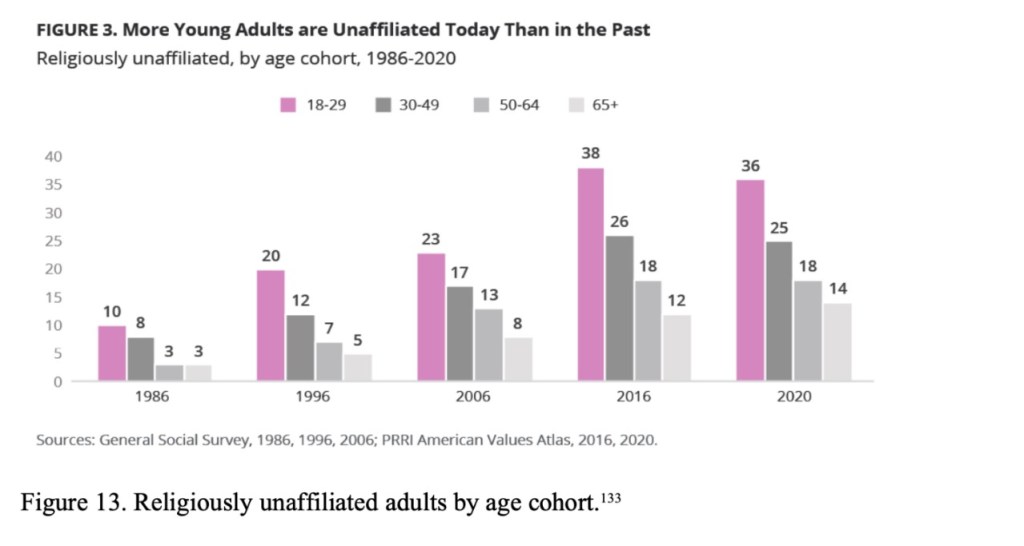
What is the significance of more than 1/3 of the population in the United States under the age of 30 having no religious affiliation with a local church or denomination? Can our local church ignore this population? How can we connect with them?
The dissertation examines membership data for The Lutheran Church—Missouri Synod (LCMS) from the mid-1970s to the present. It considers the analysis of LCMS decline by two scholars, George Hawley and Ryan MacPherson, who independently proposed that LCMS membership decline was internal in causation due to diminished birthrates and fewer young families. While acknowledging the reality of such internal decline, this dissertation argues that the lack of external growth is a greater cause for LCMS decline. Its lack of external growth is due primarily to the racial and ethnic homogeneity of the LCMS and its failure effectively to evangelize the increasingly diverse American population. This indicates a theological weakness: a failure to teach and emphasize the catholicity of the church adequately in LCMS catechesis and dogmatic theology.
Recommended Citation
Vogel, Larry, “Behind the Numbers: A Traditional Church Faces a New America” (2023). Doctor of Philosophy Dissertation. 146. https://scholar.csl.edu/phd/146
A Discussion for Church Leaders on the Decline of Weekly Church Attendance and Possible Strategies for Growing Your Place of Worship
Hank Bitten
The free exercise of religious beliefs is written into our constitution and has been part of the framework of our democratic society and American identity since the Pilgrims arrived in 1620. The principle of the separation of church and state prevented America from having a religious institution or denomination supported by the state, it has enabled the proliferation of houses of worship, the establishment of colleges to train clergy, the dissemination of religious beliefs into our culture through art, literature, and music, and prayers in public places. Religious beliefs and the practices of denominational churches are part of the tapestry of America.
“Congress shall make no law respecting an establishment of religion, or prohibiting the free exercise thereof; or abridging the freedom of speech, or of the press; or the right of the people peaceably to assemble, and to petition the Government for a redress of grievances.” (First Amendment)
This is clearly evident in the First and Second Great Awakening, the Sunday School movement, and the missionary zeal in the 19th century to convert people to the Christian faith. The names of Jonathan Edwards, George Whitfield, Charles and John Wesley, Francis Asbury, Billy Sunday, Billy and Franklin Graham, Dwight Moody, Phoebe Smith, Mary Baker Eddy, James Dobson, Tim Keller, Oral Roberts, and Pat Robertson are just a few names that are part of several high school history textbooks.
In the first two chapters of the dissertation, “Behind the Numbers: A Traditional Church Faces a New America”, Rev. Larry Vogel, presents us with a turning point in the first two decades of the 21st century that is an opportunity for discussion, debate, and discernment. The dissertation provides a sociological, anthropological, and theological perspective that is insightful in how evidence is used to support a claim or thesis.
The data from the U.S. Census Bureau presents a vision of America that is as influential today as Jean de Crèvecoeur’s “Letters from an American Farmer” were in 1782. Crèvecoeur tried to describe the ‘new American’ as industrious and religious. The experiences of living during and after the American Revolution changed the colonists from Europeans to Americans. The ‘new American’ following the passage of the Immigration and Nationality Act of 1965 is from global origins and the ‘new American’ is Hispanic, African, and Asian.
By analyzing the census data in this dissertation, high school students will be able to make a claim regarding the importance of religion in American by 2050, the impact of immigration on society, the consequences of a society that is changing over time, and make predictions for the future. In a Sociology class, students can also survey their own community and compare the data with the national data in the U.S. Census.
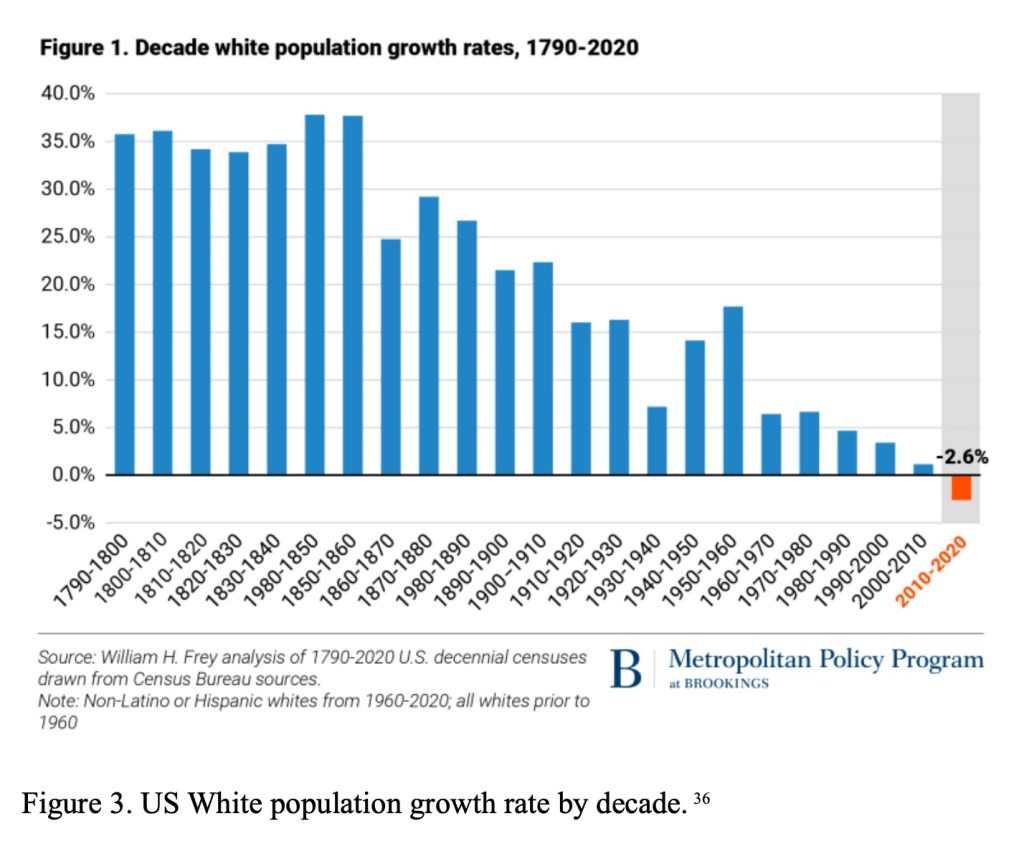
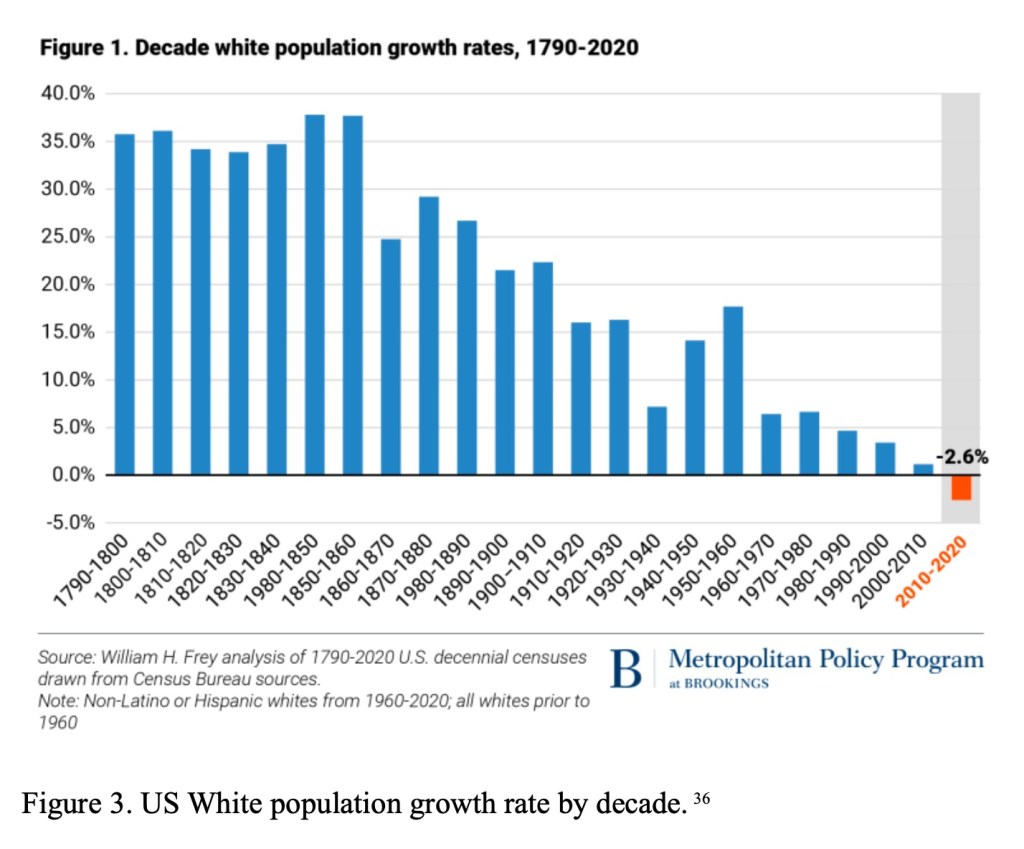
“As for ethnicity, 61.6% of the US population is White alone (204.3 million), a decline from 223.6 million and 72.4% in 2010. Blacks who self-identified without any other racial combination increased slightly in number between 2010 and 2020 (from 38.9 to 41.1 million), but declined very slightly as a percentage of the population (from 12.6% to 12.4%). The Asian alone population of the US increased both numerically and proportionately. In 2010 14.7 M (4.8%) Americans identified as Asian alone. In 2020 that number swelled to 19.9 M (6%).”The Asian population is projected to more than double, from 15.9 million in 2012 to 34.4 million in 2060, with its share of nation’s total population climbing from 5.1 percent to 8.2 percent in the same period. (p. 58)
In the table below, the majority population in the United States declined 11% in ten years from 2010-2020. Will this trend continue to fall another 10% or will it be greater than 10% in this decade?
The demographics of what is happening to the religious beliefs of the ‘new American’ are important to our culture, economy, education, families, and government. Religion is perhaps the largest service industry in the United States with more than 100 million people attending worship regularly. The number of subscribers to weekly worship experiences is declining but this change is likely disguised as the ‘new American’ still believes in a supreme deity but expresses this belief differently than the way Crèvecoeur’s ‘American’ did. The insights in “Behind the Numbers: A Traditional Church Faces a New America” encourages the debate by church leaders and clergy. The analysis of the data provides a perspective of what life will be like in the United States at mid-century. Some will see this as an opportunity and others as a threat.
To begin our inquiry into the data, examine the population profile of the top ten states with the highest immigrant populations. (pp.66) Half of these states are in the Boston-New York-Philadelphia-Baltimore- Washington, D.C. corridor. A third of these states are in the western region of the United States.
One of the striking observations in the census report is that these changes have occurred after 2000.
“The continued growth of the US population is due to immigration rather than to immigrant birth rates. All-in-all, the foreign-born US population in 2018 was nearly 14% of the total US population and their second-generation children were an additional 12.3% of the total population. This means that fully 25% of the current US population is the result of immigration and that the changing racial-ethnic profile of the US is due almost entirely to immigration in recent decades. As Taylor puts it: “Immigration is driving our national makeover.” (p. 67)
As you review the data in the graph below, consider the implications of this decline in your community and state.
Here are some questions to ask regarding this data?
Will these demographic trends continue on the same trajectory over the next three decades or escalate?
Will external events (i.e., climate, artificial intelligence, economic conditions, etc.) have a direct effect on immigration trends?
Will the immigrant population move to other states as they have in the past?
As the immigrant population of 2020 ages, how will this influence the ‘new American’ identity?
As immigrants assimilate into American culture, will they be influenced by the religious institutions in America?
The Census Bureau predicts that the trend toward racial-ethnic diversity will continue: The non-Hispanic White population is projected to shrink over coming decades, from 199 million in 2020 to 179 million people in 2060—even as the U.S. population continues to grow. Their decline is driven by falling birth rates and a rising number of deaths over time as the non-Hispanic White population ages. In comparison, the White population, regardless of Hispanic origin, is projected to grow from 253 million to 275 million over the same period. (p. 236)
Dr. Vogel’s thesis claims that “the underlying support and stimulus for Global Christianity’s surge is the Bible translated into the vernacular. The Bible in whole or in part is available in over 1500 languages, including more than 650 African tongues. With the Bible in their own tongue, Christians in Africa and throughout the globe “can claim not just the biblical story, but their own culture and lore in addition.” (p. 82) However, his thesis also raises the counterargument that the Millennial generation (birth years 1981-1996) is leading the shift away from organized religion, specifically, Christian denominations. According to the Pew research from 2019, 40% of the Millennials (also Generation Y) identify as unaffiliated with 9% claiming a faith other than Christianity. The trend for Generation Z (birth years 1996-2010) will likely be higher.
The perspective of Dr. Mark Chaves of Duke University (and high school student of the author of this article), is that America will likely continue its religious identity in this century. The diversity of the American population will lead to changes, notably that non-Christian beliefs also lead to eternal life. Church membership and worship practices will likely change. A new subculture within the religious and worshipping population may emerge in the 21st century. The ‘new American’ will likely continue helping others in need by donating food, working in a soup kitchen, providing assistance after a disaster, building homes for the homeless, as the volunteer spirit will likely continue throughout this century. But this ‘new American’ may also be influenced by social media and artificial intelligence. Engage your students in exploring answers to these questions and possibilities.
George Hawley of the University of Alabama presents a strong counter argument regarding the demographics of the denominational church in 2022. He cites that 23 percent (almost one-fourth) of the population affiliated with a Christian denominational church are over the age of 65. He also observed that only 13 percent who attend church regularly are under the age of 30. This is not sustainable beyond 2050. Non-Christian religious traditions increased from 5% percent to 7% since 2010. In terms of actual numbers, 13 million Americans identify as atheists and 33 million or 10 percent) have no particular religious affiliation. To place this in perspective, the populations of 49 states are less than 33 million people. The population of Texas is 31 million.
To add a second layer of analysis to our scaffold is the research of the Barna Group which used three factors in determining affiliation with a Christian Church.
Christian identity with a denominational church
Regular worship attendance
Placing faith as a high priority
The data reports that 25% of the American population of 330 million people are practicing Christians. In 2000, the number was 45%! (p. 113) Although weekly church attendance continues to decrease in both Protestant and Roman Catholic churches, the diversity of Roman Catholic congregations appears positive, especially if the United States will continue as a Christian country. “Nearly 40% of Catholic churches are either predominantly or very much non-White. In 2014, The Center for Applied Research in the Apostolate (CARA) study of RCC parishes, 323 out of 846 responding parishes could be identified as multi-cultural parishes.” (p. 131)
By using the data below, ask this question: ‘Why is Roman catholic weekly attendance decreasing in the first quarter of this century and Protestant weekly attendance showing a slight increase?’ (Note: the years on the y axis appear to have 1983-1986 reversed with 1995-1996)
Having reviewed the data from the U.S. Census Bureau and the data on individuals who are unaffiliated with a church denomination, consider the following observations regarding strategies for your individual need. One size does not fit every situation because of locations in rural, suburban, and urban areas, income and population demographics, and the fact that the research in the dissertation applies to Lutheran church experiences over the past 50 years. However, the research and data apply to most church denominations and readers should consider selective ‘talking points’ for their individual experience or need in the context of the catholicity of the Christian church, which is broader than the introspective doctrinal definitions of clergy or a religious organization.
Observations on the decline of Lutheran church populations (pp. 154-174)
Chapter 3 of the dissertation analyzes the demographics of several denominational churches and non-denominational churches. The Lutheran Church (LCMS) is presented as a case study for empirical and comparative evidence. Of the nearly 6,000 LCMS congregations, about 20% have fewer than 25 people attending weekly and 75% have fewer than 100 attending weekly. The picture for the Mid-Atlantic region, despite LCMS congregations in about two-thirds of all the region’s counties. New York, New Jersey, and Pennsylvania all experienced steady decline from 1970 to 2010. Total LCMS membership was a little over 100,000 in the region in 2010, about half of its membership in 1970.101 (p.187) Lutherans are not, on average, particularly committed to their faith. They are less diverse than any other group and they are much older than the overall population—with the LCMS even older than the ELCA. (p. 216)
The LCMS statistics for the South Atlantic region are more positive. Between 1970 and 2010, six of its eight states grew in LCMS membership. Maryland lost about 10,000 of the 30,000 members, the largest loss in the region. South Carolina membership grew by about 1,000 (nearly 50%). Virginia added over 5,000 (also about 50%). Florida added about 50%, or 20,000 members. Georgia added about 30%, around 2,500 members. And North Carolina added about 50% or 7,000. Only Georgia and North Carolina added members during the final decade of the period, from 2000 to 2010. (p. 189)
Baptists are in decline as a percentage of the United States (from about 20% of the United States in 1973 to around 14% in 2014). But the retention rate for Baptists is quite strong at about 78% and the total number of Baptists remained about the same.
The United Methodist Church now claims less than 4% of the population and far smaller numbers are active members. Only the African Methodist Episcopal branches of Methodism are growing. The UMC is 94% non-Hispanic White, has smaller than average families, with low retention rates of about 40% of those raised Methodist remaining in the church.
Mormon families enable the Church of Latter-Day Saints to remain strong. Mormon women with an average of 3.4 children compared to the national average of 2.1. They are also more likely to be married.
• “The retention of baptized and confirmed youth is a key area on which to focus.”
• “The number of child baptisms and adult converts have decreased together in a remarkably similar pattern.”
Baptisms are important for growing the church at the parish level. If infant or child baptism is considered important, then the activities organized by the congregation should consider intergenerational opportunities for children, parents, and grandparents to continually support the baptized child in faith through the life of the local congregation.
The connection between marriage, parenthood, and religiosity is well established. This effect is particularly pronounced for men, who are more likely to return to religion upon getting married or becoming a father. (pp. 179-80) The U.S. Census data reports that the unmarried population of the United States is approaching 50% of all adults. It is important to acknowledge the spiritual needs of this large and significant segment of the population. Marriage and parenthood are “critical for the survival of a church,” but only when children remain in the church as they become adults. (p. 185)
The LCMS ought to be fostering both internal and external growth by engaging in solid teaching about the gifts of marriage and children, so that the LCMS would grow as individual members marry, faithfully live according to the Word of God together, bear children, and bring them up as baptized disciples who learn to keep all that Christ has given to His church. In addition, the LCMS and its congregations ought to be vigorously engaged in evangelizing those who do not know Christ. (p. 254) “Congregations must be safe places for young people to wrestle with life and faith.” (p. 255)
A second strategy considered in the dissertation is stewardship education. In planning this, church leaders need to be aware of how to optimize income, the number of single parent households, extended family living arrangements, budgeting, and how to minimize debt. A serious threat to families and the local congregation is poverty, loss of income, and overspending. Churches effectively ask for contributions and some make an effort for their members to tithe. Unfortunately, few churches have the resources to help people with unexpected situations such as a loss of income, medical situation, or disability. In addition, young families and single parents have the high costs of child care, child care, and a plan to save and invest. Developing a financial mindset is an opportunity for local congregations to assist people in a practical way.
A third observation that Dr. George Hawley noted is that churches that demand more of their members have outpaced churches with minimal expectations. (p. 183) In this context, he suggests that small groups were equally effective regardless of congregational size. He also observed that contemporary worship music and styles are less of an appeal to young adults than to middle-aged adults. (p.185) One of the barriers to congregational growth is the complacency of its members. The model of the first century church should be considered by 21st century church leaders by making an effort to engage the entire spiritual community in serving others and growing together. As populations migrate from one community to another and as individuals experience anxiety and mental stress from feeling alone, the local church community needs to utilize its human resources to assimilate members into their community, culture, and place of worship.
Perhaps the two most effective strategies are the reputation of the church in the community and the personal contact that church leaders have with members and visitors through phone calls and interactive conversations. (p. 185) “Over these last two chapters, we saw that there are three variables that are correlated with strong denominations: the propensity to marry young and have large families, racial and ethnic diversity, and the percentage who claim that religion is very important to them.” (p.229)
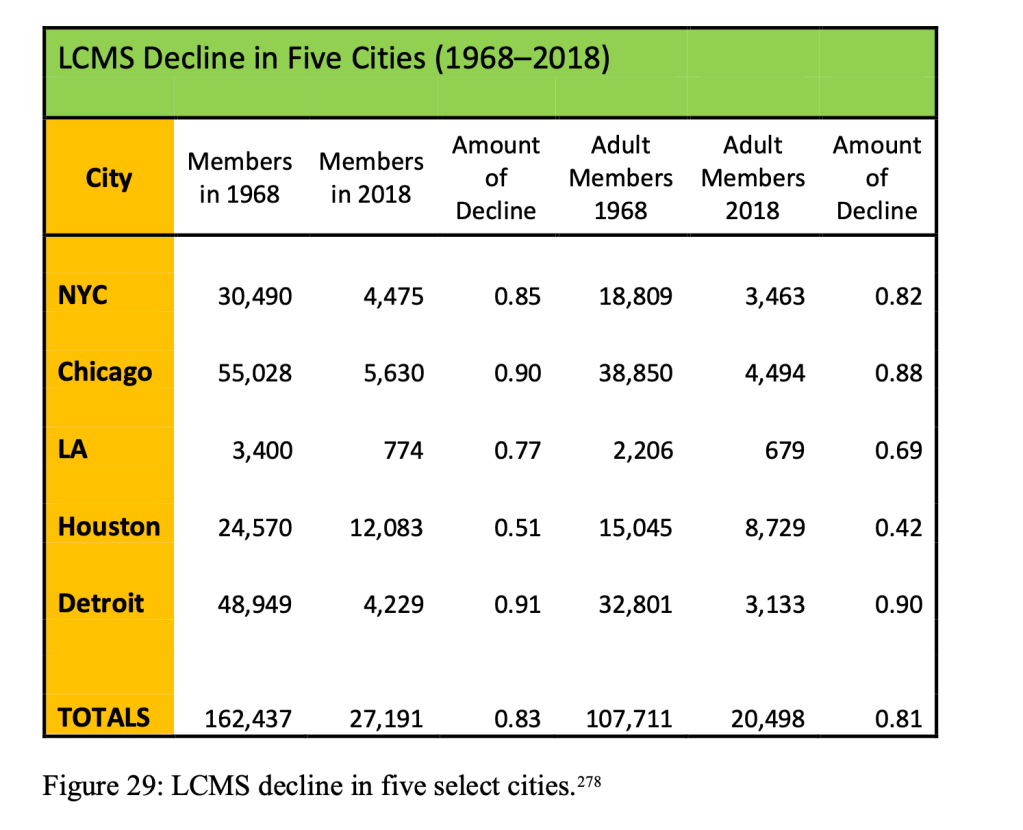
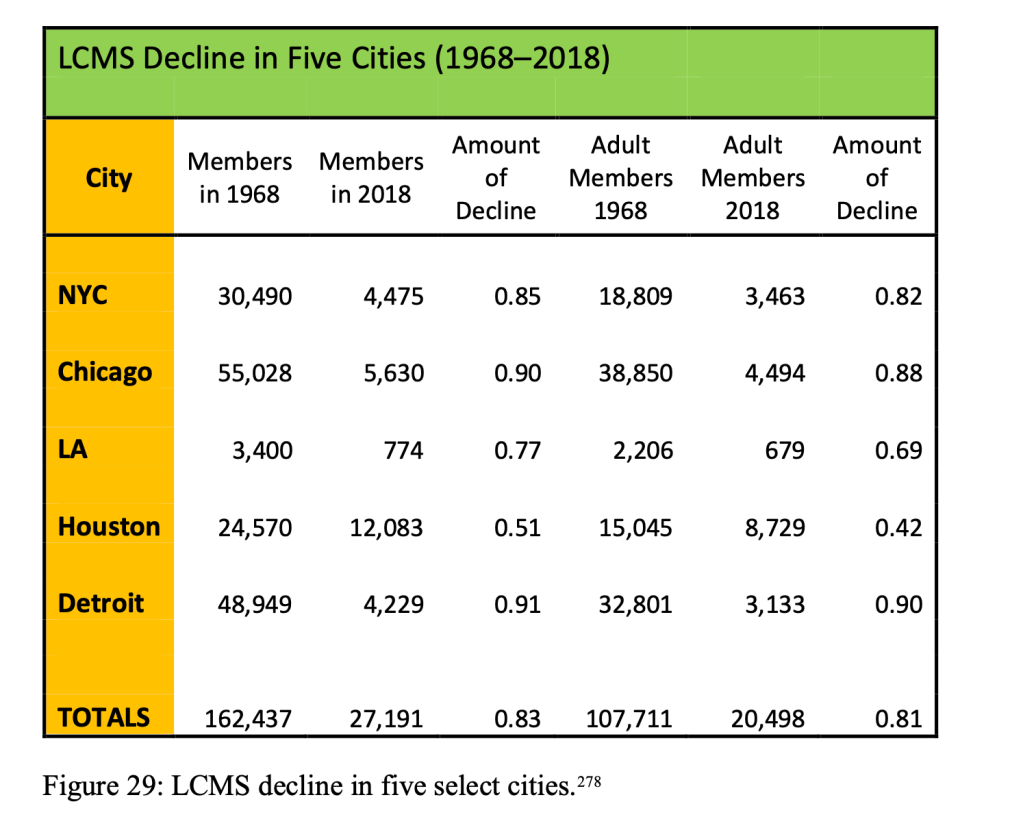
To summarize the fifty-year data presented in Figure 29, LCMS baptized membership in the five cities in question declined, overall, from 162,437 souls to 27,191. The LCMS has only slightly more than 15% as many members today as five decades ago in those cities. That is a decline of 83%! Two of those cities, Chicago and Detroit, lost population, but not nearly on the level that the LCMS declined. Detroit’s population loss was the most dramatic. Detroit and Chicago had strong populations for most of the 20th century. Its 1970 census population was 1,511,482. By the 2020 Census, Detroit’s population was only 639,111, a loss of 58% of its population (p. 239). The decline in New York City follows a similar pattern. Lutherans began worshiping in New York City in 1643 and in the 19th century, New York had a vibrant Lutheran and Protestant population and the first Thursday in June was designated as a local holiday in commemoration of the first Sunday School in 1838. As recently as 2005, this became a city-wide school holiday! This is a reminder that populations change as a result of the economy, crime, or political changes and that population changes affect schools and churches.
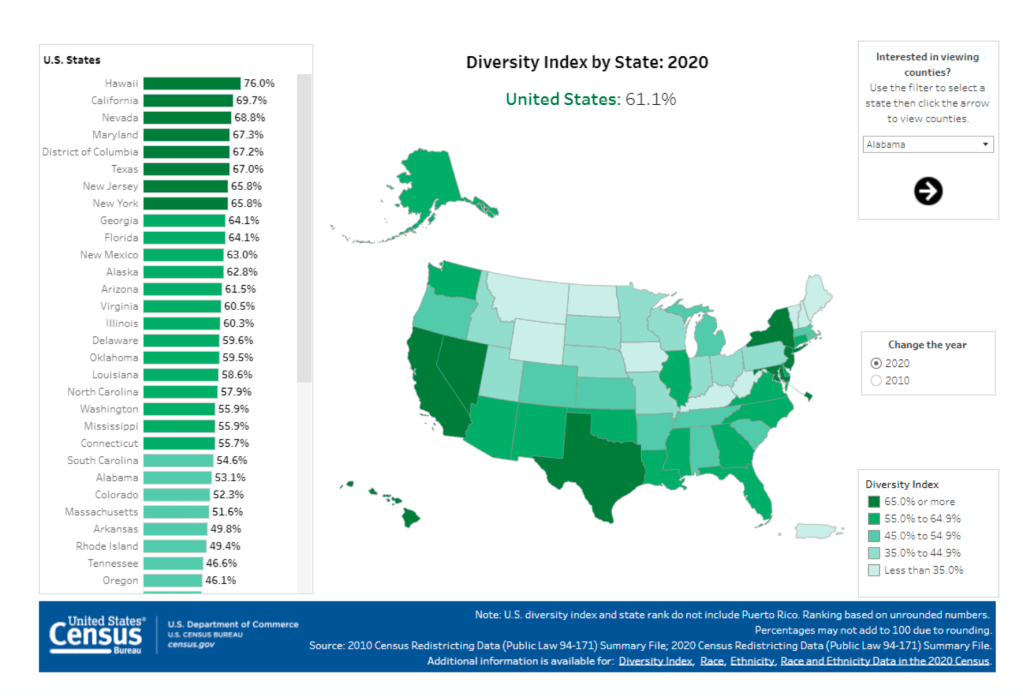
LCMS presence on the coasts is in sharp decline while the coastal US remains densely populated with 40% of the US population living in counties adjacent to either the Pacific or Atlantic coasts. (p. 244) The local church in decline needs to consider the changes in the diversity of the American population, especially in the top 25 states identified on the map below. Changes to worship styles, a visible presence in the community, hosting invitational events each have value but they are short term applications for sustained growth and connections with people.
The events of the next 15 years (2025-2040) will continue to support population migrations as climate changes cause coastal flooding, food insecurity, wildfires and heat related deaths. The influence of artificial intelligence will challenge church doctrines and civic understanding. Local and state governments may become more influential in coping with poverty, education, and the assimilation of new populations. The costs and scope of the anticipated problems in this century are likely beyond the power of national governments to solve which leads to my conclusion that this is an opportunity for the global church. The model presented in the dissertation by Dr. Vogel deserves discussion and debate as it supports the model of the first century church at a time when the Roman Empire was declining. If historians select 1975 as the beginning of the decline of American hegemony, then we are already a half-century into a turning point in world civilization and history.
The conclusion of Dr. Vogel’s thesis speaks to us as a fire bell calling the first alarm to a five-alarm fire at a church that is becoming disconnected to the population. The church in every local community needs to connect with a diverse, and perhaps disconnected, population. This is the purpose of the churches in our communities.
Chapter 4 of the dissertation provides an important analysis and historical overview of the catholic role of the Christian Church. This chapter is worth reading as the evidence clearly supports the worldview of the Christian Church in connecting with the population changes in the 21st century. A summary is not practical because of the comprehensive analysis offered.
“The church’s catholicity—its inclusiveness—involves different socio-economic groups. When Jesus says that we will always have the poor with us (Matt. 26:11; John 12:8), he is not inviting his disciples to neglect care for the poor in favor of gifts to him. Rather, he contrasts the beauty of a gift given at an opportune time (the woman’s anointing of her Lord) to a constant concern for the poor. How right it is for the Church both to adorn its worship with the most beautiful sights and sounds, and to do so all-the-while regularly seeking ways to include and to assist those who struggle with poverty and other immediate needs. To take catholicity to heart as a Synod would therefore require a sober assessment of our abandonment of the poor, whether rural or urban, although special attention herein has been given to cities.” (p. 377)
The conclusion in Chapter 5 is also worth reading regarding the acceptance of all people in a diverse community. If we use 1975 as a pivotal year for marking the end of the “American Century” we will recognize that every country in the world has experienced changes as a result of population, economics, technology, and spirituality. Fernand Braudal, a French historian and leader at the Annales School, developed a model for understanding how change occurs over time in human societies. We understand history differently in each era. The lens or perspective of understanding life on our planet and civilization may be understood through political, geographic, economic, and cultural interpretations. The Christian church can learn from this model and embrace it by connecting with the diversity of people on its doorstep. The lens of the 21st century is experiencing a change in direction because of the diversity of populations and the sharing of ideas, resources, and the need to address global problems. Church leaders and church members need to embrace this as an opportunity.
I leave you with this thought by Dr. Larry Vogel:
“Segmenting the church by generational groups not only is potentially problematic in its effects on families. It is also contrary to the horizontal catholicity of the faith. Christianity is for all people, not only in terms of ethnicity or cultural group or language, but also for all ages. For the tiniest infant and the aging woman with Alzheimer’s.” (p. 371)
The dissertation examines membership data for The Lutheran Church—Missouri Synod (LCMS) from the mid-1970s to the present. It considers the analysis of LCMS decline by two scholars, George Hawley and Ryan MacPherson, who independently proposed that LCMS membership decline was internal in causation due to diminished birthrates and fewer young families. While acknowledging the reality of such internal decline, this dissertation argues that the lack of external growth is a greater cause for LCMS decline. Its lack of external growth is due primarily to the racial and ethnic homogeneity of the LCMS and its failure effectively to evangelize the increasingly diverse American population. This indicates a theological weakness: a failure to teach and emphasize the catholicity of the church adequately in LCMS catechesis and dogmatic theology.
Recommended Citation
Vogel, Larry, “Behind the Numbers: A Traditional Church Faces a New America” (2023). Doctor of Philosophy Dissertation. 146. https://scholar.csl.edu/phd/146
VITA ………………………………………………………………………………………………………………….. 455
Talking Points for Church Leaders:
“The conclusion of this research is that the LCMS will not be able to engage in effective mission outreach unless it forthrightly addresses the changing demographic reality of the United States. There is no reason for the LCMS to forsake its constitutional objectives such as promoting doctrinal unity while avoiding unionism and promoting mission. But when we give minimal attention to the doctrine of catholicity are we meeting our second objective? Will we take to heart Leo Sanchéz’s reminder “that, in light of the increasingly ethnocultural diversity of our future, unity and mission language in synodical ecclesiology will need to be broadened and deepened critically and constructively with language that fosters the catholicity of our Synod’s identity and task in the church, the world, and the marginalized areas between the two”? It is essential for the LCMS to understand that to take its second objective to heart requires the Synod fully to appreciate and to teach that catholicity is of the esse of the Church—it is an element of identity. And, as such, it implies a task: giving attention to places and people we have largely forgotten.” (p. 376)
How do we understand ‘catholicity’? Is it catholicity with Lutherans, all Christian denominations, non-Christian faiths? Is our understanding of ‘catholicity’ limited to ages, sexual or gender preferences, people without disabilities, language, or mental health? Does ‘catholicty’ mean our church needs to accept all people without any restrictions?
The catholic calling to the LCMS means returning to cities and other places with non-Anglo populations. It means recognition of people of color throughout our communities. It means recognition that the poor will not be forgotten by God, nor are they to be forgotten by us. And it will require workers who can joyfully accept these tasks. (p. 379-80)
How can our congregation best serve the people of color in our community and support those living in relative poverty?
The Census Bureau predicts that the trend toward racial-ethnic diversity will continue: The non-Hispanic White population is projected to shrink over coming decades, from 199 million in 2020 to 179 million people in 2060—even as the U.S. population continues to grow. Their decline is driven by falling birth rates and a rising number of deaths over time as the non-Hispanic White population ages. In comparison, the White population, regardless of Hispanic origin, is projected to grow from 253 million to 275 million over the same period. (p. 236)
How can the people of the local church become personally connected with the people in their neighborhood and in their church neighborhood?
The LCMS ought to be fostering both internal and external growth by engaging in solid teaching about the gifts of marriage and children, so that the Synod would grow as individual members marry, faithfully live according to the Word of God together, bear children, and bring them up as baptized disciples who learn to keep all that Christ has given to His church. In addition, the Synod and its congregations ought to be vigorously engaged in evangelizing those who do not know Christ. (p. 254) “Congregations must be safe places for young people to wrestle with life and faith.” (p. 255)
How do we understand the recommendation to “be vigorously engaged in evangelizing those who do not know Christ?” How safe is our church for people who are wrestling with life and faith and not living according to the teachings of Jesus in the Holy Bible?
In contrast with that, religiously unaffiliated American adults are now 26% of the overall population. This decline in religiosity is primarily at the expense of Christianity, not non-Christian religious traditions whose adherents have actually increased, from 5% to 7% of the US population over the decade from 2009 to 2019. (p.153) In the last five years alone, the unaffiliated have increased from just over 15% to just under 20% of all U.S. adults. Their ranks now include more than 13 million self-described atheists and agnostics (nearly 6% of the U.S. public), as well as nearly 33 million people who say they have no particular religious affiliation. (p. 156)
While the number of atheists and agnostics has certainly increased, Pew emphasized “that many of the country’s 46 million unaffiliated adults are religious or spiritual in some way. Two-thirds of them say they believe in God (68%).” And at least a small segment of them (10%) are interested in a religious institution.157 But the most striking result of the 2012 survey was its implication that this movement away from religious affiliation would increase, not decrease, because it was a phenomenon “largely driven by generational replacement, the gradual supplanting of older generations by newer ones.” (p. 158)
What is the significance of more than 1/3 of the population in the United States under the age of 30 having no religious affiliation with a local church or denomination? Can our local church ignore this population? How can we connect with them?
April 2021 Marks the 500th Anniversary of the Most Important Event in World History since the Resurrection of Jesus Christ
Since your most serene majesty and your high mightinesses require of me a simple, clear and direct answer, I will give one, and it is this: I cannot submit my faith either to the pope or to the council, because it is as clear as noonday that they have fallen into error and even into glaring inconsistency with themselves. If, then, I am not convinced by proof from Holy Scripture, or by cogent reasons, if I am not satisfied by the very text I have cited, and if my judgment is not in this way brought into subjection to God’s word, I neither can nor will retract anything; for it cannot be either safe or honest for a Christian to speak against his conscience. Here I stand; I cannot do otherwise; God help me! Amen
The Background
On April 17, 1521, Martin Luther appeared before the Diet of Worms to defend his criticisms against the papacy and the teachings of the Roman Catholic Church. The Diet of Worms included Charles I in his first formal appearance as king of the Holy Roman Empire since the death of his uncle Maximilian, seven electors (princes), and many other dignitaries. The Diet had been meeting since January 28.
King Charles 1 had the title of King of Spain when his uncle died and he needed the support of the German electors and the Roman Catholic Church. He was named Charles V of the Holy Roman Empire but would not be crowned as emperor until February 24, 1530. King Francis 1 of France and Henry VIII of England also wanted to be the emperor of the Holy Roman Empire. Suleman the Magnificent, Sultan of the Ottoman Empire, wanted his territory. Europe was divided. The money of the Fugger family from Augsburg financed the bribes paid to the four secular electors and the power of the Roman Catholic Church provided support to the three ecclesiastical electors.
The Trial of the Century!
Martin Luther was excommunicated on January 3, 1521 and the Roman Catholic Church wanted him arrested, silenced, and to end the heresy that repentance was a daily responsibility and that forgiveness of sins was freely granted by God as written in Matthew 4:17. When Martin Luther burned the papal document (bull) calling for him to repent in public on December 10, 1520, he challenged the canon law of the Roman Catholic Church. This was radical and threatened the power and stability of the government, which was the Roman Catholic Church, its councils and popes.
Martin Luther was very popular in the area of the German states and the powerful elector in his state, Frederick the Wise, advised King Charles to give Martin Luther a ‘trial’ or the opportunity to defend his action of burning the papal bull stating that he would be excommunicated if he did not recant or denounce his books had errors.
When Luther entered the great hall of the Diet, there were twenty-five books laid before him on a table. He was asked two questions: Are these books yours? Will you recant them?
Luther came prepared to debate and to present his position. He was taken back by these two unexpected questions. He answered affirmatively that these books were his but since his books included the words of God in the Holy Bible and his interpretation of these sacred words, he was not able to answer the second question and denounce them because he considered God’s Word to be the truth.
April 18, 1521 is perhaps the most famous day in world history. Martin Luther did not recant and defended the Word of God as the source of truth and its authority was superior to the canon law of the Roman Catholic Church, which was the rule of law in Europe since the Council of Nicaea (Nicene Creed) in 325.
What Changed?
Martin Luther was declared public enemy #1 in all of Europe and given 60 days of protection to return to his home town of Wittenberg. He would then be arrested and executed. Instead, upon leaving the city of Worms he was taken hostage in a pre-arranged plan to protect him in hiding in the Wartburg Castle in the Thuringia forest. He was disguised and took the name of Junker Jorge. He remained in hiding for ten months and returned to public life in an attempt to provide unity to how his teachings were being implemented by others. While he was in hiding, he interpreted the New Testament of the Bible into the German language. This new translation will be published in September 1522 and this changed the world!
People began reading the Gospels and quoting verses from the Holy Bible when they wrote letters and gave speeches. The Roman Catholic lost its monopoly on knowledge as the Bible was introduced into homes and schools. It inspired artists, musicians, writers, and inspired many to become ministers. One hundred years later in 1620, the Pilgrims will come to Plymouth colony in Massachusetts for religious freedom. Marriages will be approved by local secular officials in addition to the clergy. Norway and Denmark will sanction the Lutheran faith as their state religion in the next 15 years.
What does this Anniversary Mean for the 21st Century?
The 400th anniversary of the Diet of Worms was a big world event even though it occurred during the Flu Epidemic, at a time when materialism and science challenged religious truths and when the world was rebuilding after World War 1. There were concerts, movies, and speeches.
The 500th anniversary will likely go unnoticed by the media, governments, artists and musicians. It is a lost opportunity and one that can perhaps be regained as we remember the translation of the New Testament of the Bible into the language of the people in September 1522. I have tried to get people’s attention for the past three years and have been rejected every time – even by the clergy.
The celebration of God’s Word, the free gift of forgiveness, the opportunity to read and reflect on God’s Word in the privacy of our homes is why the events at the Diet of Worms a half a millennium in the past is the most important event in world history since the Resurrection of Jesus Christ!
The practical reason why we need to remember the Diet of Worms is that in the first 21 years of the 21st century, we have experienced three devasting challenges: the terrorism of 9/11, the financial collapse of the world economy in 2008, the Covid-19 pandemic of 2020.
The future challenges of the next 21 years are predictable and our children and teenagers need to have the spiritual foundation and confidence to meet the death and evil that will be coming. Perhaps the biggest challenges shaking our faith will be the impact of a warmer climate – deadly storms, food shortages, flooding, and migration of people to cooler places in the North. The Baby Boomer generation will turn 85 and be faced with health issues, dementia, and loneliness. Morality will continue to decline as artificial intelligence dominates our decision-making, injustice and hatred increase, and church buildings are converted into secular enterprises.
We do not have time on our side. Hopefully, you will be inspired to follow in the steps of Martin Luther and take a stand for the truth in God’s Word!
The Response of the Christian Church to Significant Changes in World History
Introduction: One of the themes in world history is continuity and change over time. The Christian Church emerged during the first century during a time when the Roman Empire was flourishing during the Pax Romano. The first centuries of the early church were faced with persecution, death, and a deliberate effort by the government to prohibit it. In 313 A.D. Emperor Constantine issued the Edict of Milan ending the persecution of Christians. The Edict of Thessalonica in 380 A.D., the Roman government recognized Christianity as an official religion. Historical events lead to change and the Christian Church is now in the third millennium of historical time. However, the Christian Church is not static or passive; instead its role is one of change in response to world events.
In the first part of the 21st century, the world is experiencing an historic event that will likely change the lives of humans around the world in a significant way. This event is the arrival of a powerful and pervasive virus, COVID-19, which is already changing government budgets, the way people respond to information, educational institutions, and our consumer economy. The global pandemic will also change the institution of the Christian Church (and other religious institutions) and may also affect the way people respond to the message of the Christian Church. There is no “normal” for the coming years and likely the “new normal” will evolve over a decade or longer. After the Attack on America on September 11, 2001, the way people traveled changed dramatically.
This point of view essay may be used as a discussion with small groups interested in the evolution of the institution of the church over time. The article below is one of forecasting and prediction for the purpose of discussion among people of faith and in positions to influence congregational or institutional planning.
The Global Pandemic of 2020
21st Century
Lutheran Pastor in New Jersey preparing a Virtual Worship Service
The Christian Church in the 21st century does not have any prophets to predict the impact of the current global pandemic that impacted every country on the planet. At least 90% of the 7.5 billion people in the world were ordered by their governments to stay in their homes and practice self-distancing and wearing a mask if they left their homes for essential services or medical care. Churches were closed and maintained communication with their members via technology and social media platforms. The pandemic brought the church to where the people are (in their homes) instead of the people coming to the church for worship. This paradigm change is significant.
Here are some things that will likely have a negative impact on the Christian Church in the coming years:
1. The economic impact on churches will be significant.
2. The threat of future viruses, natural disasters, and uncertain events will continue.
3. The worship behavior of the population before the pandemic was limited to about 40% of the population and will likely be less after the pandemic.
4. People experienced significant emotional and spiritual stress during the period of the pandemic.
5.The future will likely result in the expansion of artificial intelligence, social alienation, and divided opinions on culture, religion, and social issues.
Here are some questions for discussion about the Christian Church in the next ten years:
Will smaller group meetings become more effective than larger meetings as a congregation?
2. Should the emphasis on ministry and worship change from cognitive themes expressed through sermons to local actions addressing social and environmental problems?
3. How likely will technology (artificial intelligence, social media, blogs, webinars, video, podcasts, etc.) increase in popularity and effectiveness as the medium to educate people about faith and religious teachings?
4. To what extent will the pandemic change how people view and trust institutions (education, government, international forums, financial, etc.) including the Church?
5. Which voices will have the most effective influence on young people under the age of 30 in the coming years? (peers, music, artificial intelligence, therapists, parents, etc.)
6.To what extent will music become have less influential in worship and prayer, print media, video, and personal stories have greater importance and meaning?
7. How likely with the sermon become less important in worship than alternative means for educating and growing in the faith?
TheResponse of the Christian Church to Significant Changes in World History
Introduction: One of the themes in world history is continuity and change over time. The Christian Church emerged during the first century during a time when the Roman Empire was flourishing during the Pax Romano. The first centuries of the early church were faced with persecution, death, and a deliberate effort by the government to prohibit it. In 313 A.D. Emperor Constantine issued the Edict of Milan ending the persecution of Christians. The Edict of Thessalonica in 380 A.D., the Roman government recognized Christianity as an official religion. Historical events lead to change and the Christian Church is now in the third millennium of historical time. However, the Christian Church is not static or passive; instead its role is one of change in response to world events.
In the first part of the 21st century, the world is experiencing an historic event that will likely change the lives of humans around the world in a significant way. This event is the arrival of a powerful and pervasive virus, COVID-19, which is already changing government budgets, the way people respond to information, educational institutions, and our consumer economy. The global pandemic will also change the institution of the Christian Church (and other religious institutions) and may also affect the way people respond to the message of the Christian Church. There is no “normal” for the coming years and likely the “new normal” will evolve over a decade or longer. After the Attack on America on September 11, 2001, the way people traveled changed dramatically.
This point of view essay may be used as a discussion with small groups interested in the evolution of the institution of the church over time.
World War 2
20th Century (1945-2020)
Christian Crusade at Yankee Stadium in New York City with Billy Graham
World War 2 had a direct impact on the United States from December 7, 1941 through September 2, 1945. Approximately 16.5 million American men and women participated in the war effort and the domestic home front was one of sacrifice and fear. The ending of the war did not bring a lasting peace as a cold war emerged and young men were drafted into the military and sent to areas in Asia, Europe, and the Middle East. On the home front, returning soldiers married and the United States was overwhelmed with the births of babies (Baby Boomers). As a result, churches organized social events for families and summer educational programs for children.
The impact of World War 2 provided a climate for the expansion of the Christian religion with the building of new churches, an increase in church membership, mega-churches, and an interest in studying the Holy Bible. This movement was supported by the evangelism of Billy Graham and the leadership of churches in combatting segregation and social injustice. Protestant and Roman Catholic churches used folk music to bring people into their churches.
Unfortunately, Protestant and Roman Catholic churches faced challenges that began in the 1960s regarding the role of women in the church, contraception, abortion, secularism, and the literal interpretation of the Holy Bible. As a result of these internal debates among clergy and scholars, many denomination churches split, which resulted in declining membership. The traditional or conservative groups within these churches identified with the basic teachings of Jesus, literal interpretation of the Bible, and conservative values. The liberal groups within these churches endorsed ecumenism, acceptance of homosexuals, women as clergy, and a Pentecostal or emotional structure to worship.
A major change in Roman Catholic churches began in 1947 with the encyclical Mediator Dei issued by Pope Pius XII who stressed the importance of the participation of the people in liturgical worship. The reforms began to be introduced in 1965 with a new order of service and worship in the language of the people. Another change was that the Roman catholic Church offered both elements of bread and wine to members. Many Protestant churches began to distribute Holy Communion in individual cups instead of the common cup, which was the practice since the first century, as a result of the fear of contagious viruses (HIV) and the changing demographics of congregations.
In the second half of the 20th century women became more involved with education after high school, employment, and delaying decisions about marriage. Divorce rates increased to 50% of American households, communities became more mobile, and immigrant populations increased significantly as a result of the 1964 Immigration and Naturalization act. Although this provided new opportunities for the church to minister to different populations, it was difficult for denominational churches to relate to Spanish, Japanese, and Indian populations while they had some success with Korean and African populations.
Churches applied innovations with contemporary music, national gatherings, social ministry in the community, providing pre-schools and day care, television ministries, and sports programs.
How can the Christian Church today regain the popularity it experienced in the years following World War 2?
How effective are the decisions to modernize the Christian Church with new forms of liturgy, music, and changing with the times?
Are there changes the Christian Church could have taken to address the diversity of populations in America and Europe and the changes within the family.
The Response of the Christian Church to Significant Changes in World History
Introduction: One of the themes in world history is continuity and change over time. The Christian Church emerged during the first century during a time when the Roman Empire was flourishing during the Pax Romano. The first centuries of the early church were faced with persecution, death, and a deliberate effort by the government to prohibit it. In 313 A.D. Emperor Constantine issued the Edict of Milan ending the persecution of Christians. The Edict of Thessalonica in 380 A.D., the Roman government recognized Christianity as an official religion. Historical events lead to change and the Christian Church is now in the third millennium of historical time. However, the Christian Church is not static or passive; instead its role is one of change in response to world events.
In the first part of the 21st century, the world is experiencing an historic event that will likely change the lives of humans around the world in a significant way. This event is the arrival of a powerful and pervasive virus, COVID-19, which is already changing government budgets, the way people respond to information, educational institutions, and our consumer economy. The global pandemic will also change the institution of the Christian Church (and other religious institutions) and may also affect the way people respond to the message of the Christian Church. There is no “normal” for the coming years and likely the “new normal” will evolve over a decade or longer. After the Attack on America on September 11, 2001, the way people traveled changed dramatically.
This point of view essay may be used as a discussion with small groups interested in the evolution of the institution of the church over time.
The Industrial Revolution
19th Century
Sunday School in England
In 1765 James Watt improved on the earlier steam engine of Thomas Newcomen. The steam engine changed the way people worked and lived. Instead of producing goods in the home, factories emerged in new towns along rivers and near water falls. In the first 25 years of the 19th century canals, railroads, and clipper ships moved resources and products. People worked long hours for low wages seven days a week. As a result of the low wages (10 cents an hour), young children had to perform work. There were no schools and sickness and injuries were common.
The first Sunday School started in England by William King in 1751. By 1785, there were 250,000 English children attending Sunday School. It was the only education available as public education will slowly evolve after 1850. The first Sunday School in the United States was started in Brooklyn in 1838 and Brooklyn Queens Day is still a holiday. The Sunday School movement led the way to public education in the United States and continued to increase in popularity through most of the 20th century. Even with the decline in Sunday Schools after 1975, they continued to be an important part of church ministry into the 21st century. This period also embraced the holidays of Christmas with Christmas trees and pageants of the birth of Jesus and Lent with fasting, confession, prayers, and resurrection themed sermons.
The problems of poverty, homeless, immigration motivated church groups in the United States to organize social ministries. This movement was less popular in Europe. Walter Rauschenbusch was a pastor in New York City and promoted the social gospel. The Salvation Army was organized by William Booth in London to aid the homeless and destitute. The mission is based on the call of the disciples of Jesus Christ to assist people in need. Today they are an international organization. The Young Men’s Christian Association (Y.M.C.A.) also began in London and promoted its evangelical mission in cities around the world. The social gospel movement was prominent with denominational Protestant churches and evangelical churches. During the civil rights movement, the social gospel evolved in promoting social justice in the United States. The popularity of the Sunday School and social gospel ministries sparked the establishment of the parish church structure we have today in communities and neighborhoods around the world.
The Industrial Revolution also led to globalization in the name of imperialism and colonialism. As capitalist businesses acquired natural resources in other countries and looked for new markets to sell products, the Christian Church saw the need to convert people in other countries to their faith. Missionary work first began with Ignatius Loyola at the University of Paris with the Society of the Jesus. His followers traveled throughout Europe, Africa and Asia to convert Muslims, counter the teachings of Martin Luther with the Roman Catholic faith, and eventually organizing schools.
The missionary work of the Christian Church began around 1820 in Europe with the end of the Napoleonic wars. In the United States, the missionary work before the Civil War was mostly invested in spreading the gospel with the expansion west to California. After 1850, the work of foreign missions exploded in China, Korea, India, Africa and continued on a global scale with the translation of the Holy Bible into vernacular languages. Missionary work was an opportunity for men and women to start hospitals, orphanages, and schools. Missionary work continued to increase throughout the 20th century and continues to be important to the goals of Protestant, evangelical, and Roman Catholic institutions.
With 21st century people concerned about social injustice, are there lessons to be learned from the social ministries of the 19th century?
How did the Christian Church meet the needs of the people during this time?
Is missionary work in other countries critical to the vision of the Christian Church today or does the Church need to focus on different needs and issues?
The Response of the Christian Church to Significant Changes in World History
Introduction: One of the themes in world history is continuity and change over time. The Christian Church emerged during the first century during a time when the Roman Empire was flourishing during the Pax Romano. The first centuries of the early church were faced with persecution, death, and a deliberate effort by the government to prohibit it. In 313 A.D. Emperor Constantine issued the Edict of Milan ending the persecution of Christians. The Edict of Thessalonica in 380 A.D., the Roman government recognized Christianity as an official religion. Historical events lead to change and the Christian Church is now in the third millennium of historical time. However, the Christian Church is not static or passive; instead its role is one of change in response to world events.
In the first part of the 21st century, the world is experiencing an historic event that will likely change the lives of humans around the world in a significant way. This event is the arrival of a powerful and pervasive virus, COVID-19, which is already changing government budgets, the way people respond to information, educational institutions, and our consumer economy. The global pandemic will also change the institution of the Christian Church (and other religious institutions) and may also affect the way people respond to the message of the Christian Church. There is no “normal” for the coming years and likely the “new normal” will evolve over a decade or longer. After the Attack on America on September 11, 2001, the way people traveled changed dramatically.
This point of view essay may be used as a discussion with small groups interested in the evolution of the institution of the church over time.
The Enlightenment (Age of Reason)
18th Century
Attacks Against the Roman Catholic Church in France
Unfortunately, the Enlightenment forced the Christian Church underground. The extremely conservative Puritan Revolution in England introduced a strict moralism on religious beliefs while the extremely radical French Revolution banned the Roman Catholic Church and removed statues and monuments. This was the Age of Reason, not the Age of Faith or Grace. Although many people identify with the liberal democratic principles and values of this era, it was not a productive period for the Christian faith.
While many Americans celebrate the political ideas of Thomas Paine in Common Sense and the Rights of Man, his book, The Age of Reason; Being an Investigation of True and Fabulous Theology, exposed the corruption of the Christian Church and celebrated the laws of nature (Newton) as superior to the laws of God. The world accepted Deism, removed the miracles from the Bible, and deemphasized worship.
Actually, Thomas Paine’s ideas were conservative, although 21st century Christians would view them as extreme. He argued for religious toleration and the freedom of worship. Paine had the acceptance of the educated in Europe.
I believe in one God, and no more; and I hope for happiness beyond this life.
I believe in the equality of man; and I believe that religious duties consist in doing justice, loving mercy, and endeavoring to make our fellow-creatures happy.
But, lest it should be supposed that I believe many other things in addition to these, I shall, in the progress of this work, declare the things I do not believe, and my reasons for not believing them.
I do not believe in the creed professed by the Jewish Church, by the Roman Church, by the Greek Church, by the Turkish Church, by the Protestant Church, nor by any church that I know of. My own mind is my own church.
All national institutions of churches, whether Jewish, Christian or Turkish, appear to me no other than human inventions, set up to terrify and enslave mankind, and monopolize power and profit.
For centuries, Martin Luther’s explanation of the authority of the divine right of authority in the Fourth Commandment was challenged as democratic ideals in the name of popular sovereignty changed this deterministic view of God’s role in history.
In America, the voices of Jonathan Edwards, George Whitefield, and the missionary work of John and Charles Wesley opposed the worldly views of the Age of Reason and called people to the theological ideas of John Calvin and Martin Luther. This was not an awakening of God’s love but one of fear of an angry God calling sinners to repentance. Predestination was a popular belief as was the truth of God’s Word in the Holy Bible. The Great Awakening occurred in the middle of 18th century colonial America. It was theologically powerful, supported by the new universities of Yale, Harvard, and Princeton and popular with the people.
How should the Christian Church have responded to the philosophy of the Enlightenment?
How did the teachings of Martin Luther and John Calvin provide different answers to the spiritual needs of people?
Are there lessons to be learned from the Great Awakening that might apply to the 21st century?
The Response of the Christian Church to Significant Changes in World History
Introduction:One of the themes in world history is continuity and change over time. The Christian Church emerged during the first century during a time when the Roman Empire was flourishing during the Pax Romano. The first centuries of the early church were faced with persecution, death, and a deliberate effort by the government to prohibit it. In 313 A.D. Emperor Constantine issued the Edict of Milan ending the persecution of Christians. The Edict of Thessalonica in 380 A.D., the Roman government recognized Christianity as an official religion. Historical events lead to change and the Christian Church is now in the third millennium of historical time. However, the Christian Church is not static or passive; instead its role is one of change in response to world events.
In the first part of the 21st century, the world is experiencing an historic event that will likely change the lives of humans around the world in a significant way. This event is the arrival of a powerful and pervasive virus, COVID-19, which is already changing government budgets, the way people respond to information, educational institutions, and our consumer economy. The global pandemic will also change the institution of the Christian Church (and other religious institutions) and may also affect the way people respond to the message of the Christian Church. There is no “normal” for the coming years and likely the “new normal” will evolve over a decade or longer. After the Attack on America on September 11, 2001, the way people traveled changed dramatically.
This point of view essay may be used as a discussion with small groups interested in the evolution of the institution of the church over time.
The Renaissance
16th Century
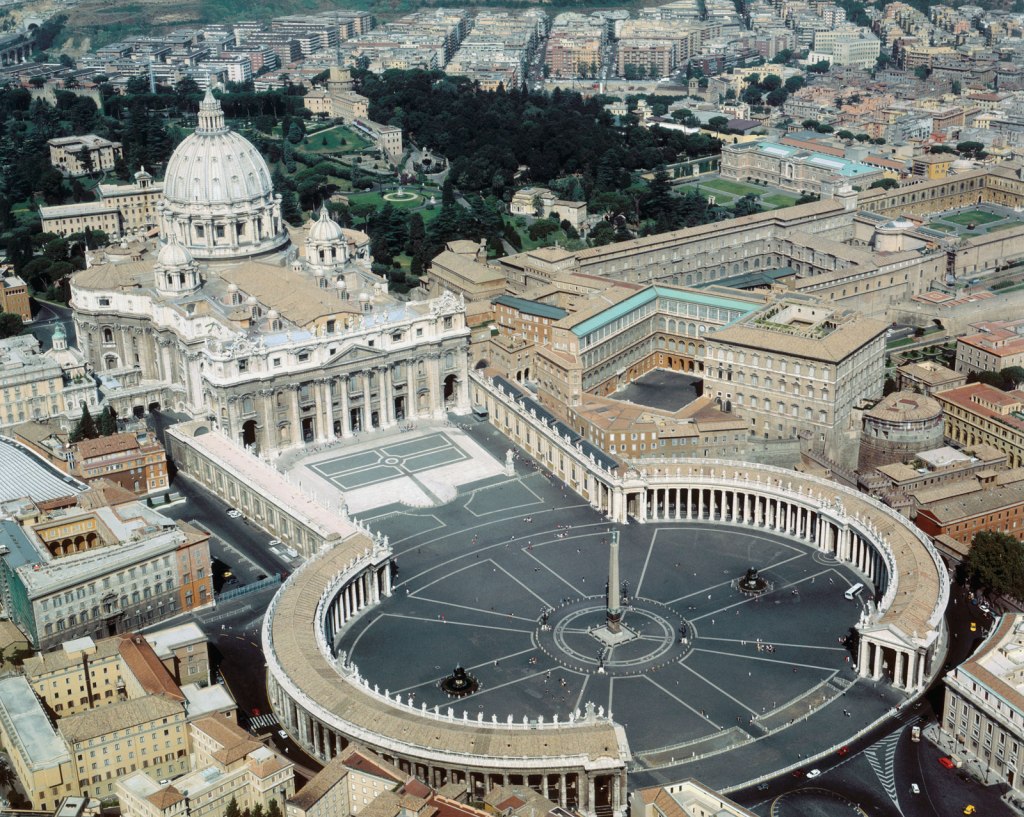
St. Peter’s Basilica, Vatican City
The Renaissance took place over many years, even centuries, in Europe. However, if we were to document a date for when the Christian Church began to change, it would likely be December 25, 800 with the coronation of Charlemagne by Pope Leo III in St. Peter’s Basilica in Rome or we could use the year the Crusades ended with relinquishing Acre (in Syria) to the Muslims in 1291 A.D. The date is less important than how the Renaissance changed the Church.
During this time the Christian Church (the Roman Catholic Church) was the most powerful institution in Europe. It was a time of trade with China and the Middle East, people were moving to towns, cathedrals were constructed in these new towns, universities developed, and merchants emerged as a new class. It was also a time of a short life expectancy (perhaps 35) because of unsanitary conditions, plagues, pollution, and crowded living conditions. As a result, people looked to the messages of the Church in the promise of baptism, faithful and obedient worship, and Christian burial.
The teachings of church councils and Pope were perceived as infallible. Anyone who challenged the teachings of the church was likely declared a heretic and put to death. Kings received their power from the blessings of popes and in return they used the threats of excommunication and interdicts (excommunication of a large territory) to check the power and decisions of kings. As a result of the political and religious power of the Roman Catholic Church, corruption was widespread. Because the corruption (bribery, immorality, nepotism) involving the clergy was well-known, it negatively impacted the laity or the masses. Although monasteries continued in some places, many were closed and properties sold in northern Europe and England. The Reformed or Protestant churches allowed the clergy to marry.
The Christian Church supported the ideology of scholasticism. The Scholastics combined the truth of the Holy Bible with the reasoning of church councils and theologians. The source of truth came from reason, experience, and authority of Church Councils and the Pope. When competing ideas or arguments emerged, universities provided the forum for debates and disputations as did church councils. This pattern of reason would continue in the 16th century until it was challenged by the Christian humanism of Martin Luther.
The Church also changed as a result of the Renaissance as three-dimensional images were created to educate the illiterate about the teachings of the Bible, the lives of saints, and the printed word. The Renaissance motivated the “Golden Age” of religious art in painting and sculpture. While the 15th century was dominated by Roman Catholic artists, the Protestant Reformation in the 16th century became the catalyst for the humanistic art of Durer, Rembrandt, Bruegel, Cranach, Gerung, and Holbein. The Protestant Reformation and the translation of the New Testament into the languages of the people in Europe contributed to new styles of music and literature. The music of Bach, Mendelssohn, Gerhardt, Schutz inspired the faith of people that sustained Christian worship for centuries.
The Renaissance changed worship from passive worship to active worship. As people left Europe because of persecution and religious wars for the opportunity to worship freely in America, the Christian Church faced new challenges with Native Americans, the absence of trained clergy, and theocratic governments in some of the colonies.
Why did Scholasticism become discredited as a source of truth?
How did music, literature, and the translation of the Bible significantly change the way people worshipped?
Did the Christian Church capitalize or miss opportunities in the settlement of North and South America?








 Bible 500